
Shanghai Institute of Applied Physics Makes Important Progress in Electrolyzer Design and Electrocatalytic Materials Research
 Scan to share
As a stable low-carbon energy source, nuclear energy is increasingly prominent in strategic importance. However, nuclear fuel production, spent fuel reprocessing, and nuclear facility operation and decommissioning generate large amounts of uranium-containing wastewater. Among these, the organic cleaning agent diethylene glycol dimethyl ether (diglyme) used in chemical decontamination processes has a high boiling point, stable chemical properties, and is difficult to naturally degrade. It also readily forms stable complexes with uranyl ions, intertwining uranium resource recovery with organic pollution treatment and making processing extremely difficult. Traditional electrochemical uranium extraction materials mostly rely on high-specific-surface-area pore structures, facing bottlenecks such as pore clogging and structural deactivation under complex operating conditions, and are difficult to simultaneously treat coexisting organic compounds. This study starts from the overall design of the electrolyzer and proposes a synergistic strategy of "nonporous electrode material + membrane-divided electrolyzer": using nonporous MOF (CuTTB-3) as the cathode electrocatalytic material, using an anion exchange membrane to separate the anode chamber from the cathode chamber to construct an H-type electrolyzer, and employing commercial platinum sheets as the anode material, spatially separating cathodic uranyl capture from anodic organic ether oxidation (Figure 1).
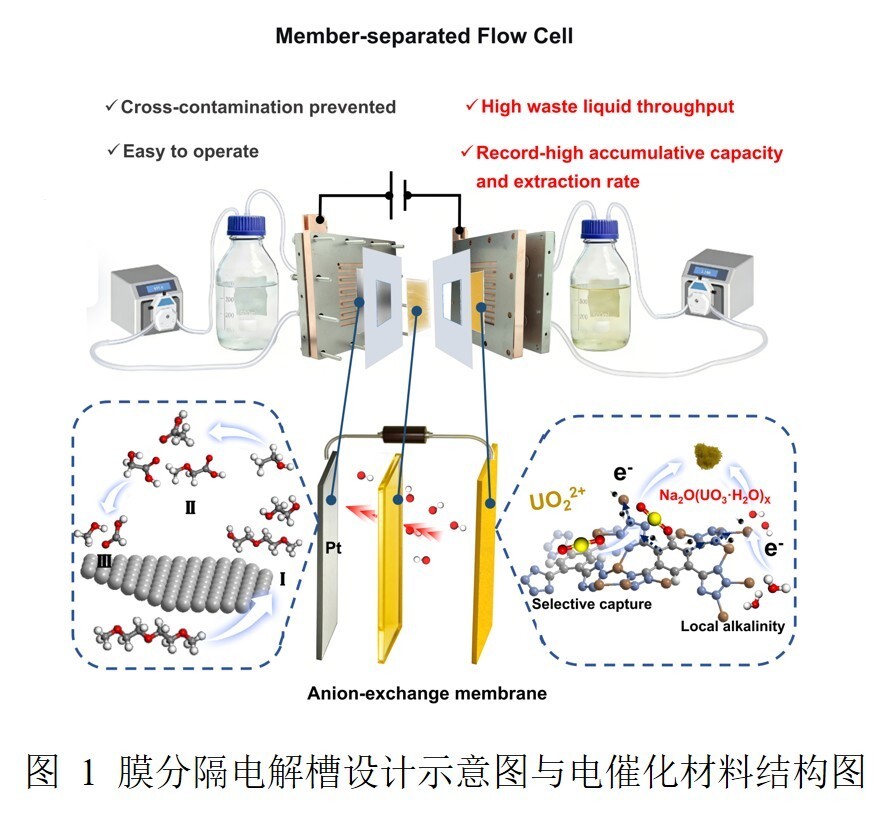
This spatial separation design fundamentally avoids interference from organic ether degradation intermediates on cathodic uranium extraction, enabling the system to achieve synergistic and efficient operation of uranium recovery and organic ether degradation in complex wastewater containing high concentrations of uranyl and organic ether: uranium extraction efficiency reached 99.8% within 1 hour, with cumulative extraction capacity and extraction rate both setting records among reported materials, while simultaneously achieving deep mineralization of organic ether. By combining in situ X-ray absorption spectroscopy, in situ infrared/Raman spectroscopy, and other methods, the extraction mechanism of uranium "surface enrichment − local alkalization hydrolysis polymerization − solid-phase detachment" and the anodic oxidation degradation pathway of organic ether were elucidated, confirming that the structural robustness of the nonporous framework under electrochemical operating conditions, rather than merely high porosity, is the key to high-performance sustainable electrochemical uranium extraction. Thus, the electrolyzer becomes a hub connecting energy and resources. Driven by nuclear power and renewable energy electricity, it can achieve "uranium extraction by electricity, waste treatment by electricity," providing a scalable pathway for alleviating dependence on natural uranium ores and building advanced energy systems with multi-energy complementarity.
The first author of the paper is Lyu Yingtong, a doctoral student jointly trained by the Shanghai Institute of Applied Physics and Southwest University of Science and Technology. The corresponding authors are Researcher Zhang Linjuan, Associate Researcher Li Zijian, and Researcher (Institute of Materials, China Academy of Engineering Physics) Shuai Maobing. This research was funded by the National Key Laboratory of Thorium-based Nuclear Fission Energy, the Strategic Priority Research Program of the Chinese Academy of Sciences, the Youth Climbing Program of the Shanghai Branch of the Chinese Academy of Sciences, the National Natural Science Foundation of China, and the National Key Research and Development Program, and received guidance and assistance from Researcher Hu Zhiwei of the Max Planck Institute for Chemical Physics of Solids, Germany.
Disclaimer: Information republished from partner media, institutions or other websites is provided for reference and communication purposes only. It does not imply endorsement of its views or verification of its accuracy. Please contact us if any content infringes rights or requires correction.