
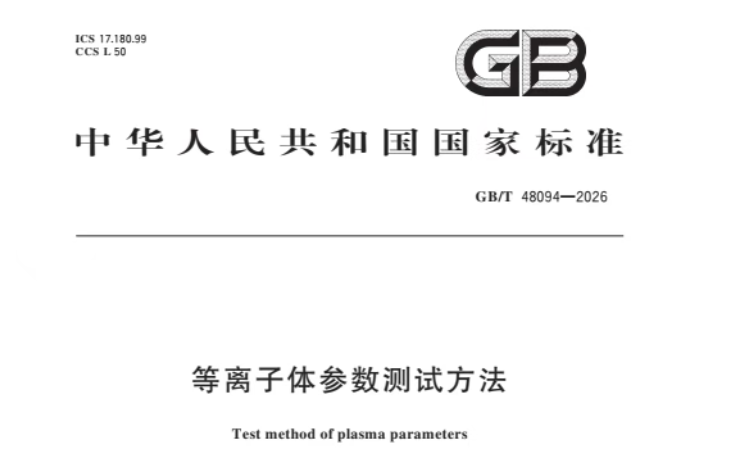
National Standard "Test Methods for Plasma Parameters (GB/T 48094—2026)" Led by the University of Science and Technology of China Officially Released, Solidifying the Standardization Foundation for Controlled Nuclear Fusion and High-Tech Industries
 Scan to share
Recently, led by the University of Science and Technology of China (USTC), in collaboration with research institutions including the Aerospace Information Research Institute of the Chinese Academy of Sciences, the Hefei Institutes of Physical Science of the Chinese Academy of Sciences, the Southwestern Institute of Physics (SWIP), and the Beijing Institute of Environmental Characteristics, universities including Yunnan University, Nanchang University, China Jiliang University, and Chizhou University, as well as key industry-chain enterprises including Anhui USTC Yuke Technology Co., Ltd., Anhui Zhongke Fusion Terahertz Technology Co., Ltd., and Fermion Technology (Shanghai) Co., Ltd., jointly drafted, and the national standard "Test Methods for Plasma Parameters" (Standard No.: GB/T 48094—2026), under the centralized management of the National Technical Committee 487 on Optoelectronic Measurement of Standardization Administration of China (SAC/TC487), was officially approved for release and will be formally implemented from March 2027. This standard establishes unified specifications for test methods of key plasma physical parameters, fills the gap in national-level technical standard basis, and marks a milestone breakthrough for China in the standardization of advanced plasma diagnostic technology.
Plasma, as the fourth state of matter, is a complex multi-particle nonlinear system composed of electrons, ions, and various excited-state active particles, and plays an irreplaceable role in strategic fields such as magnetically confined controlled nuclear fusion, advanced semiconductor chip manufacturing (plasma etching/deposition), surface material modification, modern biomedicine, industrial treatment of the three wastes for environmental governance, and aerospace propulsion. Among these, macroscopic and microscopic fundamental physical parameters such as active particle species, ion temperature, ion velocity distribution function, electron density, and electron temperature are the core criteria for accurately inverting plasma thermodynamic and transport properties, and are even the “eyes” of controlled nuclear fusion physics experiments and engineering discharge control. The accuracy and stability of their measurement and calibration directly determine the depth of understanding of fusion plasma physical mechanisms.
Relying on the deep technical accumulation of the School of Nuclear Science and Technology in plasma physics and diagnostic experiments, the University of Science and Technology of China took the lead in breaking through the industry pain point of lacking unified specifications for the measurement of related parameters. Since 2022, the research team systematically launched technical research and literature demonstration, led the preparation of the draft standard, and in March 2024 successfully passed the project evaluation of the National Standard Technical Review Center of the Standardization Administration of China; in July of the same year, the Standardization Administration of China officially issued the recommended national standard development plan. In the subsequent development stage, USTC, as the lead unit, organized 13 industry-academia-research-application units to form a joint drafting group, and after cross-platform experimental comparison and verification, in-depth industry discussions, public solicitation of comments, and professional technical final review, completed over several years the preparation of a standard text with rigorous scientificity and high applicability.
In terms of technical architecture, the national standard "Test Methods for Plasma Parameters (GB/T 48094—2026)" focuses on the three core test objects of active particles, ions, and electrons, comprehensively standardizes the basic testing principles, test environmental conditions, equipment and instrument specifications, standardized operating procedures, signal inversion and data processing algorithms, and the final test report output format, and establishes a full-chain standardized operating procedure from environment setup, hardware calibration, online testing, to data quality control. As China's controlled nuclear fusion engineering gradually leaps from basic physics experiments to major engineering demonstration and verification stages such as BEST and CFETR, the implementation of this standard not only provides an authoritative technical yardstick for the development of fusion reactor diagnostic systems, cross-comparison of experimental data, and multi-institution cross-platform collaboration, but also builds a solid standardization foundation for technical evaluation and equipment mass production in high-tech industries such as semiconductor material processing, microelectronic integrated circuits, and biological and agricultural irradiation.
Disclaimer: Information republished from partner media, institutions or other websites is provided for reference and communication purposes only. It does not imply endorsement of its views or verification of its accuracy. Please contact us if any content infringes rights or requires correction.