
Major Scientific Facility Enables Breakthrough in New Energy Materials: IHEP Leverages Beijing Synchrotron Radiation Facility to Reveal High-Efficiency Crystallization Mechanism of Perovskite, Sub-module Photoelectric Conversion Efficiency Reaches 22.9%
 Scan to share
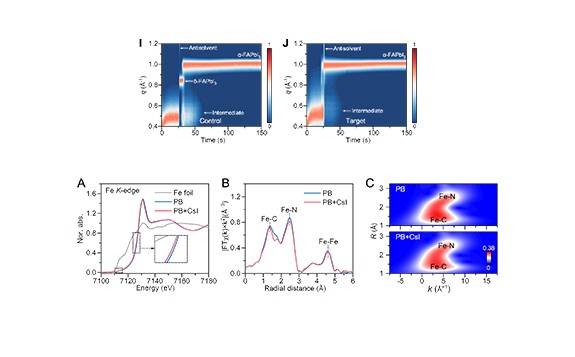
Recently, the research team at the Multidisciplinary Research Center of the Institute of High Energy Physics (IHEP), Chinese Academy of Sciences, has made important progress in the study of the microscopic mechanisms of perovskite solar cell materials. The research team innovatively introduced Prussian Blue (PB) nanoframes with a high degree of lattice matching to perovskite, and leveraged a national major scientific and technological infrastructure——the Beijing Synchrotron Radiation Facility (BSRF)——to conduct multi-dimensional in-situ synchrotron radiation characterization. From the two perspectives of transient crystallization kinetics evolution and microscopic local coordination structure, they systematically elucidated for the first time the physicochemical mechanism by which Prussian Blue regulates perovskite nucleation and crystallization and suppresses ion migration.
During the wet thin-film fabrication process of large-area perovskite photovoltaic modules, random nucleation and extremely complex solvated intermediate phase evolution often occur, readily leaving residual tensile strain, microscopic lattice disorder, and point defects within the film, which subsequently trigger ion migration and sharp performance degradation under long-term illumination, heating, and applied electric fields. To break through this large-area efficiency bottleneck constraining the industrialization of photovoltaic modules, researchers leveraged the in-situ grazing-incidence wide-angle X-ray scattering (GIWAXS) at the BSRF 1W1A beamline and the X-ray absorption fine structure (XAFS) technique at the 1W1B beamline to conduct high spatiotemporal resolution dynamic tracking:
Precise induction of dynamic crystallization pathways: In-situ GIWAXS analysis revealed that Prussian Blue, serving as a heterogeneous nucleation template, effectively guides the system to switch from disordered random homogeneous nucleation to a controlled heterogeneous nucleation mode, significantly suppressing the formation of low-activity solvated intermediates and the photo-inactive yellow phase ($\delta$-FAPbI$_3$), thereby opening a kinetic pathway for rapid transformation into the black photoactive phase ($\alpha$-FAPbI$_3$); this regulatory mechanism promotes strict preferential orientation growth of crystals along the (100) crystallographic plane, substantially eliminating lattice tensile stress within the film;
Atomic-scale framework robustness and ion confinement: Fe K-edge XAFS absorption spectra, extended-edge fitting, and wavelet transform analysis obtained at the 1W1B beamline confirmed that even under extreme microenvironments where cations such as Cs$^+$ migrate and intercalate into the internal channels of Prussian Blue and Fe$^{3+}$ undergoes redox reactions, its Fe–C$\equiv$N–Fe cubic coordination framework still exhibits extremely strong structural rigidity with no significant distortion in radial coordination distances, providing a solid microstructural barrier for continuously immobilizing mobile cations and suppressing ion sliding at grain boundaries.
Benefiting from the microscopic kinetic guidance provided by accelerator-based synchrotron radiation experiments, the research team achieved a performance leap at the device level: the photoelectric conversion efficiency of laboratory small-area perovskite cells climbed to 26.9%; in scale-up fabrication processes, 6 cm × 6 cm small modules achieved an efficiency of 23.4%, and 30 cm × 30 cm large-area sub-modules achieved a high-level certified efficiency of 22.9%, laying a solid scientific foundation for high-stability, large-area perovskite photovoltaic cells to transition from the laboratory to industrial production lines.
Disclaimer: Information republished from partner media, institutions or other websites is provided for reference and communication purposes only. It does not imply endorsement of its views or verification of its accuracy. Please contact us if any content infringes rights or requires correction.