
BESIII Experiment Achieves High-Precision Measurement of Charm Meson Semileptonic Decays and First Constraint on "Scalar Current"
 Scan to share
Recently, the BESIII international collaboration utilized the world's largest near-threshold charm meson data sample to perform a combined measurement of four semileptonic decay channels: D⁰→K⁻e⁺νₑ, D⁰→K⁻μ⁺νμ, D⁺→K̄⁰e⁺νₑ, and D⁺→K̄⁰μ⁺νμ. The research team extracted the quark mixing matrix element |Vcs| with a precision better than 0.5%, determined the form factor zero-point value f₊(0) with a precision better than 0.2%, and verified lepton universality in the above processes at the 0.5% precision level. Beyond these precise determinations of Standard Model parameters, what is particularly noteworthy is that this experiment has, for the first time, delineated the experimentally allowed region for scalar current contributions in charm quark decays.
Semileptonic decays of charm mesons serve as an ideal bridge connecting weak and strong interactions. At the quark level, a charm quark (c) can transition to a light quark (q=s,d) via the weak interaction while emitting a virtual W⁺ boson (c→qW⁺), which subsequently decays into a positively charged lepton and a neutrino (W⁺→ℓ⁺νℓ). The other light quark in the original charm meson enters the final-state light meson as a "spectator," as illustrated in Figure 1. The weak interaction strength of such processes is governed by the Standard Model fundamental parameter—the quark mixing matrix element |Vcq|—while all non-perturbative effects of the strong interaction are encapsulated in the form factor f₊(q²), which varies with the four-momentum transfer squared q² of the lepton pair. Through high-precision studies of the internal dynamics of charm meson semileptonic decays, one can precisely determine |Vcq| to test the unitarity of the quark mixing matrix, and simultaneously precisely measure the form factor zero-point value f₊(0), thereby providing a calibration benchmark for lattice quantum chromodynamics calculations.
The Standard Model posits that the three generations of charged leptons (electron, muon, tau) possess identical interaction properties apart from their masses—namely, lepton universality—and that the charged current has a purely vector−axial-vector structure with no scalar current. However, in recent years, several hints of lepton flavor non-universality have been observed in semileptonic decays of bottom mesons, drawing intense attention from the community. Some new physics models beyond the Standard Model propose scalar currents as one possible theoretical explanation, and charm meson decays provide an independent testing platform for this hypothesis.
The BESIII experiment, leveraging approximately 140 million charm meson pairs and its low-background advantage, conducted a combined analysis of the four decay channels mentioned above. Under strictly controlled systematic uncertainties, the research team achieved a precision of approximately 0.5% for |Vcs| and approximately 0.2% for f₊(0). The test of lepton universality shows that the ratio of decay rates between the electron and muon channels agrees with the Standard Model prediction within 0.5% precision, with no significant deviation observed. Figure 2 summarizes the weighted comparison of |Vcs| measurements from different experiments, demonstrating that these results represent the highest precision level in the field of charm physics. After completing the precise determinations of the aforementioned Standard Model parameters, the research team further analyzed the possible contributions of scalar currents. The analysis reveals that when the scalar current is assumed to be zero in the muon-channel semileptonic decays of charm mesons, the experimental data exhibit a deviation of 2.3 standard deviations (as shown in Figure 3). This marks the first time that the experimentally allowed region for scalar currents has been delineated in charm quark semileptonic decays, significantly constraining the relevant new physics parameter space and providing important complementary information for understanding the hints of lepton flavor non-universality in B meson semileptonic decays.
These results have been published as a Letter and an accompanying long paper in Physical Review Letters 137, 091803 (2026) and Physical Review D 114, 033008 (2026), respectively. The related analysis work was led by doctoral student Zeng Yijia, supervised by Professor Ma Hailong from the Institute of High Energy Physics, Chinese Academy of Sciences. The research was supported by the Chinese Academy of Sciences, the National Key Research and Development Program of the Ministry of Science and Technology, and the National Natural Science Foundation of China.
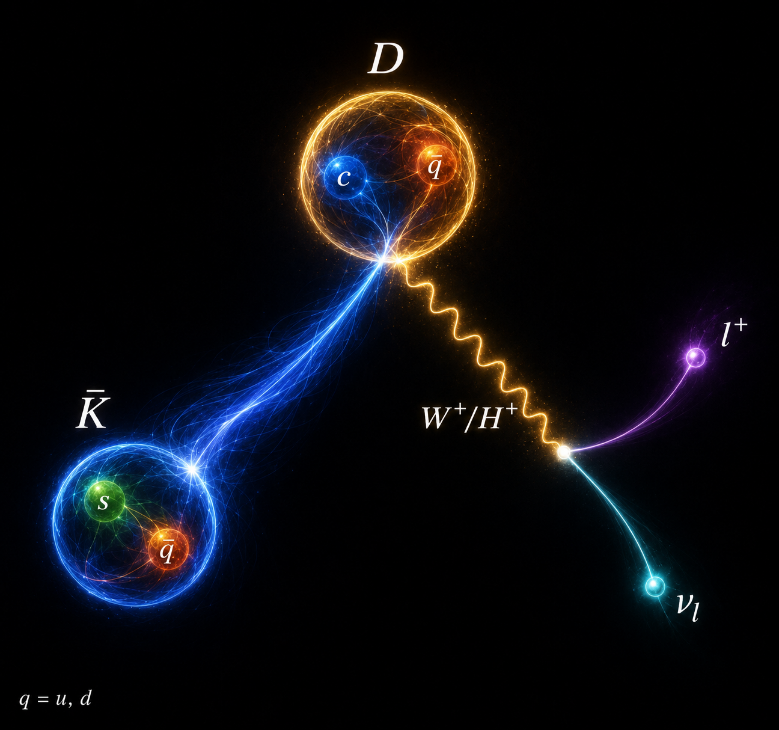
Figure 1. Schematic diagram of D meson semileptonic decay to an antikaon. The Standard Model process is mediated by the W⁺ boson, while potential charged scalar particles such as H⁺ can produce additional scalar current contributions.
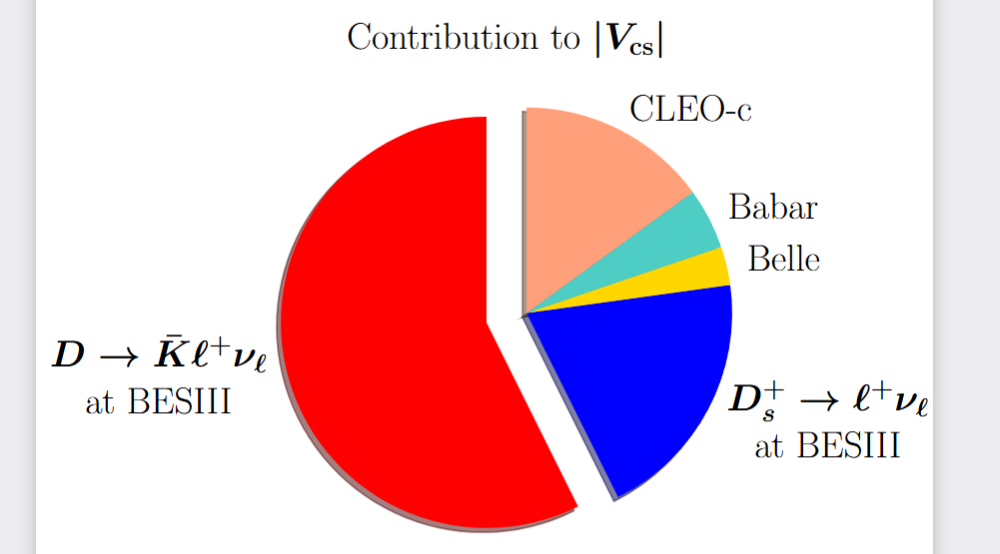
Figure 2. Weighted comparison of |Vcs| measurements from different experiments
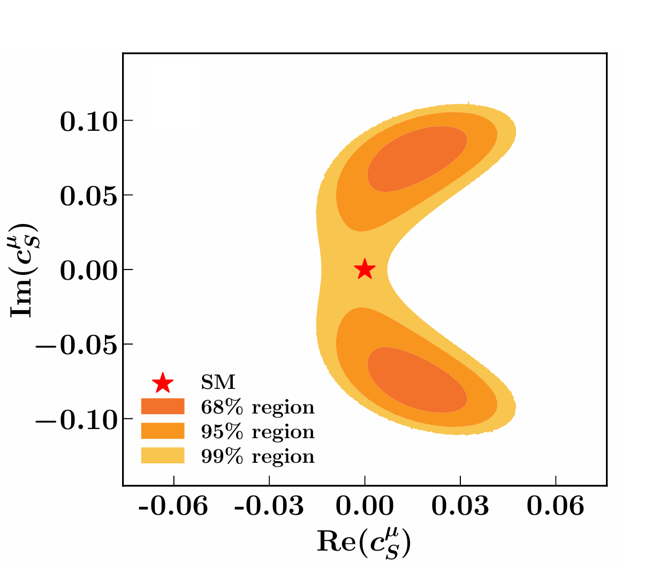
Figure 3. Confidence regions for the complex scalar current coefficient in the muon channel as determined by BESIII
Disclaimer: Information republished from partner media, institutions or other websites is provided for reference and communication purposes only. It does not imply endorsement of its views or verification of its accuracy. Please contact us if any content infringes rights or requires correction.