
German Research Team Completes First Phase Analysis of Chernobyl "Hot Particles": Nuclear Fuel Crystal Structure Still Exhibits Unexpectedly High Chemical Stability After 40 Years
 Scan to share
Nearly 40 years after the 1986 Chernobyl Nuclear Power Plant accident, a research team from Leibniz University Hannover and Helmholtz-Zentrum Dresden-Rossendorf (HZDR) in Germany has completed the world's first synchrotron radiation X-ray-based precision crystal phase analysis of 6 micron-sized highly radioactive fragments (commonly known in the industry as “Hot Particles”) ejected from the destroyed reactor. The related breakthrough research findings have been officially published in the top-tier journal in environmental and radioecology, the Journal of Hazardous Materials.
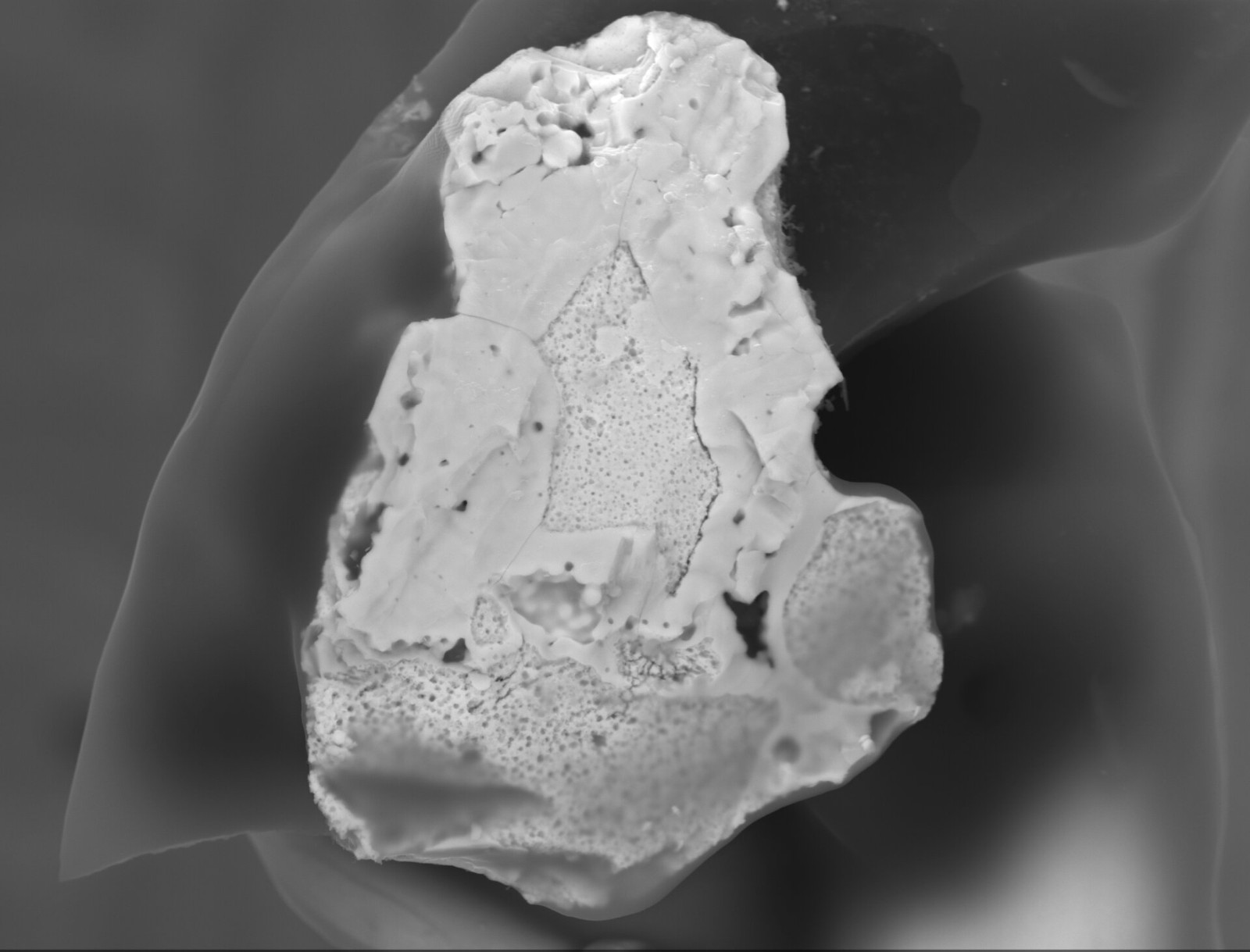
During the violent explosion and subsequent graphite fire of that year, a large amount of reactor core material was ejected into the atmosphere and surrounding environment, and to this day still exists in the form of tiny dust particles in the soil of the exclusion zone. Tobias Weissenborn, a radioecology physicist at Leibniz University Hannover, pointed out that the particles ejected from the accident mainly exhibit three types of occurrence states: the first type is highly preserved in physical and chemical form as the original uranium dioxide (UO₂) nuclear fuel; the second type was tightly co-melted and encapsulated with the surrounding heat-resistant zirconium alloy cladding when the reactor transiently overheated and melted; the third type, due to the intense 10-day combustion of the graphite moderator, was deeply oxidized into micron-sized aerosols such as triuranium octoxide (U₃O₈) that are mechanically fragile, easily weathered and pulverized, and drift with the wind.
In order to investigate the long-term weathering mechanisms of these radioactive particles, which measure only between 8 and 50 micrometers, in the natural environment, the team led by Dr. Christoph Hennig, a crystal physicist at HZDR, set up a high-precision micro-diffraction experimental station at the Rossendorf Beamline of the European Synchrotron Radiation Facility in Grenoble, France. The researchers mounted individual particles separated from Ukrainian soil samples onto tungsten electrode needle tips and placed them under a high-brightness X-ray beam with a focused spot of only 100 micrometers (equivalent to the thickness of a human hair). Using a precision rotation device, they collected omnidirectional diffraction signals from 2,000 different projection angles, achieving non-destructive determination of multiple oxide phases and crystal defects within the micron-sized fragments.
The experimental analysis revealed an unexpected phenomenon: after 40 years of harsh natural environmental physical weathering and groundwater erosion, the uranium dioxide nuclear fuel lattice framework in these examined particles has remained highly intact to this day, demonstrating chemical stability far exceeding previous scientific expectations. This means that the dense crystal structure effectively locks in, at the microscopic level, the dissolution and release rate of internal fission products into deeper soil and surrounding water networks.
However, the research team emphasizes that the crystal phase differences between individual particles are extremely significant, and conclusions applicable to the entire Chernobyl area cannot be drawn from only 6 samples collected from two locations. Weissenborn cautiously pointed out that even if the overall degradation exhibits periodic patterns, there still exist in the environment "long-lived anomalous particles" that release radionuclides, and in the short term, no protective restrictions can be relaxed within the Chernobyl Exclusion Zone. Currently, the joint German-French research team has launched follow-up experiments, focusing on the microscopic evolution dynamics of the phase states of transuranic elements in these historical legacy fragments.
Disclaimer: Information republished from partner media, institutions or other websites is provided for reference and communication purposes only. It does not imply endorsement of its views or verification of its accuracy. Please contact us if any content infringes rights or requires correction.