
LHAASO "Sees" for the First Time How Black Holes Produce the Highest-Energy Particles in the Universe
 Scan to share
How do black holes accelerate particles to the highest energies in the universe? The latest research provides the answer. On July 31, it was learned from the Institute of High Energy Physics of the Chinese Academy of Sciences that the Large High Altitude Air Shower Observatory (LHAASO, “Lasso”), a major national scientific and technological infrastructure, has for the first time “clearly seen” the process by which a black hole, while devouring material from its companion star, regularly produces the highest-energy particles in the universe like a metronome, and has identified the first PeV gamma-ray variable source. The related research results were published in the *National Science Review*.
Cygnus X-3 is a binary system located in the constellation Cygnus, consisting of a black hole and a massive companion star. The gravitational pull there is extremely strong, and the black hole frantically accretes the stellar wind blown off by its companion. “Lasso” detected gamma rays emitted by this system with extremely high energies, corresponding to cosmic ray particle energies of at least 30 PeV (peta-electron volts), far exceeding current theoretical predictions, making it the highest-energy particle accelerator known in the universe to date.
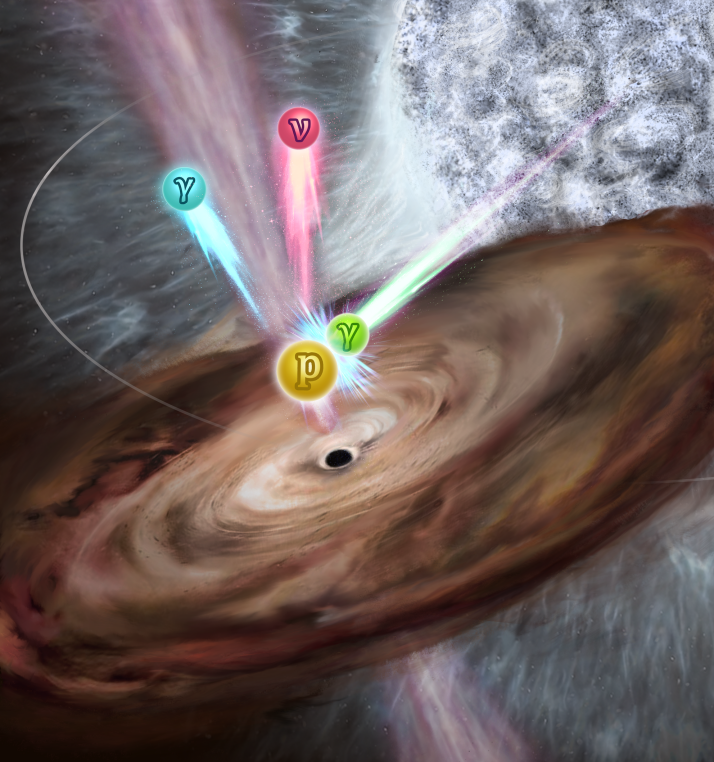
“It's as if we saw the black hole letting out a 'super burp' while feeding, and it was rhythmic,” said Li Cong, co-corresponding author of the paper and associate researcher at the Institute of High Energy Physics of the Chinese Academy of Sciences. The regularity is reflected in two aspects: first, the ultra-high-energy outbursts observed by “Lasso” are highly synchronized with the low-energy outbursts observed by the Fermi Gamma-ray Space Telescope — when the low-energy emission is bright, the high-energy emission is also bright, and when the low-energy emission is dim, the high-energy emission is completely extinguished; second, this signal varies with a period of 4.8 hours, showing a distinct rhythm that exactly matches the time it takes for the black hole and its companion star to orbit each other once.
With this “rhythm,” researchers from the Institute of High Energy Physics of the Chinese Academy of Sciences and other institutions precisely localized the region where the black hole accelerates particles to a scale of only about three solar radii. This is the highest-precision localization of an ultra-high-energy cosmic particle accelerator ever achieved by humanity.
“Seeing clearly how a black hole periodically accelerates particles to such extreme energies means we are no longer just taking static snapshots of the universe, but can now shoot high-definition movies,” Li Cong stated. This discovery opens up the field of ultra-high-energy time-domain astronomy and paves a new path for exploring the extreme gravitational, magnetic field, and matter states near black holes. Currently, this achievement has attracted great attention in the astrophysics community and has become one of the most hotly discussed topics at various international professional conferences.
Disclaimer: Information republished from partner media, institutions or other websites is provided for reference and communication purposes only. It does not imply endorsement of its views or verification of its accuracy. Please contact us if any content infringes rights or requires correction.