
Additively Manufactured CrMoTaTiV Refractory Alloy Demonstrates Excellent Radiation Resistance
 Scan to share
A materials study released on July 31 shows that a research team used laser powder directed energy deposition (LP-DED) technology to fabricate a novel Cr₁₀Mo₂₅Ta₂₅Ti₁₅V₂₅ refractory complex concentrated alloy and systematically evaluated its structural stability and mechanical properties under irradiation environments. The study targets the demand for high-temperature, high-irradiation structural materials in next-generation nuclear fission and fusion devices.
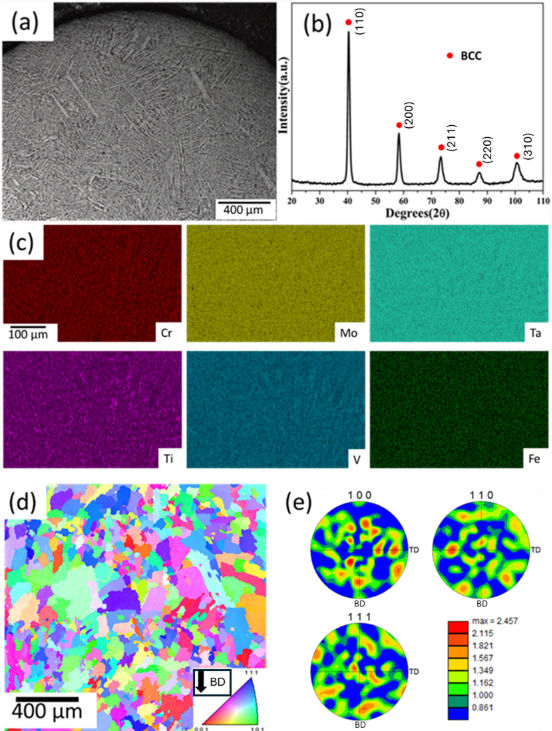
In the study, samples were subjected to 3.5 MeV Fe²⁺ ion irradiation at the Ion Beam Materials Laboratory of Los Alamos National Laboratory in the United States, at irradiation temperatures of room temperature and 650°C, with local doses reaching approximately 1.8, 6, and 18 dpa. Microstructural analysis revealed that the alloy is predominantly composed of a dendritic body-centered cubic (BCC) matrix, with interdendritic regions enriched in Cr, V, and Ti, while also containing Ti- and O-rich face-centered cubic (FCC) second-phase particles.
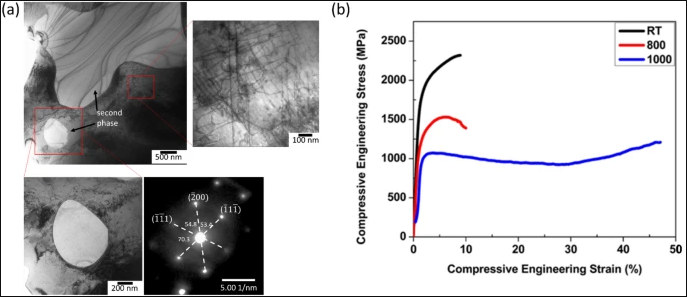
Mechanical testing showed that the alloy exhibits a yield strength of approximately 1611±30 MPa at room temperature with a fracture engineering strain of approximately 9±1%; at 800°C, the yield strength is approximately 1100±50 MPa with plastic deformation capability remaining at approximately 10%; even at 1000°C, the yield strength still reaches 953±70 MPa, demonstrating good compressive ductility. Compared to similar alloys fabricated by conventional vacuum arc melting, the LP-DED samples exhibited higher yield strength across multiple temperature conditions.
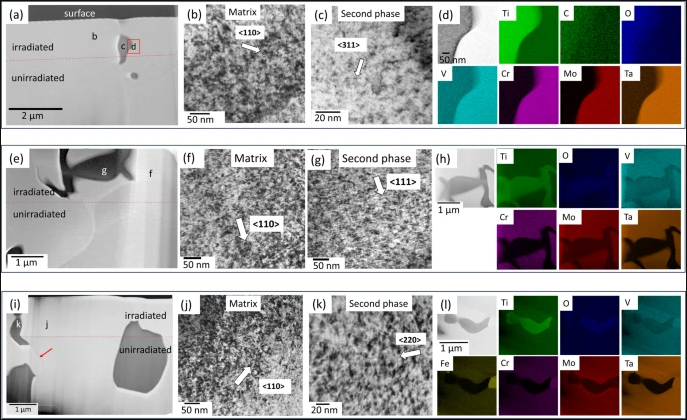
Irradiation results showed that under room temperature and 650°C conditions, both the BCC matrix and FCC second phase remained stable, with no void formation or phase transformation observed. The researchers found that high-density, small-size dislocation loops formed within the material after irradiation; at room temperature, with increasing dose, dislocation loop size decreased slightly while density increased, indicating that nucleation processes dominated; at 650°C, dislocation loop size increased with dose while density decreased, suggesting a trend toward loop coalescence.
The study suggests that the high dislocation density introduced by the additive manufacturing process, sluggish diffusion within the complex concentrated alloy matrix, and the presence of oxygen-rich FCC second-phase particles collectively enhance the alloy's radiation resistance. The research team noted that such additively manufactured refractory complex concentrated alloys hold further research potential for next-generation nuclear fission and fusion-related material applications.
Disclaimer: Information republished from partner media, institutions or other websites is provided for reference and communication purposes only. It does not imply endorsement of its views or verification of its accuracy. Please contact us if any content infringes rights or requires correction.