
Multinational Team Reveals Mechanisms of Lithiation in Modulating the Structural and Electronic Properties of Borophene Using Synchrotron Techniques
 Scan to share
A research team from the Institute of Physics in Zagreb, Croatia, Elettra Synchrotron in Trieste, Italy, Shimane University, and Tokyo University of Science recently conducted a study on the interaction between lithium atoms and borophene, revealing the mechanisms by which lithiation affects the atomic structure and electronic properties of borophene. The findings were published in *ACS Nano* and selected as the journal cover article.
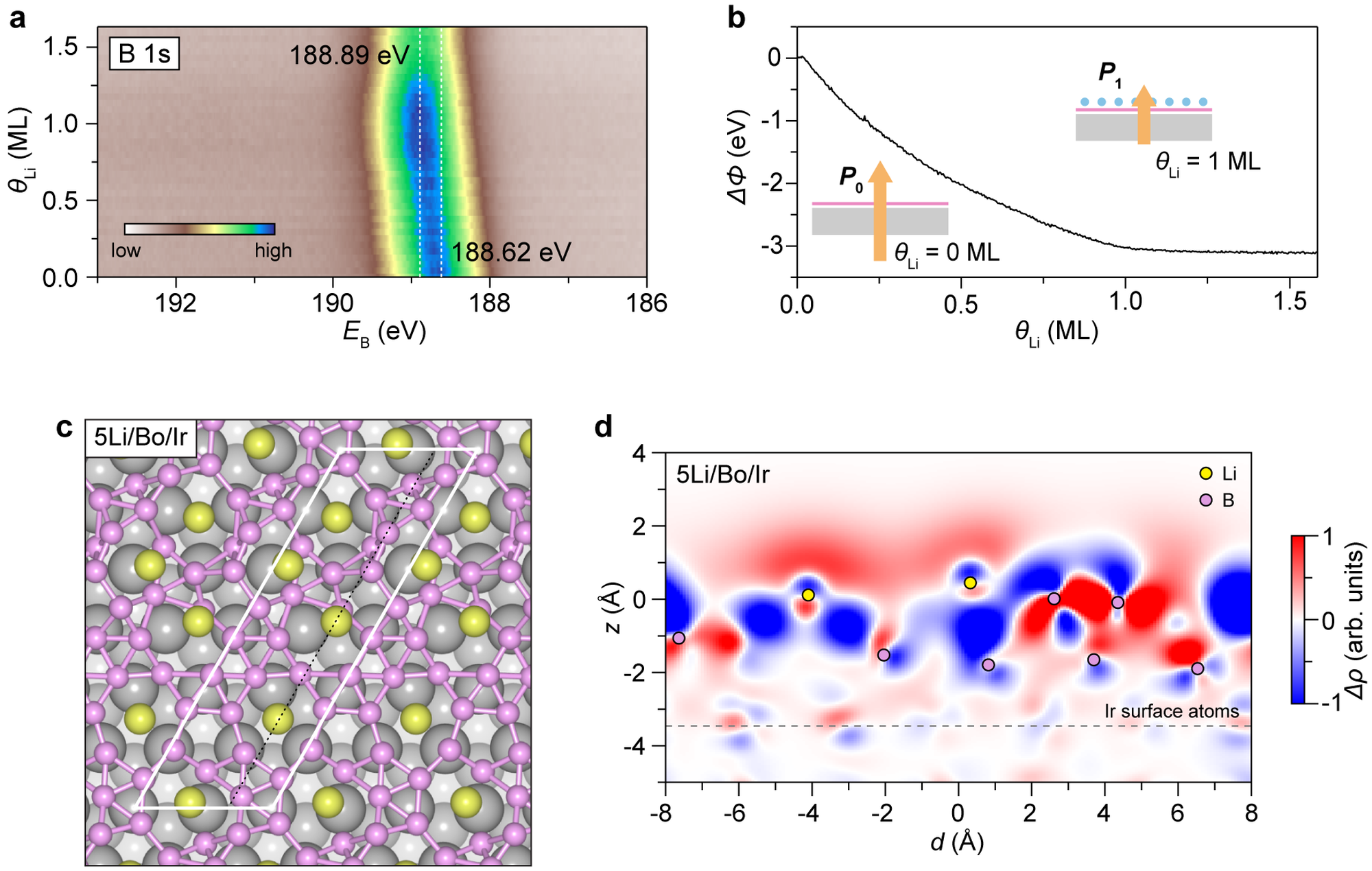
(a) Shift of the B 1s core level toward higher binding energy; (b) reduction of the sample work function due to charge transfer from Li atoms to B atoms; (c) lithium atoms (yellow) deposited on borophene (magenta) induce deformation of the borophene lattice, attributed to significant charge redistribution within the system, as shown in (d). Adapted from ACS Nano 20, 20198 (2026).
Borophene is a two-dimensional planar material composed of boron atoms. Due to its unique atomic arrangement, metallic character, and structural tunability, borophene is considered to have potential applications in next-generation nanoelectronic devices, sensors, and energy storage systems. However, how to precisely tune its properties through chemical interactions between foreign elements and borophene remains a fundamental question in this field. Lithium, as a typical alkali metal and a key element in modern energy storage technologies, has attracted particular attention regarding its interaction with borophene.
In this study, the team investigated the adsorption behavior of lithium on the surface of epitaxial borophene grown on an iridium substrate. By combining high-resolution microscopy and spectroscopy techniques at the nanospectroscopy beamline of Elettra Synchrotron with theoretical modeling approaches, the researchers analyzed atomic-scale changes during lithium deposition. Among these, spectromicroscopy techniques such as photoemission spectroscopy and low-energy electron microscopy provided critical support for simultaneously acquiring real-space imaging, diffraction imaging, and spectroscopic information.
Experimental results showed that lithium atoms deposited on borophene predominantly remained on the borophene surface without intercalating beneath the material. Meanwhile, a strong interaction occurred between lithium and the boron layer, with lithium atoms transferring substantial electronic charge to the borophene film. This process not only significantly modified the electronic structure of borophene, shifting the B 1s core level toward higher binding energy and reducing the sample work function, but also induced measurable distortion in the borophene lattice.
The study also found that after thermal treatment, some lithium atoms desorbed from the surface, while the remaining lithium atoms participated in forming a new boron—lithium—iridium surface phase. This phenomenon indicates that lithiation can not only alter the electronic properties of borophene but may also provide a new pathway for the chemical modification of borophene.
The research team believes that this work provides new fundamental data for understanding the chemical and physical properties of two-dimensional boron materials and offers a reference for the future design of borophene-based material systems. The findings contribute to further exploration of how atomic-scale interactions can be used to tune the electronic properties of emerging two-dimensional materials, serving research in nanoelectronics, catalysis, and energy-related technologies.
Disclaimer: Information republished from partner media, institutions or other websites is provided for reference and communication purposes only. It does not imply endorsement of its views or verification of its accuracy. Please contact us if any content infringes rights or requires correction.