
BESSY II reveals early-stage copper oxidation: providing evidence for catalyst development and corrosion research on nuclear waste final disposal containers
 Scan to share
Germany's BESSY II synchrotron facility has recently provided new experimental insights into the early-stage oxidation process of copper surfaces. The study shows that before the formation of pure copper oxides, copper and oxygen atoms first form complex surface superstructures, such as “29”CuₓO. The chemical state of such structures has long been debated, and the findings are of reference value for catalyst research as well as for corrosion protection studies of copper containers used for radioactive waste final disposal.
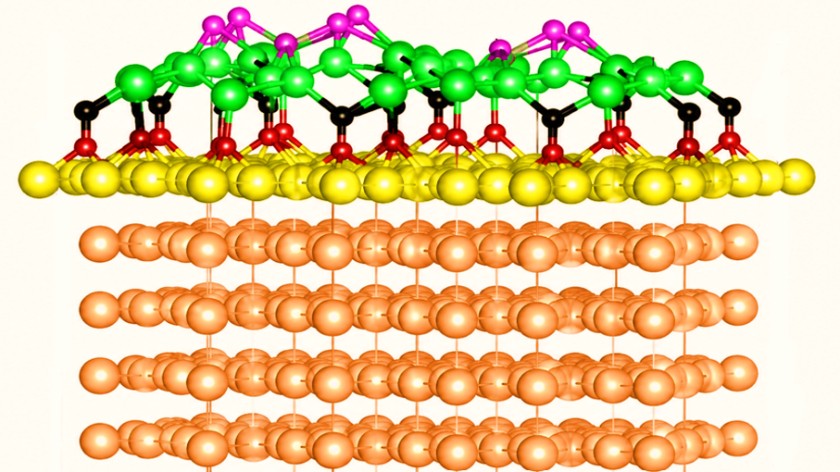
Before the formation of pure copper oxide, complex superstructures composed of copper and oxygen atoms emerge—such as “29”CuxO. HZB
In everyday environments, copper surfaces gradually lose their red metallic luster and form a greenish oxide layer. This layer structure can slow further corrosion over an extended period. Regarding the initial stages of this process, the core question researchers focus on is: to what extent are copper atoms actually oxidized once oxygen enters the copper surface. Since conventional spectroscopic methods struggle to clearly distinguish between pure copper and partially oxidized surfaces, such oxidation states have previously been difficult to determine directly.
A research team led by Professor Alexander Föhlisch conducted measurements using Auger-photoelectron coincidence spectroscopy (APECS) at BESSY II. This method offers high surface sensitivity, enabling researchers to more clearly distinguish between different chemical states.
The results show that in the known “29” surface oxide, copper atoms remain very close to the metallic state, with an oxidation state of only approximately 0.3. In other words, despite the relatively high oxygen concentration on the surface, the electronic state is closer to metallic copper than to cuprous oxide (Cu₂O). The researchers also identified the distribution of oxygen species that constitute the protective surface oxide. This result indicates that surface oxygen content does not directly determine the degree of copper atom oxidation.
These findings can provide fundamental data for two directions. On one hand, copper is commonly used in catalytic processes such as CO₂ reduction, methanol synthesis, and oxidation reactions. Many active sites are not fully oxidized CuO, Cu₂O, or pure metal, but rather partially oxidized surfaces. If these surfaces are electronically close to the metallic state, this could help explain their activity and selectivity, which differ from those of pure oxides. On the other hand, a more refined understanding of copper surface corrosion mechanisms also supports safety research on copper containers used for the final disposal of spent fuel assemblies.
It is reported that the experimental work for this study was carried out at the CoESCA endstation of the UE52-PGM beamline at BESSY II within the framework of the Uppsala–Berlin joint laboratory; the corresponding first-principles calculations were supported by a collaborative team from Stockholm University in Sweden.
Disclaimer: Information republished from partner media, institutions or other websites is provided for reference and communication purposes only. It does not imply endorsement of its views or verification of its accuracy. Please contact us if any content infringes rights or requires correction.