
"Wukong" Detects "Super-Iron" Elements in Cosmic Rays, Achieving First High-Precision Cosmic Ray Nickel Energy Spectrum in the TeV Range
 Scan to share
The origin of super-iron elements in cosmic rays has long been a challenge for the scientific community. It is generally believed that cosmic ray elements are primarily produced in nuclear fusion processes within stars, but since iron nuclei have the highest binding energy per nucleon, stellar fusion reactions typically struggle to proceed beyond elements near iron. Heavier elements than iron are generally attributed to different nucleosynthesis processes such as neutron capture. Because the abundance of super-iron elements is typically at least an order of magnitude lower than that of iron, measurements of super-iron elements in cosmic rays remain extremely scarce. Most experiments have only provided relative abundances of different elements; a few experiments have measured the differential flux spectrum of cosmic ray nickel, but with energy upper limits of only a few hundred GeV/n.
The "Wukong" satellite is the first spacecraft launched under the Strategic Priority Research Program on Space Science of the Chinese Academy of Sciences and is also China's first space astronomy satellite. Its scientific objectives include indirectly detecting dark matter by measuring cosmic ray electrons, precisely measuring cosmic ray elemental energy spectra, and conducting gamma-ray astronomy research. The satellite was successfully launched at the end of 2015 and has been operating stably in orbit for over 10 years, having transmitted nearly 20 billion high-energy particle events. Compared with similar international space-based high-energy particle detection instruments, "Wukong" not only covers a wide energy range, provides accurate energy measurements, and possesses strong particle identification capabilities, but also offers a larger acceptance, providing favorable conditions for measuring the energy spectra of low-abundance elements such as super-iron elements in cosmic rays.
In this research achievement, the scientific team, based on nine years of data, extended the energy spectrum measurement of nickel in cosmic rays to the high-energy range of 2 TeV/n for the first time, improving it by approximately an order of magnitude. The results show that the shape of the nickel energy spectrum exhibits a clear similarity to that of iron, and the nickel-to-iron abundance ratio remains approximately constant in this energy range, strongly indicating that the two elements may share similar origins, propagation, and acceleration mechanisms. This discovery provides new evidence for understanding the synthesis pathways of super-iron elements in cosmic rays and will promote further refinement of related theoretical models.
This achievement was accomplished jointly by our university, the Institute of Modern Physics, the Purple Mountain Observatory of the Chinese Academy of Sciences, the Institute of High Energy Physics, the University of Geneva in Switzerland, and several Italian research institutions. The team of Professor Huang Guangshun, Professor Zhang Yunlong, and Associate Professor Wei Yifeng from the School of Physics led this analysis work, and doctoral student Sun Haoran is the primary contributor to this paper.
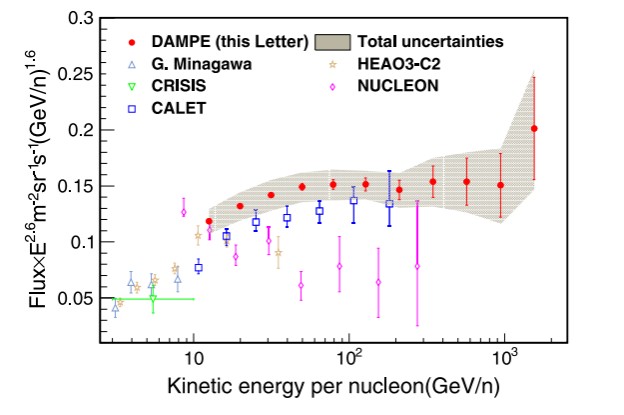
Figure 1. Differential flux spectrum of nickel nuclei from 10 GeV/n to 2 TeV/n observed by DAMPE.
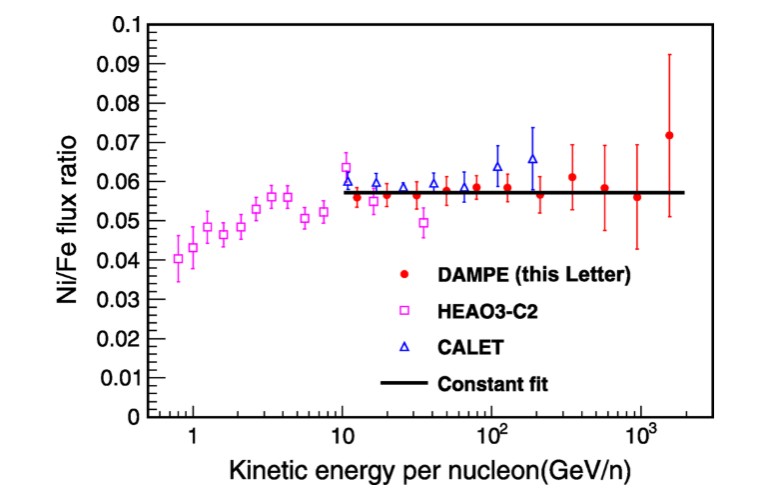
Figure 2. The nickel-to-iron ratio observed by DAMPE is approximately constant.
This research was supported by the National Natural Science Foundation of China and the Ministry of Science and Technology.
Background information:
The BGO calorimeter, the core payload subsystem of the "Wukong" satellite, was developed by the former State Key Laboratory of Particle Detection and Electronics of our university. Since 2009, this laboratory has participated as a key member in the preliminary feasibility studies and pre-research work of the satellite project and completed the development of a ground-based prototype.
After the "Wukong" satellite project was officially approved in 2012, the team overcame the key technical challenge of "large dynamic range readout of BGO crystals" and successfully developed the BGO calorimeter. In 2015, when the Dark Matter Particle Explorer Science Collaboration was formally established, faculty and students from this laboratory undertook important research tasks within the collaboration, deeply participating in the on-orbit detection and scientific data analysis of the "Wukong" satellite.
The successive production of a series of important physics results also fully confirms the excellent performance and reliable quality of the BGO calorimeter developed by this team.
Disclaimer: Information republished from partner media, institutions or other websites is provided for reference and communication purposes only. It does not imply endorsement of its views or verification of its accuracy. Please contact us if any content infringes rights or requires correction.