
Japanese research team accelerates muons to 0.3 MeV, taking a step toward the world's only muon accelerator
 Scan to share
A research team comprising the J-PARC Center, High Energy Accelerator Research Organization (KEK), the University of Tokyo, Tokai National Higher Education and Research System, Nagoya University, and RIKEN recently completed muon cooling and radio-frequency acceleration experiments in the newly constructed muon acceleration experimental area at the J-PARC Materials and Life Science Experimental Facility, successfully accelerating muons to a kinetic energy of 0.3 MeV, corresponding to approximately 8% of the speed of light.
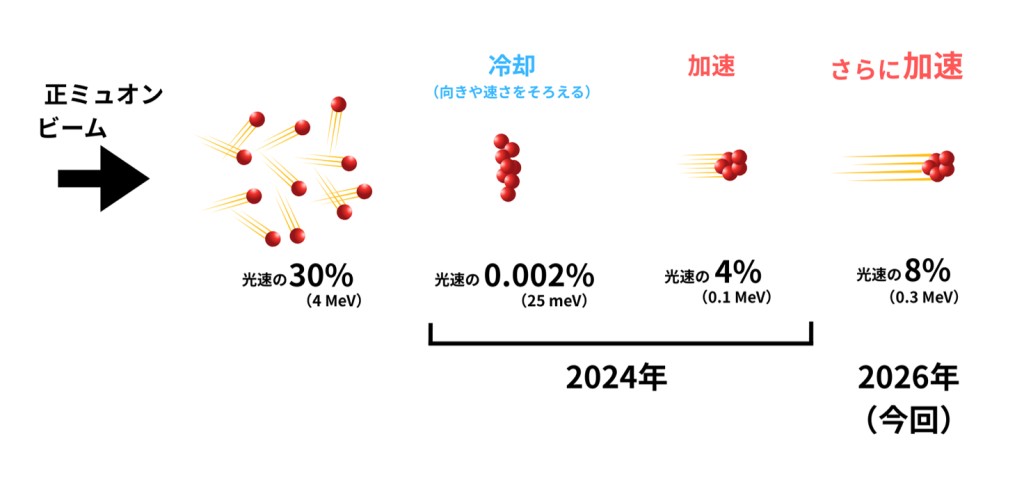
Conceptual diagram of cooling and accelerating positive muon beams. By cooling positive muons with non-uniform direction and velocity, efficient high-frequency acceleration can be achieved.
Muons are elementary particles similar to electrons that can be artificially produced by accelerators and are widely used in fields such as materials science, particle physics research, and imaging of large-scale structures. However, muon beams produced by conventional accelerators are non-uniform in direction and velocity, making it difficult to directly feed them into subsequent acceleration stages. Therefore, how to first cool muons and then achieve stable acceleration is a key technical challenge in related research.
This experiment was conducted in the dedicated muon beamline H-line experimental area newly established at MLF. The research team first cooled muons with a kinetic energy of approximately 4 MeV to bring them into a state more suitable for high-frequency acceleration, and then used a radio-frequency accelerating cavity to accelerate them to 0.3 MeV. Compared with the world's first muon cooling and acceleration demonstration completed by the team in 2024, the acceleration energy in this experiment was increased to approximately three times, and the beam intensity was enhanced to approximately 200 times, reaching about 10 muons per second.
The research team stated that this result signifies that muon acceleration research is transitioning from the technological "demonstration" phase to the "implementation" phase capable of producing experimentally usable muon beams, representing a significant milestone in the construction and operation of the world's only muon accelerator.
According to the subsequent plan, the research team aims to accelerate muons to 4 MeV, approximately 30% of the speed of light, around 2027 to 2028, in order to establish core technologies related to artificial and portable muon beams. In the longer term, the team hopes to further accelerate muons to above 200 MeV for ultra-precise measurements such as muon g-2 and electric dipole moment, and to promote applied research of transmission muon microscopy in materials science and engineering.
Disclaimer: Information republished from partner media, institutions or other websites is provided for reference and communication purposes only. It does not imply endorsement of its views or verification of its accuracy. Please contact us if any content infringes rights or requires correction.