
Fudan team extracts CKM matrix element |Vus| via quantum entanglement in collider experiment for the first time
 Scan to share
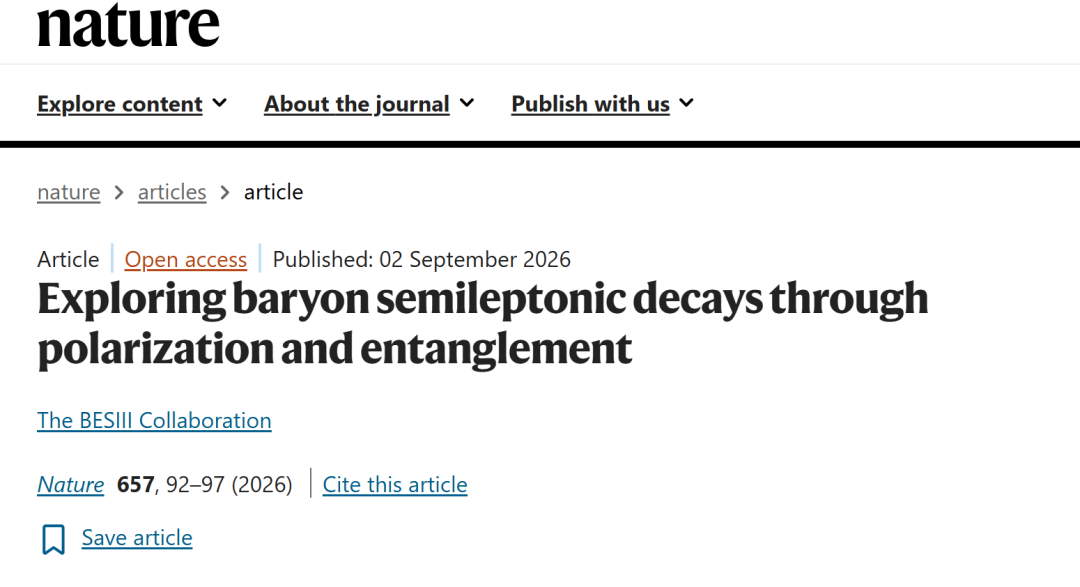
On the evening of September 2, 2026, Beijing time, the team led by Luo Tao from the Institute of Modern Physics at Fudan University, together with collaborators, published a research achievement titled “Exploring baryon semileptonic decays through polarization and entanglement” in Nature. This study, for the first time in a collider experiment, utilized quantum entanglement and polarization information to extract the Cabibbo-Kobayashi-Maskawa (CKM) matrix element |Vus|, providing a new experimental pathway for precisely testing the Standard Model of particle physics.
The CKM matrix describes the strength of transitions between different quarks under the weak interaction. Among them, |Vus| corresponds to the transition from the strange quark to the up quark, and its numerical precision is related to the test of the three-generation quark mixing mechanism in the Standard Model. Currently, results for |Vus| obtained from different decay processes still show discrepancies, and the unitarity test of the first row of the CKM matrix also exhibits some tension, necessitating more independent measurement methods for verification.
This study focuses on the β decay of the Λ hyperon. The Λ hyperon consists of one up quark, one down quark, and one strange quark, and can decay into other particles within an extremely short time. Its β decay process involves the transition of a strange quark into an up quark, accompanied by the production of an electron and an antineutrino. Since antineutrinos are difficult to detect directly by detectors, traditional measurements face considerable challenges.
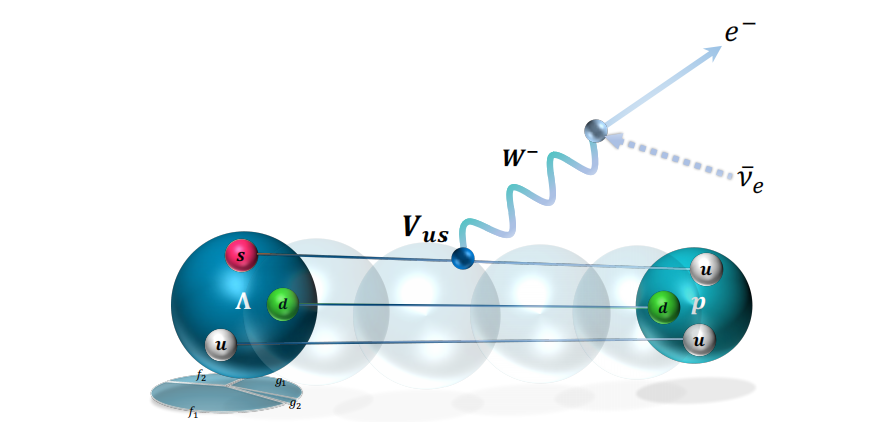
Schematic diagram of Λ particle β decay: The Λ particle decays into a proton, an electron, and an electron antineutrino via a virtual W⁻ boson. The pie chart illustrates the relative magnitudes of the dominant vector and axial-vector form factors involved in this transition process
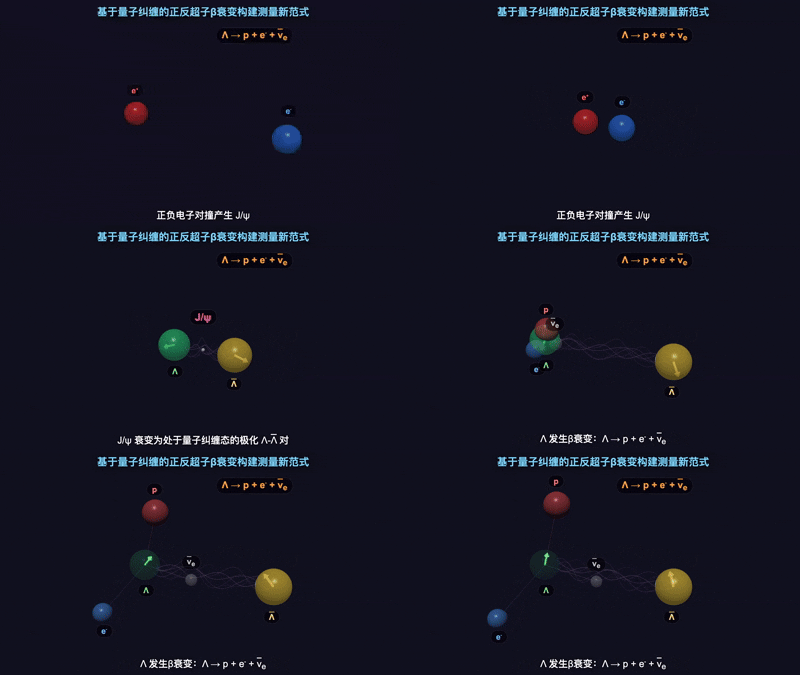
In the Beijing Spectrometer III (BESIII) experiment, Λ and anti-Λ are produced in pairs and maintain spin quantum entanglement. The research team inferred the anti-Λ information by detecting visible decay particles on the anti-Λ side, then indirectly obtained the production information of the Λ through the quantum entanglement relationship; for the invisible antineutrino, energy and momentum conservation were used for inference. The team incorporated the production, polarization, quantum entanglement, and decays on both sides of the Λ and anti-Λ into a unified joint angular distribution multivariate fitting method for analysis, enabling the extraction of physical information that was previously difficult to resolve.
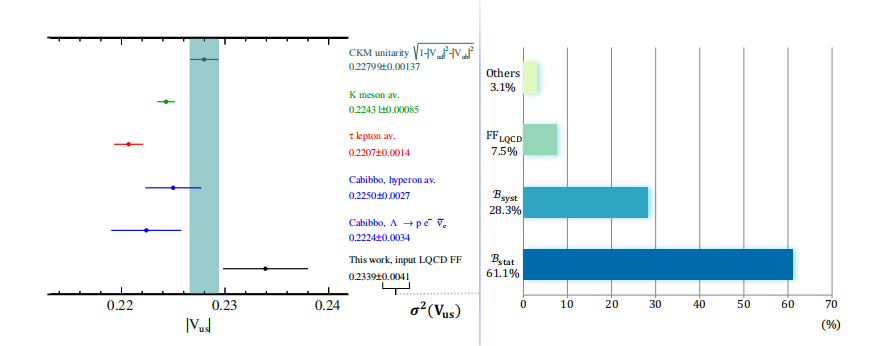
Results related to |Vus|: (Left panel) shows the first-row CKM unitarity constraints, along with the average values measured from K meson decays and τ lepton decays, while the two hyperon decay results are taken from the work of Cabibbo. (Right panel) presents the various sources of uncertainty contributing to this |Vus| measurement in the form of variances.
This study spanned six and a half years. Due to the very low probability of Λ hyperon β decay, the team ultimately selected 1,854 signal events from 10 billion J/ψ decay events, with the signal sample being only one-twentieth of that from an earlier experiment at the Fermi National Accelerator Laboratory in the United States. Despite the limited statistics, the research team achieved a measurement precision comparable to existing high-precision experiments, and for the first time measured the absolute branching ratio of Λ hyperon β decay, the weak-electroweak coupling parameters, and multiple decay parameters of the anti-Λ, filling relevant experimental gaps.
The researchers stated that the significance of this work lies not only in obtaining new experimental values, but also in demonstrating that quantum entanglement and polarization analysis can be transformed into practical measurement information in baryon β decay. This method has already been extended to other baryon studies at BESIII, and is expected to provide methodological support for more hyperon β decay measurements and research at next-generation large scientific facilities.
Professor Luo Tao from the Institute of Modern Physics at Fudan University is the corresponding author of the paper, and Wang Shun, specially appointed associate professor at the School of Mathematics and Physics of Southwest University of Science and Technology, is the lead author of the paper. Researchers from Southeast University, the Institute of High Energy Physics of the Chinese Academy of Sciences, Uppsala University in Sweden, and other institutions participated in this work. The research was supported by projects from the National Key Research and Development Program of the Ministry of Science and Technology, the National Natural Science Foundation of China, the Ministry of Education, and others.
Disclaimer: Information republished from partner media, institutions or other websites is provided for reference and communication purposes only. It does not imply endorsement of its views or verification of its accuracy. Please contact us if any content infringes rights or requires correction.