
South Korean research team reveals that water storage capacity of cold subducting slabs has been underestimated using synchrotron radiation sources
 Scan to share
A research team led by Professor Yongjae Lee of the Department of Earth System Sciences at Yonsei University in South Korea has recently found that in cold, rapidly descending tectonic subduction zones, crustal rocks may transport up to 1 trillion kilograms of water to the mantle each year—approximately twice the previous estimate. The findings have been published in Nature Communications.
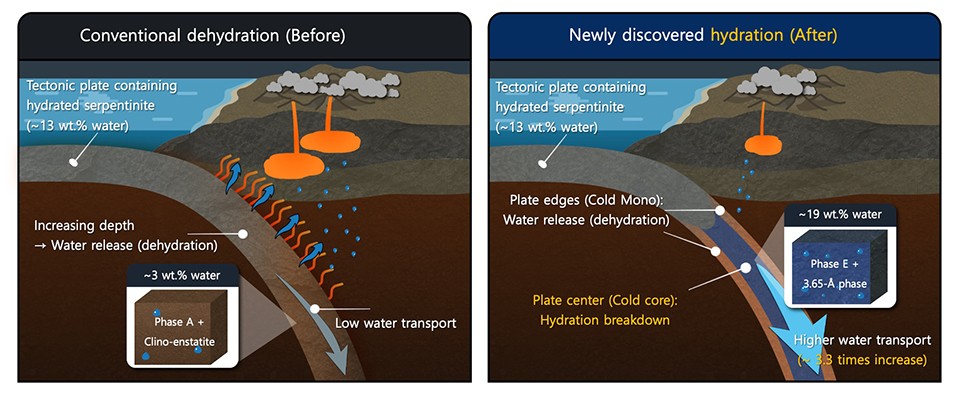
Subduction zones are regions where Earth's tectonic plates converge and one plate descends beneath another, often accompanied by volcanic and seismic activity. For a long time, the academic community has generally believed that serpentinite, a water-bearing rock, gradually dehydrates as it descends with the plate due to increasing pressure and temperature, and the released water further promotes melting of the overlying plate and is associated with the formation of volcanic arc chains.
This new study shows that the situation may be more complex. Since 2019, the research team has conducted a series of high-pressure and high-temperature experiments, utilizing facilities such as the PETRA III synchrotron radiation source at DESY in Germany, the Advanced Photon Source at Argonne National Laboratory in the United States, and the Pohang Accelerator Laboratory in South Korea, to observe structural changes in serpentine minerals under deep-Earth conditions. At the P02.2 and P61B beamlines of PETRA III, the team conducted high-pressure, high-temperature X-ray diffraction experiments and ultrasonic velocity measurements, respectively, to analyze serpentine stability and its corresponding seismic wave properties.
The experimental results show that in the warmer marginal regions of the descending slab, water is indeed released at depths of approximately 220 kilometers, increasing rock density by about 16% and thereby affecting seismic wave propagation. However, in the colder environment of the slab interior, serpentine undergoes a reaction at approximately 280 kilometers depth that had previously been suspected but not directly observed in experiments. Under water-rich conditions, the newly formed structure can absorb additional water equivalent to approximately 6% of its own weight; under water-poor conditions, another structure continues to retain its original water content.
Based on these findings, the research team concludes that the water retention capacity of serpentinite in cold subducting slabs is approximately three times greater than previously recognized. As the crust bends and forms faults during descent, additional water may enter the subduction zone along these channels, undergoing various water-absorbing or water-retaining reactions under different pressure, temperature, and water content conditions.
On a global scale, the researchers further combined model analyses of 16 cold or ultra-cold subduction zones among 56 subduction zones, estimating that these regions can transport up to 1 trillion kilograms of water into the mantle each year. The research team stated that this finding implies that cold subducting slabs may act like "giant sponges," storing and transporting large amounts of water to deeper regions of the Earth's interior; existing models of intraplate water cycling, Earth's internal evolution, and interpretations of seismic and volcanic data may need to be revisited.
Disclaimer: Information republished from partner media, institutions or other websites is provided for reference and communication purposes only. It does not imply endorsement of its views or verification of its accuracy. Please contact us if any content infringes rights or requires correction.