
XENONnT Observes First Low-Energy Solar Neutrino-Electron Scattering Signals
 Scan to share
Scientists of the XENON collaboration recently announced the first observation of low-energy solar neutrino scattering off electrons in the XENONnT particle detector. The results were presented at a workshop held on August 31, 2026, at the Gran Sasso National Laboratory of the Italian National Institute for Nuclear Physics. The team of Prof. Teresa Marrodán Undagoitia and Dr. Hardy Simgen from the Max Planck Institute for Nuclear Physics played a key role in the experiment.
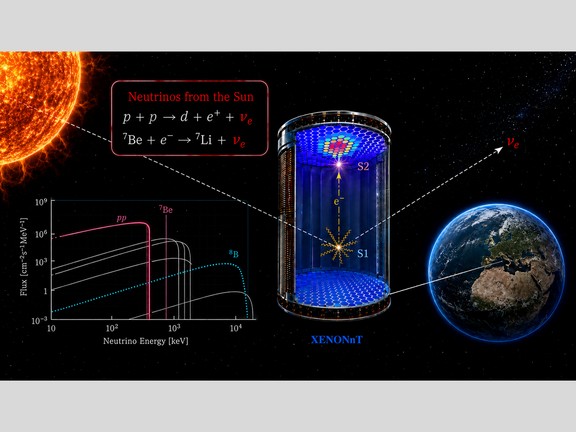
Nuclear fusion in the Sun continuously produces vast numbers of neutrinos, with hundreds of billions passing through every square centimeter of Earth each second. Because neutrinos interact with matter extremely weakly, detecting these particles has always been a highly challenging task in particle physics experiments. The measurement achieved by XENONnT extends the directly observed neutrino energy range down to approximately 17 kiloelectronvolts (keV), the lowest neutrino energy threshold reached to date. The currently measured signal originates primarily from "pp neutrinos," i.e., neutrinos produced by the proton-proton fusion reaction in the Sun, which constitute the dominant component of solar neutrino radiation.
The XENONnT detector is located approximately 1,400 meters underground in the Gran Sasso mountain range in Italy, with about 30 international research institutions involved in its construction and operation. Its core instrument is a dual-phase xenon time projection chamber containing 5.9 tons of high-purity liquid xenon, used to record the faint scintillation and ionization signals produced by particle interactions. Surrounding the central detector are two water Cherenkov detectors, which serve to identify neutron and μon background signals originating from cosmic rays.
XENONnT was originally designed primarily to search for hypothetical dark matter particles in the Milky Way. Previously, the facility had observed coherent elastic neutrino-nucleus scattering induced by high-energy solar neutrinos. The newly obtained low-energy solar neutrino-electron scattering signal demonstrates that the same detector, while continuing its dark matter search, can also be used to study questions related to neutrino physics.
To capture the extremely faint low-energy neutrino signals, the experiment requires minimizing and precisely quantifying the detector background as much as possible. The XENON collaboration has conducted long-term material screening programs and uses a dedicated cryogenic distillation system to continuously remove radon from the xenon, while also identifying and quantifying low-radioactivity background sources such as lead and krypton isotope β decays and trace γ-rays from detector materials.
The collaboration states that the low-background techniques developed for XENONnT and its predecessor XENON1T will lay the foundation for the next generation of liquid xenon detectors. The planned XLZD experiment, with a xenon mass approximately ten times that of XENONnT, is expected to further improve dark matter detection sensitivity and measure low-energy solar neutrinos with higher precision, providing new experimental conditions for neutrino physics and the study of other rare processes.
Disclaimer: Information republished from partner media, institutions or other websites is provided for reference and communication purposes only. It does not imply endorsement of its views or verification of its accuracy. Please contact us if any content infringes rights or requires correction.