
No Evidence of Mirror Neutrons Found in Swiss PSI Ultracold Neutron Experiment
 Scan to share
The Ultracold Neutron Physics Group at the Paul Scherrer Institute (PSI) in Switzerland recently stated that its research team found no evidence of spontaneous transformation of ordinary neutrons into "mirror neutrons" in a high-precision experiment. The researchers said the result essentially rules out the main parameter space previously suggested for anomalous neutron–mirror neutron oscillation signals, and also weakens the possibility that mirror neutrons could be a component of dark matter.
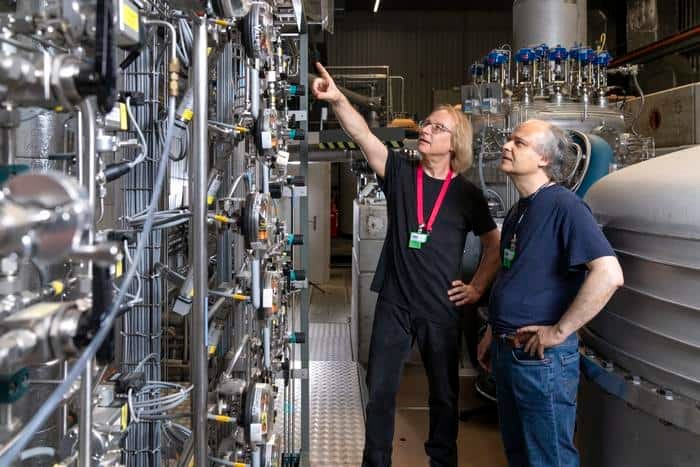
Bernhard Lauss (left) and Géza Zsigmond examined approximately 2.5 billion neutrons at the ultracold neutron source at the Paul Scherrer Institute (PSI). They essentially ruled out the hypothesis of spontaneous transformation of neutrons into mirror neutrons. (Image courtesy of Paul Scherrer Institute PSI/Markus Fischer)
The mirror world theory dates back to the 1950s, when it was proposed to address issues related to parity symmetry conservation in particle physics. According to this concept, every ordinary elementary particle could have a "mirror counterpart" with nearly identical mass but opposite chirality. For neutrons, in theory, an ordinary neutron could, in extremely rare cases, transform into a mirror neutron and "disappear" from conventional detection—a process known as neutron–mirror neutron oscillation.
However, such oscillations are extremely difficult to observe. Theoretical predictions suggest that the oscillation time between neutrons and mirror neutrons could be as short as tens of seconds, but environmental factors such as ordinary matter, mirror matter, and ordinary or mirror magnetic fields can suppress this process. To reduce interference, researchers typically conduct experiments using ultracold neutrons, which are maintained at extremely low temperatures and move at very slow speeds.
In this study, PSI researchers, in collaboration with ETH Zurich, Jagiellonian University in Kraków, and other institutions, conducted measurements using the PSI ultracold neutron source. In the experiment, the research team produced ultracold neutrons in a deuterium crystal cooled to 5 K using superthermal moderation techniques, and stored them in a stainless steel non-magnetic container under vacuum conditions. The experiment examined approximately 2.5 billion neutrons in total, providing higher sensitivity than previous studies of this kind.
Eight rectangular coils were arranged around the experimental apparatus to generate and precisely control the magnetic field. The research team scanned magnetic fields ranging from 5 to 109 microteslas and varied the field direction to cover the regions where neutron–mirror neutron oscillations were expected to potentially occur. Approximately every 6 minutes, the researchers released about 1.5 million neutrons into a gas electron multiplier-based neutron detector, counting the number of neutrons remaining in the container after a 200-second storage period. This process continued for several months and was combined with simulations performed on the EULER computing cluster at ETH Zurich to compare theoretical transition probabilities with measured neutron losses.
The researchers stated that no evidence of neutron transformation into mirror neutrons was found under the tested conditions. PSI researcher Bernhard Lauss noted that 99.98% of the parameter space previously claimed to potentially exhibit signals has been ruled out. He also stated that the result rules out the possibility of mirror neutrons as relevant dark matter particles.
The research team stated that they still plan to study neutron–mirror neutron transitions that could theoretically occur under zero mirror magnetic field conditions, in order to further tighten constraints. However, the researchers also noted that further increasing experimental sensitivity would be extremely challenging. For example, doubling the sensitivity would require approximately 16 times more neutrons, since experimental sensitivity scales with the fourth root of the neutron count.
Disclaimer: Information republished from partner media, institutions or other websites is provided for reference and communication purposes only. It does not imply endorsement of its views or verification of its accuracy. Please contact us if any content infringes rights or requires correction.