
IAEA Technical Meeting on Data Requirements for Ion Beam Analysis Explores Prospects for Nuclear Track Emulsion Applications
 Scan to share
From 24 to 28 August 2026, the International Atomic Energy Agency convened a Technical Meeting on Data Requirements for Ion Beam Analysis Experiments in Vienna, Austria, attended by scientists and experts from multiple nuclear physics research institutions. The meeting discussed the nuclear data requirements for current and future applications of ion beam analysis, with attention to new experimental methods and the application of artificial intelligence and machine learning in experiments and data processing.
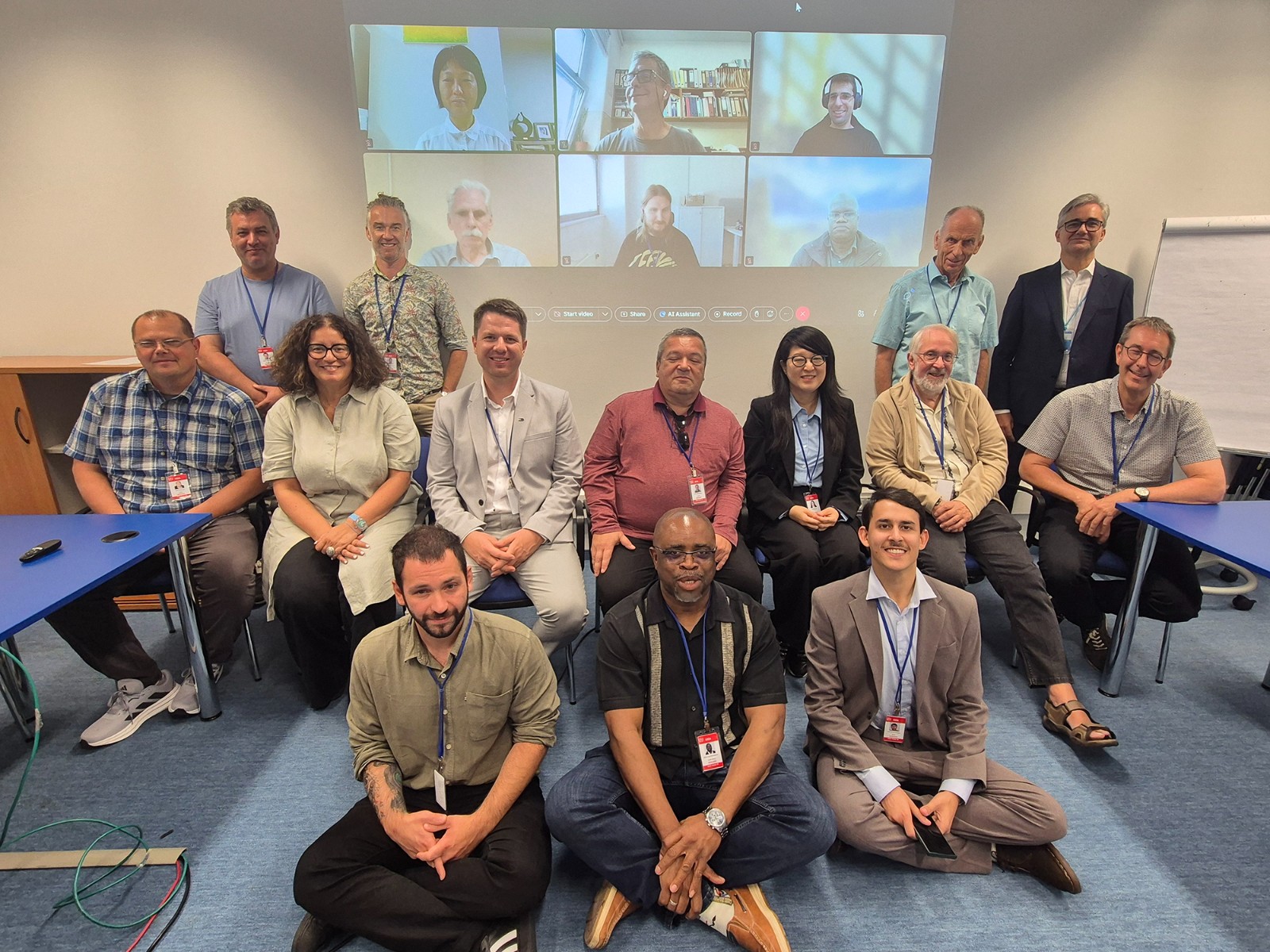
The meeting focused on assessing whether existing nuclear data can meet the needs of ion beam analysis applications, covering areas such as elastic recoil cross sections, nuclear reaction data, and gamma-ray spectrum analysis. Participants discussed the limitations that insufficient existing data impose on quantitative analysis and uncertainty assessment, and exchanged views on nuclear data evaluation, validation, propagation methods, and the prospects for developing the IAEA nuclear data database IBANDL.
Andrey Zaitsev, Senior Researcher at the High Energy Physics Laboratory of the Joint Institute for Nuclear Research, delivered a presentation titled "Modern Applications of Nuclear Emulsions in Heavy-Ion Physics," introducing the current capabilities of nuclear track emulsions and the research progress of the BECQUEREL project. The report noted that, leveraging the high spatial and angular resolution of nuclear emulsions, researchers can conduct studies of relativistic nuclear fragmentation, analyze correlations between fragments, and identify low-energy nuclear states, including 8Be, 9B, and the Hoyle state of 12C.
The report also presented recent advances in emulsion technology. With the development of automated and intelligent microscopy, computer vision, artificial intelligence, and machine learning methods are being applied to nuclear emulsion data analysis, enabling research to move beyond traditional visual analysis of individual events toward experimental studies with higher statistical power.
In research related to the NICA accelerator complex, nuclear emulsions combined with automated microscopy can be used not only to study individual nuclear interactions but also to quantitatively analyze the spatial distribution and beam characteristics of heavy-ion beams. The report also noted that solid-state track detectors based on CR-39 polymer can serve as an independent detection method for beam profile and fluence measurements.
Zaitsev also introduced potential applications of nuclear emulsions in studies of alpha radioactivity, nuclear fission, and low-energy ion beams. The ensuing discussions concluded that systematic calibration studies under different energies and irradiation conditions are necessary, based on known nuclear reactions and processes. Obtaining experimental data with high statistical significance will help improve the metrological accuracy of nuclear track emulsions, establish reference experimental datasets, and promote the development of automated analysis methods.
The meeting provided the international scientific community with a deeper understanding of the latest capabilities of nuclear track emulsion technology and offered a platform for exchanging views on its application prospects in ion beam research. The discussions indicated that continued maintenance and improvement of nuclear emulsions and related analysis techniques are of significant importance for ion beam analysis and nuclear physics experimental data research.
Disclaimer: Information republished from partner media, institutions or other websites is provided for reference and communication purposes only. It does not imply endorsement of its views or verification of its accuracy. Please contact us if any content infringes rights or requires correction.