
Antihydrogen hyperfine splitting measurement sets new precision record
 Scan to share
The ALPHA collaboration at CERN has recently completed a new measurement of the ground-state hyperfine splitting of antihydrogen. The results show that the hyperfine splitting of antihydrogen and ordinary hydrogen agrees within an uncertainty of four parts per million, improving the measurement precision by two orders of magnitude over previous experiments.
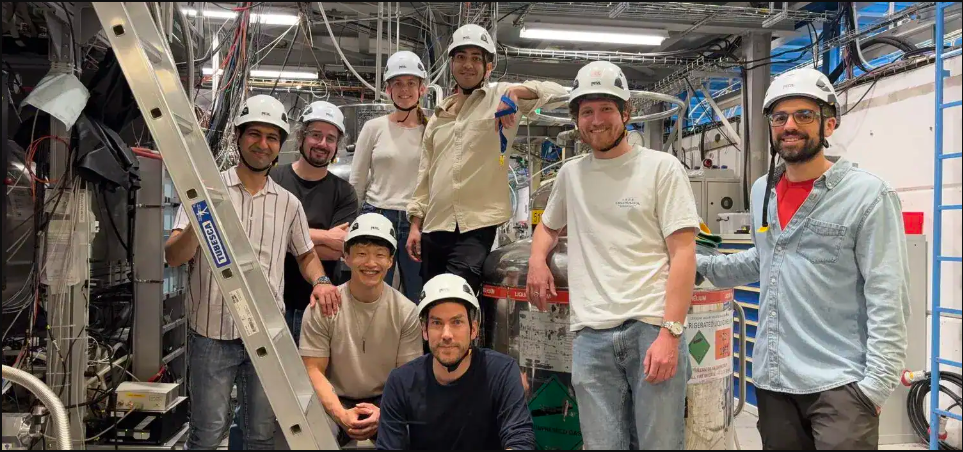
Antihydrogen tamers: ALPHA team members from the University of Calgary in Canada. Back row, left to right: Pouya Heidari, Reece Stefanyshyn, Abbygale Swadling, Filobateer Ghaly, Sean Wilson, and Alberto Jesus Uribe Jimenez. Front row: Jay Suh (left) and Timothy Friesen. (Photo courtesy of Jay Suh)
Antihydrogen, composed of an antiproton and a positron, is one of the simplest antimatter atoms. According to the Standard Model of particle physics, matter particles and their corresponding antimatter counterparts should have identical properties except for opposite electric charge and magnetic moment. However, the universe contains far less antimatter than matter, a phenomenon that remains a major unsolved problem in modern physics. High-precision measurements of antihydrogen are considered an important avenue for probing potential subtle differences between matter and antimatter.
The experiment was conducted at the ALPHA-2 antihydrogen apparatus in the Antiproton Decelerator facility at CERN. To prevent antihydrogen from annihilating upon contact with ordinary matter, the researchers confined the antimatter in a cylindrical Penning–Malmberg trap under ultrahigh vacuum conditions, using strong superconducting magnets to levitate it within the trap.
This study focused on the hyperfine splitting of antihydrogen. This phenomenon arises from the magnetic interaction between the spins of the antiproton and the positron, which splits the ground state of the positron in the antihydrogen atom into four sublevels. The ALPHA team applied microwave pulses in the 28 GHz to 31 GHz frequency range to induce positron spin-flip transitions between the relevant energy levels, and thereby determined the hyperfine splitting energy.
Timothy Friesen, a researcher at the University of Calgary in Canada, stated that the team advanced the precision of antihydrogen hyperfine splitting measurements to 4 ppm at a magnetic field of 1 tesla, bringing the matter–antimatter symmetry comparison between antihydrogen and ordinary hydrogen to one of the most precise levels to date.
The researchers noted that although this precision is already sufficient to enter the measurement range sensitive to antiproton structure, it still lags behind comparable measurements on ordinary hydrogen. The current results show no difference between antihydrogen and hydrogen, and existing physics models remain consistent with the experimental findings. The team's next steps include attempting to induce antiproton spin-flip transitions and combining them with laser cooling of antihydrogen samples to reduce errors from magnetic field inhomogeneities and spectral linewidth broadening, further improving measurement precision.
Disclaimer: Information republished from partner media, institutions or other websites is provided for reference and communication purposes only. It does not imply endorsement of its views or verification of its accuracy. Please contact us if any content infringes rights or requires correction.