
Japanese Team Discovers New Ordered State of "Electronic Chirality" in Uranium Compound
 Scan to share
The Japan Atomic Energy Agency and Tohoku University announced on July 28 that their research team has discovered a new electronic ordered state in the uranium compound URhSn, confirming for the first time in an actual material that even when the crystal structure itself lacks chirality, the arrangement of electrons within the material can spontaneously form “right-handed/left-handed” characteristics.
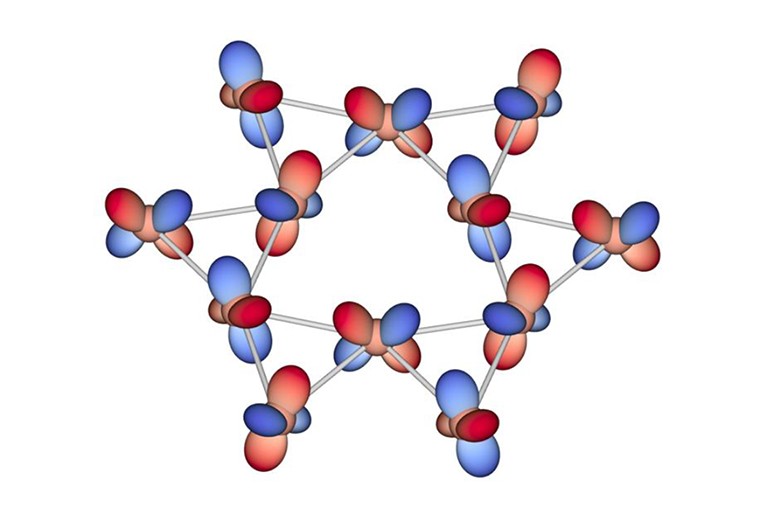
Chirality generally refers to the property where an object cannot perfectly coincide with its mirror image, such as left and right hands, screw thread directions, and the helical structure of DNA. In the past, material chirality was generally believed to originate from asymmetry in atomic arrangement. This study demonstrates, however, that chirality can also arise from the ordered arrangement of electron distributions.
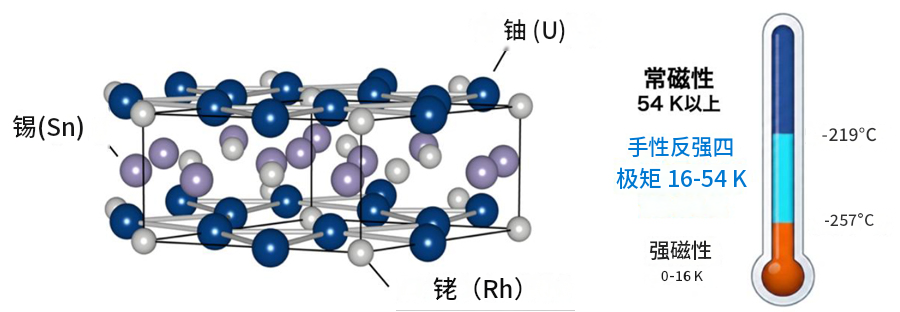
The research team used single-crystal samples of URhSn, composed of uranium, rhodium, and tin, and conducted a detailed analysis of their electronic states using nuclear magnetic resonance (NMR). The results showed that at low temperatures below -219°C (54 K), the electron distribution around uranium atoms exhibits directionality, with the overall arrangement displaying chiral characteristics, namely “chiral antiferro-quadrupolar ordering.”
The researchers noted that, unlike structural chirality, which requires atomic motion to switch between “left-handed” and “right-handed” properties, electron-derived chirality relies primarily on electronic responses and is theoretically more conducive to high-speed functional control through light, electric currents, or magnetic fields. This discovery is expected to open new directions for research on novel optical functional materials, spintronic materials, and next-generation quantum functional materials.
The findings were published online on July 20, 2026, and were selected as an Editor's Choice paper. The research team also stated that they will continue to explore methods for controlling electronic chirality and investigate whether similar properties exist in uranium-free materials.
Disclaimer: Information republished from partner media, institutions or other websites is provided for reference and communication purposes only. It does not imply endorsement of its views or verification of its accuracy. Please contact us if any content infringes rights or requires correction.