
New Progress in Ion Dynamics Regulation in Nanofluidic Memristors by the Institute of Modern Physics, Chinese Academy of Sciences
 Scan to share
Water-based nanofluidic ionic devices offer unique advantages in frontier fields such as brain-computer interfaces and biocompatible computing. Recently, the research team from the State Key Laboratory of Heavy Ion Science and Technology at the Institute of Modern Physics, Chinese Academy of Sciences, in collaboration with Lanzhou University, Hebei University of Geosciences, and other partners, successfully achieved stable ionic memristive effects in single-ion-track nanochannels. Through precise regulation, they realized programmable transitions in memristive and synaptic functions, providing a new technological pathway for the development of next-generation low-power neuromorphic computing hardware. The related results were published in the journal *Small* on July 22.
Using the microbeam single-ion irradiation and track etching techniques at the Heavy Ion Research Facility in Lanzhou (HIRFL), the researchers fabricated nanofluidic memristive devices with two configurations: single-conical nanochannels (SCN) and double-conical nanochannels (BCN). Experiments demonstrated that both types of devices exhibited excellent cycling stability, maintaining stable memristive performance after hundreds of switching cycles.
The study further revealed that by varying the ionic species (potassium, magnesium, and iron ions) in the electrolytes on both sides of the device, the memristor could flexibly switch among "unipolar," "bipolar," or "mixed" modes, and the memristive mode could undergo programmable transitions with changes in cation valence states and continuous voltage cycling. The research showed that ion accumulation and depletion mechanisms serve as the unified physical origin of memristive switching behavior and synaptic plasticity, a mechanism quantitatively validated by COMSOL multiphysics simulations.
In terms of energy efficiency, the energy consumption per single synaptic event of the device was only approximately 13.2 pJ. An artificial neural network training model achieved a recognition accuracy of 94.5% on the small-scale MNIST handwritten digit recognition task, validating the application potential of this nanofluidic memristive device in neuromorphic computing.
This work was supported by the Strategic Priority Research Program of the Chinese Academy of Sciences, the Major Science and Technology Project of Gansu Province, and the National Natural Science Foundation of China. The first author of this paper is Muhammad Jahangeer, a doctoral student at the University of Chinese Academy of Sciences, and the corresponding authors are Professor Wang Qi from Lanzhou University and Professor Du Guanghua from the Institute of Modern Physics, Chinese Academy of Sciences.
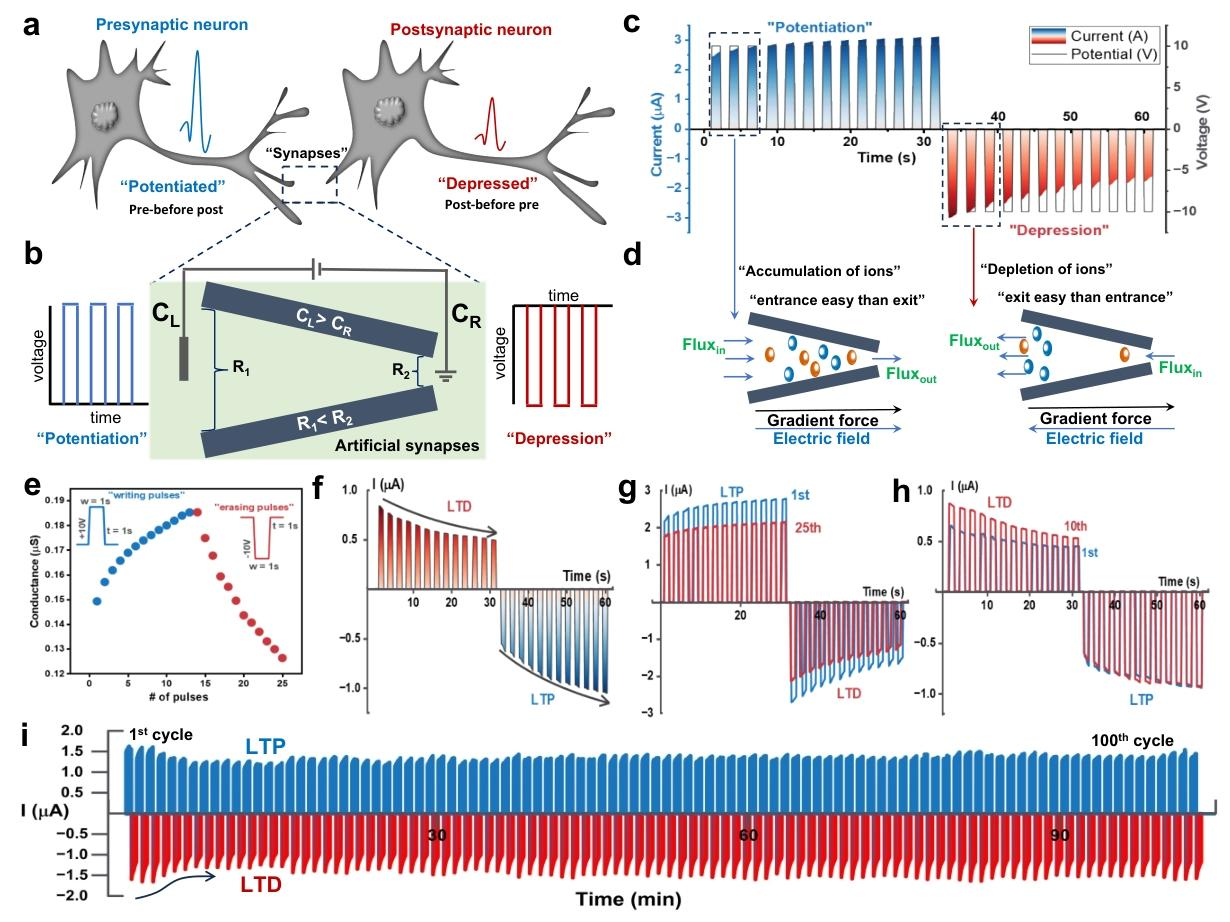
Figure: Evolution of synaptic potentiation and depression effects regulated by ion accumulation/depletion processes in nanofluidic memristors
Disclaimer: Information republished from partner media, institutions or other websites is provided for reference and communication purposes only. It does not imply endorsement of its views or verification of its accuracy. Please contact us if any content infringes rights or requires correction.