
New Progress in First-Principles Quantum Computing for Nuclear Structure
 Scan to share
Recently, the research team at the Institute of Modern Physics, Chinese Academy of Sciences, has made new progress in quantum computing studies of first-principles nuclear structure for multi-fermion systems. The team developed a universal quantum-classical hybrid computing framework capable of calculating Green's functions and spectral functions of nuclear many-body systems. The relevant results were published as a Letter in Physical Review C.
First-principles Hamiltonian many-body calculations are a core approach for revealing the laws of strongly correlated quantum systems, widely applied in fields such as quantum chemistry and nuclear physics. However, the Hilbert space of such problems grows exponentially with particle number, posing insurmountable computational resource limitations on classical computers. Quantum computing is expected to become a disruptive technology for overcoming this "exponential wall" challenge. Most existing quantum algorithms can only solve a limited set of energy levels such as the ground state, and cannot obtain the complete bound-state spectrum or key structural information such as angular momentum. In addition, traditional encoding schemes incur high circuit compilation overhead, severely restricting their application to realistic nuclear structure problems.
The theoretical physics research team at the Institute of Modern Physics, together with collaborators, proposed a novel quantum encoding scheme applicable to multi-fermion Hamiltonians. This scheme circumvents the enormous compilation overhead of traditional methods while fully preserving the intrinsic symmetries of the Hamiltonian itself, compressing the required number of quantum gates to the theoretical lower bound.
Building on this encoding scheme, the research team further constructed a quantum-classical hybrid computing framework capable of solving Green's functions and spectral functions of nuclear many-body systems. Based on the spectral function solving approach, the team designed a two-layer scanning strategy that can completely solve the full bound-state energy spectrum, including the energy and corresponding angular momentum of each bound state, circumventing the parameter optimization difficulties faced by variational quantum algorithms.
As a validation calculation, the researchers used the quantum algorithm with realistic nuclear interaction Hamiltonians to obtain the complete bound-state energy spectrum and corresponding total angular momentum quantum numbers of the oxygen-20 nucleus. The quantum simulation results based on classical simulators agree well with classical full configuration interaction calculations, and also show good consistency with experimental results. This framework combines universality and scalability, providing a new pathway for first-principles quantum computing of nuclear structure, and can be directly extended to studies of strongly correlated many-body problems across multiple fields.
This work was jointly completed by the Institute of Modern Physics, the Guangdong Provincial Laboratory of Advanced Energy Science and Technology, Iowa State University, and Lawrence Berkeley National Laboratory. The first author of the paper is Associate Researcher Du Weijie from the Institute of Modern Physics, and the corresponding author is Postdoctoral Researcher Liu Zixin from the Institute of Modern Physics. This research was supported by the Chinese Academy of Sciences Talent Program and the "Outstanding Youth" project of the Guangdong Provincial Laboratory of Advanced Energy Science and Technology.
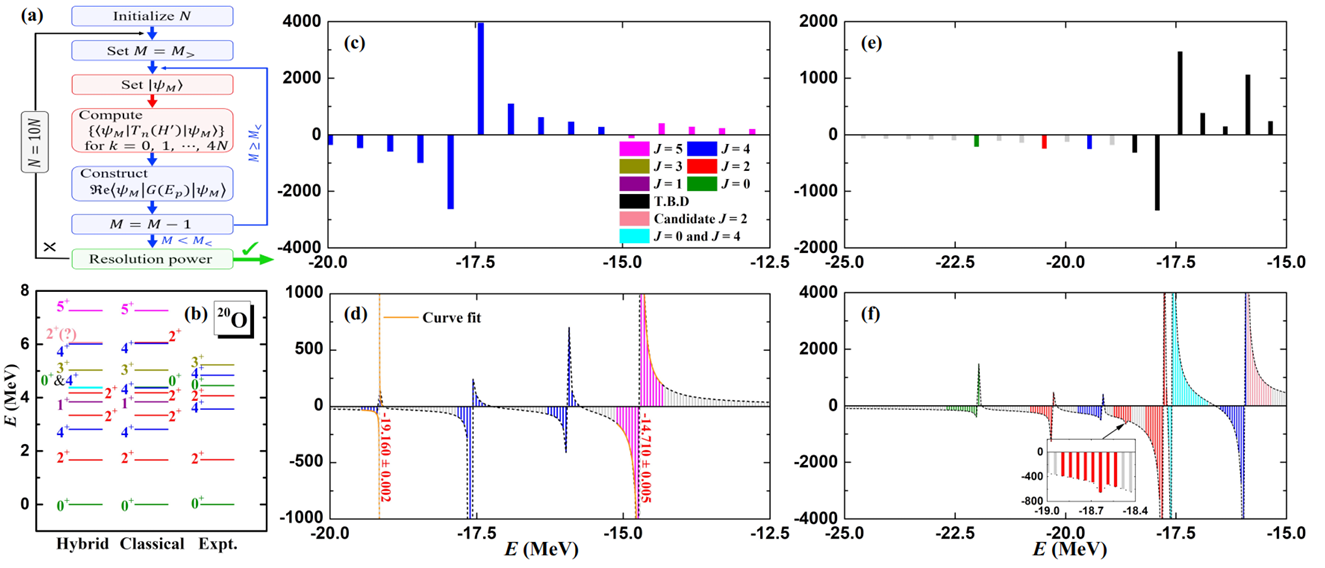
Figure: (a) Schematic diagram of the quantum-classical hybrid algorithm framework. (b) Excitation energies and total angular momentum J values of oxygen-20 energy eigenstates calculated using this framework, along with comparisons to classical full configuration interaction results and experimental values. (c-f) Schematic scans of the oxygen-20 spectral function at different total angular momentum projections and energy resolutions.
Disclaimer: Information republished from partner media, institutions or other websites is provided for reference and communication purposes only. It does not imply endorsement of its views or verification of its accuracy. Please contact us if any content infringes rights or requires correction.