
Global nuclear power generation hits record high in 2025, with net growth mainly driven by China
 Scan to share
According to the latest release of the Statistical Review of World Energy, global nuclear power generation reached 2,845 TWh in 2025, an increase of approximately 30 TWh from 2024, up 1.3% year-on-year, setting a new record. Among this, China's nuclear power generation increased by more than 34 TWh, becoming the primary source of net global nuclear growth.
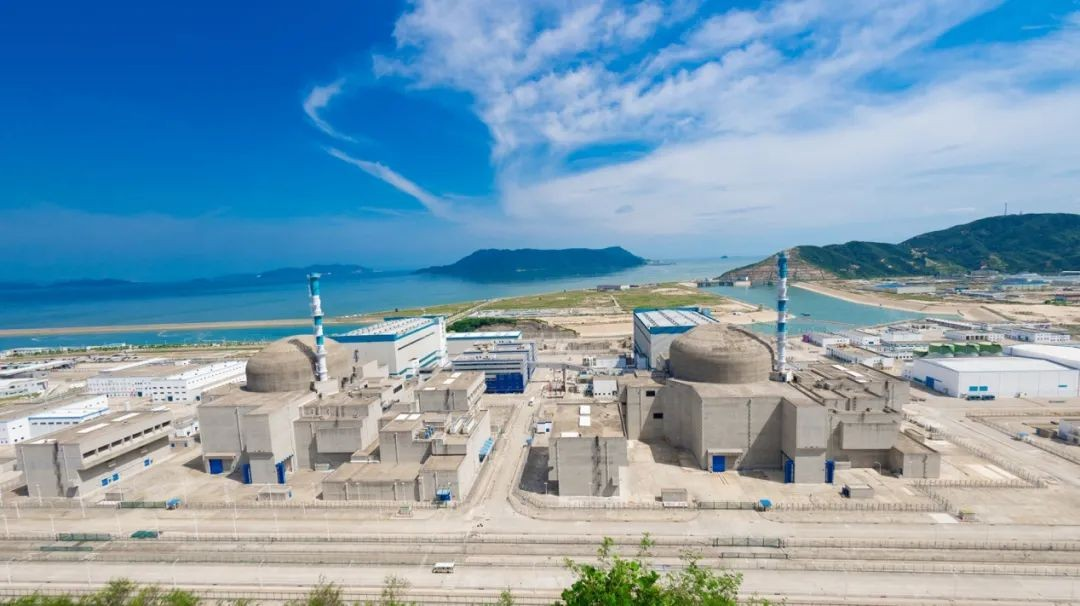
This record needs to be viewed within a longer timeframe. The previous peak in global nuclear power generation occurred in 2006, when it reached 2,803 TWh. In other words, although 2025 global nuclear power generation has surpassed the previous peak, the cumulative increase over 19 years is only about 1.5%, which does not indicate rapid expansion on a global scale.
Over the past decade, global nuclear power generation increased from 2,576 TWh in 2015 to 2,845 TWh in 2025, an increase of approximately 10.5%. During the same period, China's nuclear power generation rose from 171 TWh to 485 TWh, an increase of about 314 TWh, while global nuclear power generation saw a net increase of approximately 270 TWh. This means that, excluding China, nuclear power generation in the rest of the world in 2025 was approximately 44 TWh lower than a decade earlier.
By country, the United States remains the world's largest nuclear power producer. In 2025, U.S. nuclear power generation reached 826 TWh, accounting for about 29% of the global total; China ranked second with 485 TWh, representing 17.1%; France ranked third with 390 TWh, accounting for 13.7%. Russia, South Korea, Japan, and Canada also rank among the major nuclear power producers.
However, U.S. nuclear power generation has remained largely unchanged over the past decade. In 2015, U.S. nuclear power generation was 839 TWh, slightly higher than the 2025 level. In contrast, China's nuclear power generation nearly tripled over the decade, with an average annual growth rate of nearly 11%. If both countries maintain their recent growth trends, the gap in nuclear power generation between China and the United States will continue to narrow.
In addition to China, France and Japan also contributed to global nuclear growth in 2025. France's nuclear power generation increased by 9.6 TWh to reach 390 TWh, though still below its 2015 level. Japan's nuclear power generation increased by 9.2 TWh, up 11.1% year-on-year, reaching 94 TWh. Japan's nuclear output has recovered from the trough following the Fukushima accident but remains far below pre-accident levels; in 2010, Japan's nuclear power generation was approximately 292 TWh.
The regional landscape is also shifting. From 2015 to 2025, nuclear power generation in the Asia-Pacific region increased from approximately 420 TWh to nearly 845 TWh, doubling over the decade and now accounting for about 30% of global nuclear power generation. North America's nuclear power generation in 2025 was 921 TWh, lower than the 952 TWh recorded in 2015; Europe's nuclear power generation declined from 968 TWh in 2015 to 759 TWh in 2025, a decrease of nearly 22%.
The divergence between advanced and emerging economies is equally pronounced. Over the past decade, nuclear power generation in OECD member countries decreased by approximately 96 TWh, while non-OECD countries saw an increase of nearly 366 TWh. Although OECD countries still account for a significant share of global nuclear power generation, new growth is increasingly coming from regions such as Asia.
In terms of the global energy mix, the record-high nuclear power generation did not significantly raise nuclear energy's share of energy supply. In 2025, global nuclear energy supply reached 31.0 exajoules, up from 30.7 exajoules the previous year; during the same period, total global energy supply increased from 592.2 exajoules to 600.3 exajoules. As a result, nuclear energy's share of global energy supply edged down from 5.19% to 5.17%.
Data from the National Energy Administration shows that, as of now, mainland China has a total of 120 nuclear power units in operation or approved for construction, with a combined installed capacity of 135 GW, ranking first in the world in overall scale. Among these, 62 units are in operation with an installed capacity of 66.14 GW, ranking second globally; 58 units are approved for construction with an installed capacity of 69.51 GW, ranking first worldwide.
Overall, the record-breaking global nuclear power generation in 2025 largely reflects the pulling effect of China's continued nuclear expansion on the global total. The United States still holds the top position in nuclear power generation, but its output has remained largely stable over the long term; Europe remains below its level of a decade ago; and Asia, particularly China, is becoming the main center of global nuclear growth.
Disclaimer: Information republished from partner media, institutions or other websites is provided for reference and communication purposes only. It does not imply endorsement of its views or verification of its accuracy. Please contact us if any content infringes rights or requires correction.