
Researchers at the Institute of Modern Physics, Chinese Academy of Sciences, reveal the dual-directional role of shell effects in multinucleon transfer reactions
 Scan to share
Recently, the research team from the State Key Laboratory of Heavy Ion Science and Technology at the Institute of Modern Physics, Chinese Academy of Sciences, together with collaborators, revealed the dual-directional mechanism of shell effects in multinucleon transfer reactions and proposed optimized reaction systems. This study provides new insights for the efficient synthesis of neutron-rich nuclides in the laboratory. The results were published in Physics Letters B.
The synthesis and study of neutron-rich nuclides near the neutron magic number 126 are of special scientific significance, as the properties of these nuclides are directly related to how heavy elements such as gold and platinum in the universe are formed. However, efficiently producing these nuclides has long been an experimental challenge. Traditional methods such as fusion-evaporation, fission, and projectile fragmentation are difficult to effectively reach this neutron-rich region, while multinucleon transfer reactions, as an alternative pathway, have attracted widespread attention in recent years.
Shell effects are a key factor influencing the dynamics of multinucleon transfer reactions, but their mechanism of action is not yet fully understood. To this end, the researchers developed relevant theoretical models, systematically tracking the evolution of shell effects throughout the entire process from nucleon exchange to fragment de-excitation by introducing a deformation-dependent mass formula and a scaling factor that allows continuous adjustment of shell correction strength.
The researchers systematically calculated the reaction rates of xenon-136 bombarding three target nuclei: lead-208, mercury-204, and mercury-208. The study found that shell effects play a "double-edged sword" role: for products with few transferred nucleons near the entrance channel, shell effects enhance their yields; however, for neutron-rich products requiring the transfer of a large number of nucleons, shell effects strongly suppress their production. This suppression is most pronounced for the doubly magic nucleus lead-208 target.
Based on this understanding, the researchers proposed avoiding magic-number nuclei as collision partners, recommending the use of non-magic target nuclei and suggesting the "uranium-238 bombarding mercury-204" reaction system. Calculations show that this reaction can significantly enhance the probability of synthesizing neutron-rich nuclides such as iridium-203 and osmium-202, providing a clear candidate scheme for future experiments.
This study not only reveals the mechanism of shell effects in multinucleon transfer reactions but also provides important references for the experimental synthesis of neutron-rich nuclides and for unraveling the origin of heavy elements in the universe.
The first author of the paper is Dai Fanchao, assistant researcher at the Institute of Modern Physics; the corresponding authors are Xu Xinxing, researcher at the Institute of Modern Physics, Wen Peiwei, associate researcher, and Lin Chengjian, researcher, both from the China Institute of Atomic Energy. This work was supported by the National Natural Science Foundation of China, the National Key Research and Development Program, and the Strategic Priority Research Program of the Chinese Academy of Sciences.
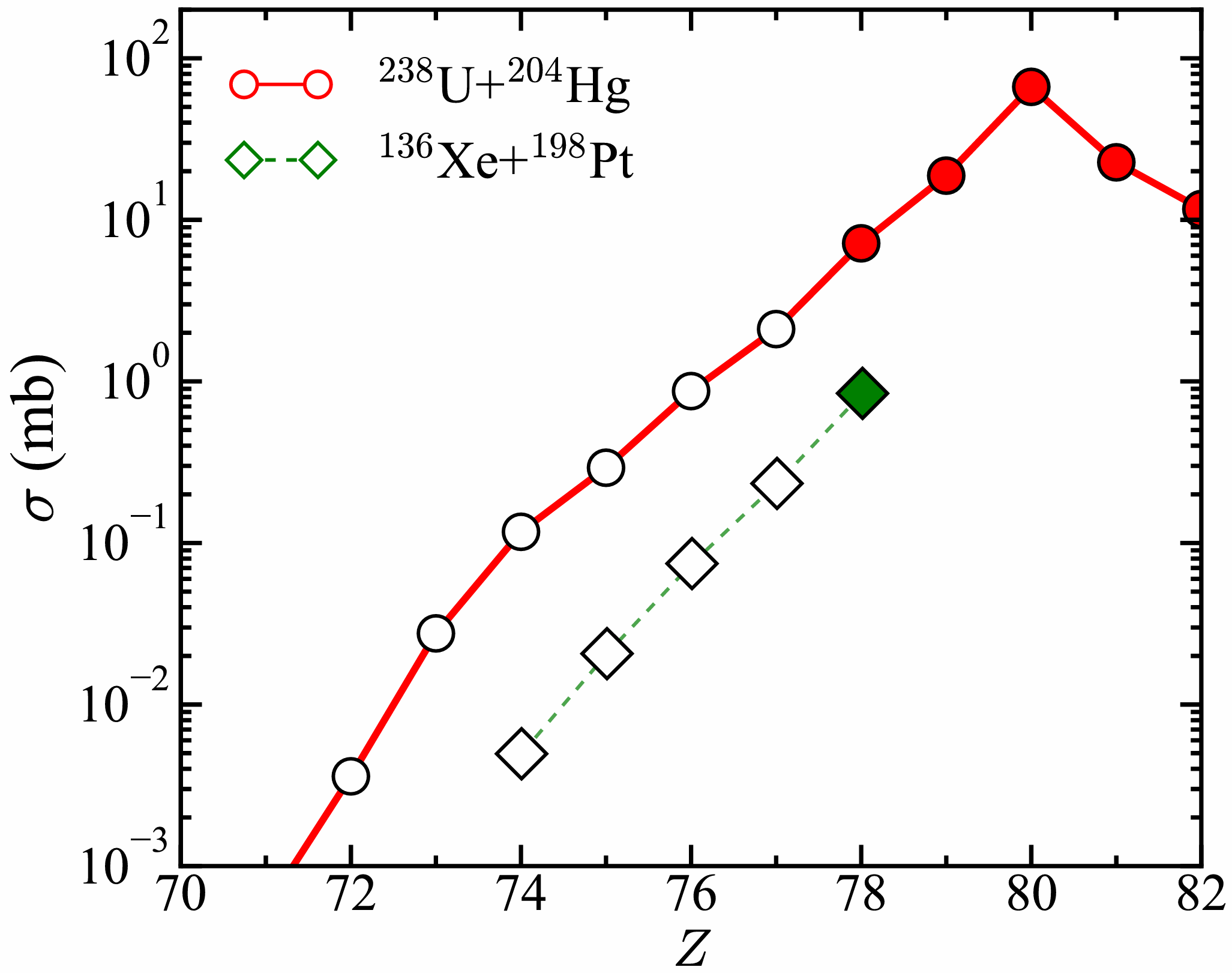
Figure 1: Comparison of predicted cross sections (red) for N = 126 isotones produced by 238U+204Hg with experimental data (green) from 198Pt+136Xe. (Source/Physics Letters B)
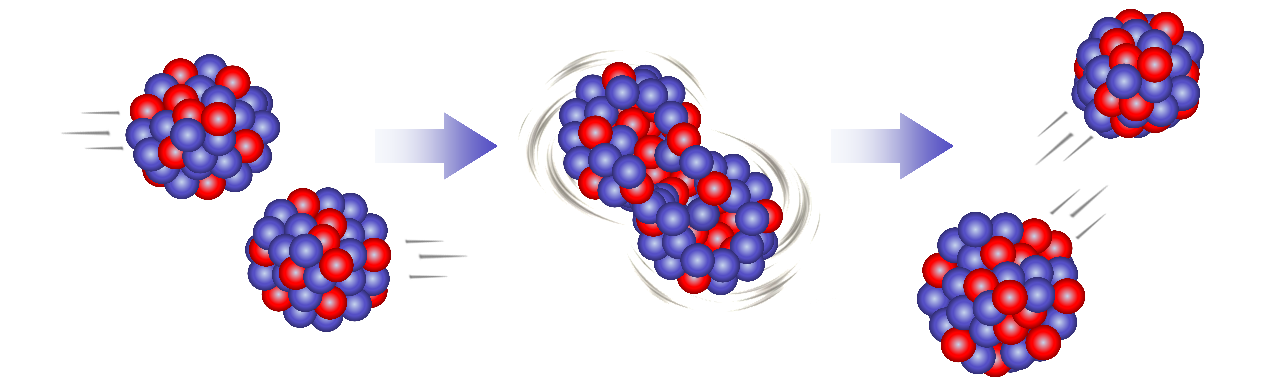
Figure 2: Schematic diagram of a multinucleon transfer reaction. Two nuclei approach each other (left), briefly combine and exchange nucleons (middle), and separate (right). (Figure/Dai Fanchao)
Disclaimer: Information republished from partner media, institutions or other websites is provided for reference and communication purposes only. It does not imply endorsement of its views or verification of its accuracy. Please contact us if any content infringes rights or requires correction.