
BESIII Experiment First Confirms the Existence of Glueballs
 Scan to share
On August 6, Beijing time, the international collaboration of the Beijing Spectrometer III experiment (BESIII) at the Beijing Electron-Positron Collider announced at the International Conference on High Energy Physics (ICHEP 2026) held in Brazil, in the form of a special plenary report: after 15 years of sustained research, the BESIII experiment has established a complete chain of evidence proving the existence of glueballs, unraveling the mystery that has puzzled the academic community for nearly half a century. This discovery not only provides a decisive validation of the theory of "quantum chromodynamics," but also demonstrates the existence of a completely new form of matter—matter composed purely of "force."
Atomic nuclei are composed of protons and neutrons, which in turn are composed of quarks. Gluons mediate the strong interaction between quarks, just as photons mediate the electromagnetic interaction. However, the unique feature of gluons is that photons do not attract each other, whereas gluons do. Therefore, gluons can attract one another to form a new type of particle—the glueball.
In the physics theory describing the strong interaction, "quantum chromodynamics," the glueball is an extremely important prediction because it is the only particle composed of "force carriers." However, for half a century, experiments have failed to find the glueball. Whether glueballs exist is a critical test of this physics theory and remains one of the major unresolved scientific questions to this day.
The Beijing Electron-Positron Collider can produce large quantities of the J/psi particle discovered by Samuel C.C. Ting. This particle decays almost instantaneously into other lighter particles after production. Theoretically, the decay process of J/psi is highly favorable for the production of glueballs, making it one of the best avenues for searching for glueballs. The experimental search for glueballs has also been one of the primary physics goals of the Beijing Electron-Positron Collider for decades.
In 2011, the BESIII collaboration discovered a new particle, X(2370), in the decay products of J/psi, suspected to be a glueball. After 13 years of effort, they successfully determined the spin and parity quantum numbers of X(2370) in 2024 using 10 billion J/psi particles. Its mass is in complete agreement with the theoretical prediction of lattice quantum chromodynamics for a glueball with the same quantum numbers, marking a crucial step toward confirming its true identity.
Recently, a research team co-led by Professor Jin Shan from Nanjing University and Researcher Huang Yanping from the Institute of High Energy Physics, Chinese Academy of Sciences, has taken another major step forward: they discovered multiple new decay modes of the X(2370) particle and, for the first time, measured another key "identity characteristic"—its "flavor singlet" nature.
The "flavor singlet" nature is the most important characteristic of a glueball. Ordinary particles such as protons and neutrons contain quarks of different "flavors," such as up quarks, down quarks, and strange quarks, whereas a glueball is composed purely of gluons and carries no "flavor" information, making it a "flavor singlet." The latest experimental results have successfully determined that X(2370) is a "flavor singlet."
At this point, through a series of studies spanning 15 years, the BESIII experiment has established a complete chain of experimental evidence—from mass and quantum numbers to "flavor singlet" nature—confirming that the primary component of X(2370) is indeed the glueball that physicists have been searching for for nearly half a century.
This is the most definitive experimental result in the search for glueballs in nearly five decades. It not only clearly validates the major theoretical prediction that "gluons can self-bind to form new forms of matter," but also demonstrates the unique advantages of the Beijing Electron-Positron Collider in studying the strong interaction. Since the major upgrade of the Beijing Electron-Positron Collider was completed in 2008, the BESIII detector has accumulated more than 10 billion J/psi events, establishing itself as the undisputed world leader in the tau-charm energy region. This discovery is a paradigm of the trinity of sustained accumulation, precision measurement, and international collaboration.
It is reported that the International Conference on High Energy Physics is a biennial global conference, and special plenary reports are only added for particularly significant announcements.
Beijing Spectrometer III (BESIII) is a large particle physics detector operating at the Beijing Electron-Positron Collider (BEPCII), with an international collaboration comprising approximately 700 scientists from about 96 research institutions across 15 countries. The experiment focuses on precision physics research in the tau-charm energy region and has achieved a series of world-leading results in hadron spectroscopy, charm physics, tau physics, and searches for new physics. The efficient work of the BESIII detector and BEPCII accelerator operation and maintenance teams during data collection, as well as the BESIII offline software team and the Computing Center of the Institute of High Energy Physics, Chinese Academy of Sciences, during data analysis, provided the foundation for this discovery.
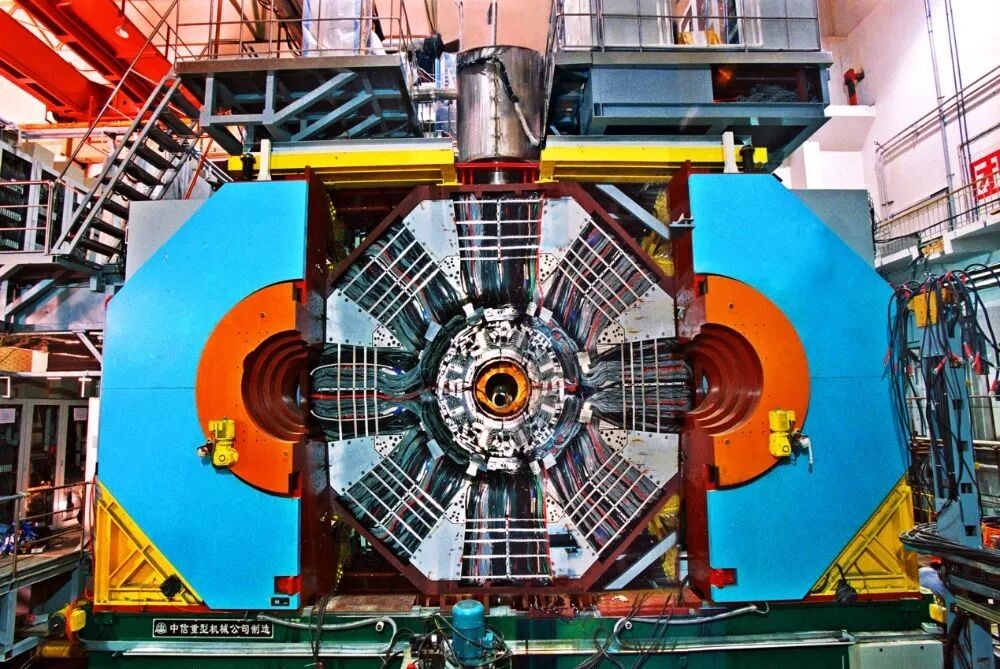
Beijing Spectrometer III (BESIII): Beijing Spectrometer III (BESIII) detector
Disclaimer: Information republished from partner media, institutions or other websites is provided for reference and communication purposes only. It does not imply endorsement of its views or verification of its accuracy. Please contact us if any content infringes rights or requires correction.