
University of Kansas Receives DOE Funding to Build New-Generation Detectors for CERN's Large Hadron Collider
 Scan to share
A particle detector development project led by the University of Kansas has recently received funding from the U.S. Department of Energy's "Established Program to Stimulate Competitive Research" (DOE EPSCoR). The project, funded at $1 million, will be used to design and build two High-Luminosity Zero Degree Calorimeters (HL-ZDC) for the Compact Muon Solenoid experiment (CMS) at CERN's Large Hadron Collider (LHC).
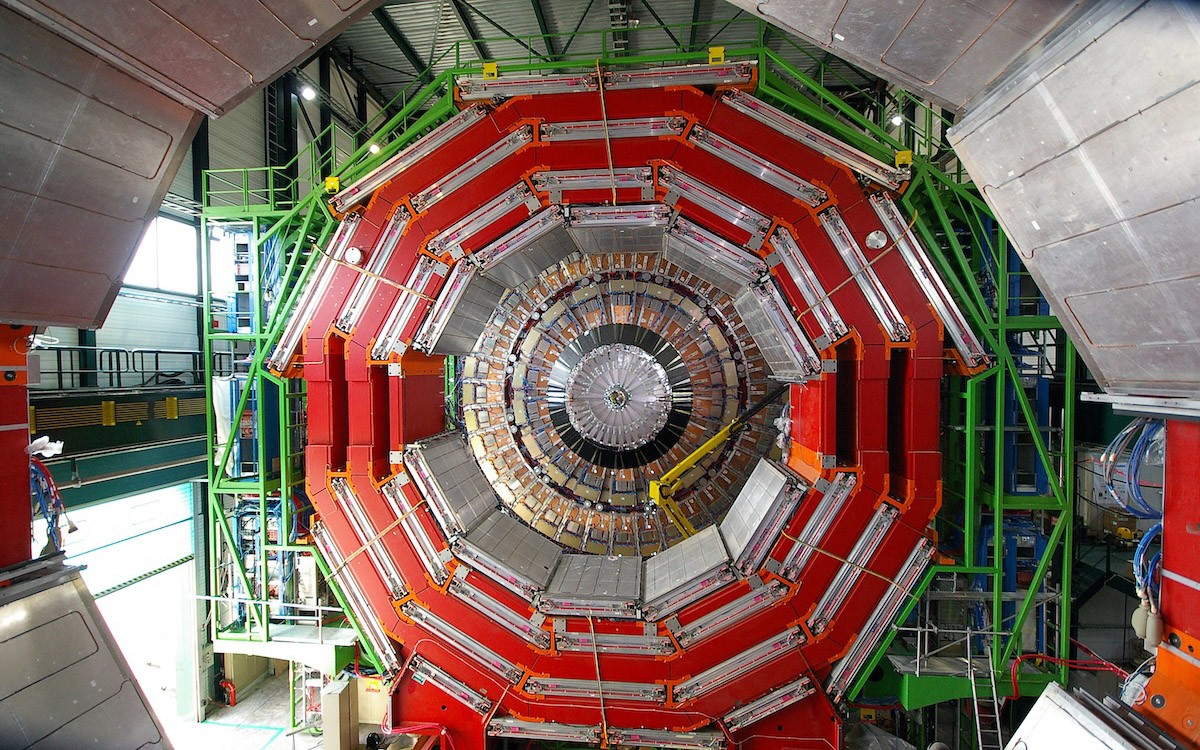
The four-year project is co-led by Michael Murray, professor in the Department of Physics and Astronomy at the University of Kansas, and Christophe Royon, distinguished professor at the University of Kansas. Murray also serves as the project lead for the CMS High-Luminosity Zero Degree Calorimeter upgrade. Georgios Krintiras, a postdoctoral researcher at the University of Kansas, will participate in the development of detector data reconstruction software.
According to the plan, the two HL-ZDC detectors will be manufactured and assembled at the University of Kansas Mechanical Prototype Laboratory, then shipped to Fermi National Accelerator Laboratory for testing with high-energy particle beams. After testing is completed, the detectors will be transported to CERN and integrated into the CMS calorimeter system for heavy-ion physics research during the High-Luminosity Large Hadron Collider phase. The first heavy-ion data collection for this phase is currently scheduled to begin in mid-2030.
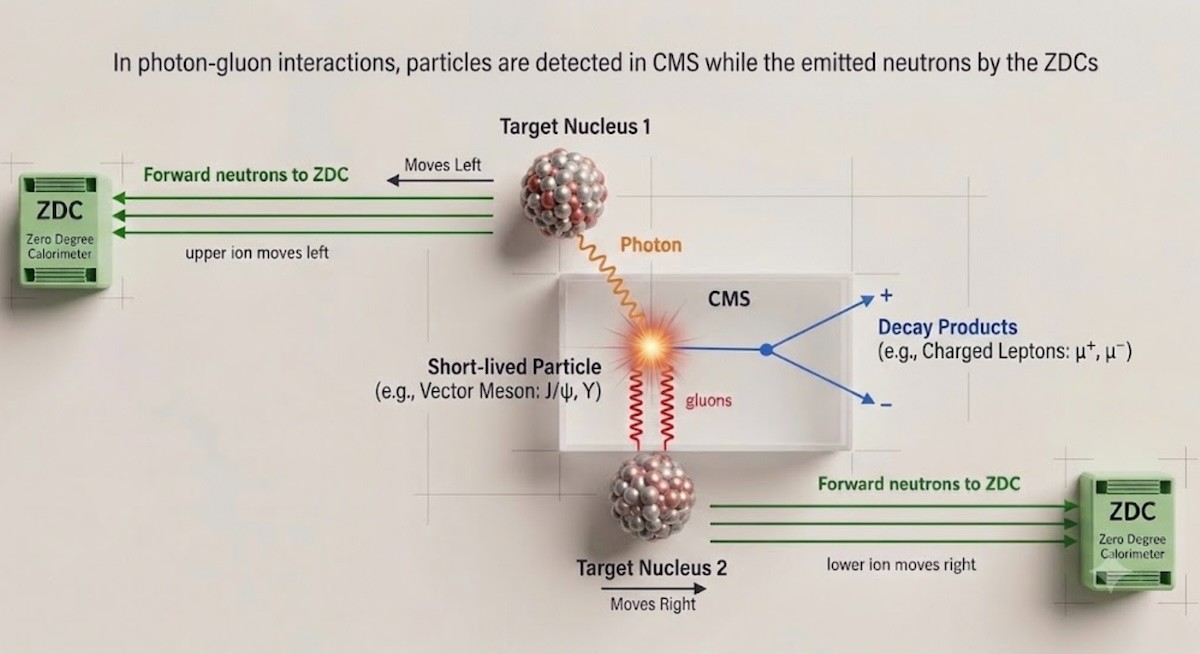
HL-ZDC detector interacting with particle beams. Image courtesy of Georgios Krintiras
The Zero Degree Calorimeters are installed on both sides of the CMS beam line, primarily used to detect high-energy neutrons and photons escaping along the beam direction. Through these measurements, physicists can reconstruct collision types. For example, in lead-nucleus collisions, the number and distribution patterns of forward-moving neutrons can help determine whether the nuclei underwent a near head-on collision or a grazing interaction. This type of information is of great significance for studying the quark-gluon plasma, an extremely high-temperature state of matter believed to have existed during the first few millionths of a second after the universe's birth. Additionally, these data help identify ultra-peripheral collisions, in which nuclei interact through strong electromagnetic fields.
The University of Kansas Particle Physics Laboratory previously built the conventional Zero Degree Calorimeters used in the CMS experiment and supported heavy-ion research during the first three operational runs of the Large Hadron Collider. With the arrival of the High-Luminosity Large Hadron Collider phase, the experimental environment will become more demanding: higher radiation levels, shorter collision intervals, and less available space for detectors. Therefore, the new-generation HL-ZDC needs to feature a more compact structure, faster response times, and enhanced radiation resistance.
The project team stated that this funding will also provide University of Kansas students with full-cycle research training covering detector fabrication, beam testing, simulation analysis, and software development. Students and researchers will collaborate with Fermilab experts and receive relevant training through the Fermilab LHC Physics Center, preparing for data collection and analysis work after the High-Luminosity Large Hadron Collider begins operation. This project will also further strengthen collaboration between the University of Kansas and Fermilab in nuclear and particle physics detector technologies.
Disclaimer: Information republished from partner media, institutions or other websites is provided for reference and communication purposes only. It does not imply endorsement of its views or verification of its accuracy. Please contact us if any content infringes rights or requires correction.