
Dark Energy Survey Releases Six-Year Results: Data from 669 Million Galaxies Helps Constrain Cosmic Accelerated Expansion
 Scan to share
On August 4, the Dark Energy Survey (DES) project released its six-year findings on dark energy detection. The project compiled 18 related papers, based on nearly 300,000 astronomical images captured between 2013 and 2019, recording information on 669 million galaxies, thousands of galaxy clusters, and more than 3,000 supernovae to study the accelerated expansion of the universe and the evolution of cosmic structure.
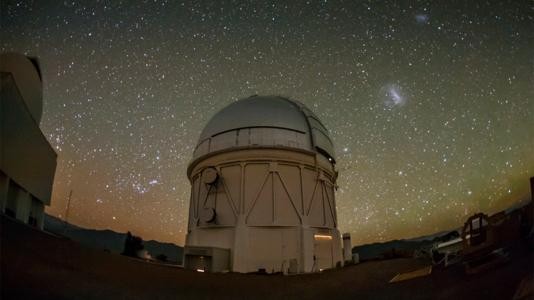
To carry out DES, Fermi National Accelerator Laboratory built an extremely sensitive 570-megapixel digital camera, DECam, and installed it on the Blanco 4-meter telescope at the National Science Foundation's Cerro Tololo Inter-American Observatory in the Chilean Andes. (Image courtesy of Reidar Hahn/Fermi National Accelerator Laboratory.)
Dark energy is thought to make up about 70% of the universe and is the invisible force driving its accelerated expansion. Since it cannot be directly imaged, scientists primarily detect it through its effects on the expansion history of the universe and the growth of large-scale structure. The DES results show that dark energy behaves like a constant, unchanging force, what physicists call the "cosmological constant"; the expansion history of the universe is consistent with the standard cosmological model, which holds that the universe consists of roughly 70% dark energy, 25% dark matter, and 5% ordinary matter.
DES conducted observations using the 570-megapixel Dark Energy Camera (DECam) mounted on the Blanco 4-meter telescope at the Cerro Tololo Inter-American Observatory in Chile. DECam was built under the leadership of Fermi National Accelerator Laboratory, with Argonne National Laboratory contributing approximately 20% of the camera's mechanical engineering and design work, including the camera control system, shutter control system, and the cooling system used to stabilize the charge-coupled devices (CCDs).
In terms of scientific support, Argonne National Laboratory used its Advanced Photon Source (APS), a synchrotron X-ray light source, to perform detailed characterization of DECam's CCD imaging sensors to test their uniformity. The CCD sensors are critical for obtaining stable, clear images of distant, faint galaxies, directly impacting the precision of weak gravitational lensing measurements.
Weak gravitational lensing is one of DES's key observational techniques. This method infers the distribution of invisible matter by measuring the tiny distortions in light from distant galaxies as it passes through the cosmic web of matter. Argonne National Laboratory also led DES's weak gravitational lensing analysis and participated in developing the "metacalibration" method, which simulates variations in weak lensing shear signals using actual survey data to reduce instrument bias and improve measurement precision.
The DES collaboration brings together more than 400 astrophysicists from 35 institutions across 7 countries. The project comprehensively uses four observational techniques—baryon acoustic oscillations, Type Ia supernovae, galaxy clusters, and weak gravitational lensing—making it the first survey to employ all four detection methods simultaneously within a single coordinated program.
The results will also provide a methodological foundation for next-generation dark energy research. The Legacy Survey of Space and Time (LSST), supported by the National Science Foundation and the U.S. Department of Energy and conducted at the Vera C. Rubin Observatory in Chile, began full operations in June and plans to capture millions of images of the southern hemisphere sky over ten years. Argonne National Laboratory scientists will continue to contribute to the development of LSST data analysis tools and theoretical models to advance research on dark energy and dark matter.
Disclaimer: Information republished from partner media, institutions or other websites is provided for reference and communication purposes only. It does not imply endorsement of its views or verification of its accuracy. Please contact us if any content infringes rights or requires correction.