
Seoul National University NEXFO Workshop: Exploring Sustainable Solutions for SMR and MMR
 Scan to share
On August 7, the Nuclear Policy Center at Seoul National University's Institute for Future Nuclear Energy Policy announced that it will host the "Nuclear Energy Sustainability NEXFO Workshop" on the afternoon of September 16 at the Seoul National University Global Engineering Education Center. The event, coinciding with the center's 10th anniversary, is themed "Embracing the Era of Full-Scale SMR·MMR Deployment" and will discuss the policy, industrial, and technological conditions for the commercialization of small modular reactors and micro modular reactors.
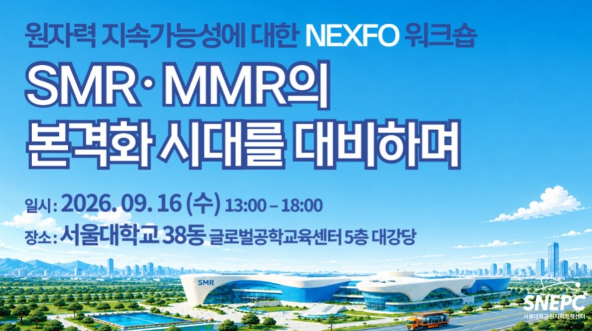
The workshop will first revisit the public discourse framework on nuclear energy sustainability, and analyze global nuclear fuel cycle trends as well as the domestic challenges facing South Korea. As SMRs and MMRs transition from technology demonstration to practical application, nuclear fuel supply, spent fuel management, and long-term policy stability have become critical factors affecting project implementation, and are also central to whether nuclear energy can be integrated into a more robust energy system in the context of carbon neutrality.
The afternoon breakout sessions will further focus on nuclear fuel cycle and safety regulation. Participating researchers will discuss spent fuel management policy directions, trends in improving nuclear safety regulatory systems in South Korea and the United States, and the role of regulatory support and policy coordination mechanisms in advanced reactor development. In addition, the improvement of nuclear power design, manufacturing, and supply chain management systems has been placed on the agenda, reflecting that South Korea's nuclear power industry is shifting from single-technology R&D to systematic industrial capacity building.
Another discussion group will center on energy policy, economics, and future technologies, including economic assessments of different power generation sources, system levelized cost of electricity, optimal energy mixes under carbon neutrality targets, and nuclear power utilization strategies. U.S. nuclear energy foreign policy, next-generation nuclear technology development trends, and export industrialization strategies will also be key agenda items, reflecting that South Korea, in advancing SMR and MMR development, is not only focused on domestic energy security but also seeks to shape them into an export industry with international competitiveness.
The significance of this workshop lies in bringing together the nuclear fuel cycle, safety regulation, economics, supply chain, and export policy required for SMR and MMR commercialization within a single framework of discussion. For South Korea's nuclear power industry, future competitiveness depends not only on reactor technology itself, but also on whether the regulatory system can be adjusted in tandem, whether executable solutions for spent fuel can be formulated, whether the manufacturing supply chain can expand stably, and whether overseas market strategies can align with the international nuclear policy environment.
Disclaimer: Information republished from partner media, institutions or other websites is provided for reference and communication purposes only. It does not imply endorsement of its views or verification of its accuracy. Please contact us if any content infringes rights or requires correction.