
First Observation of Anti-Kaonic Nuclei in Photon Beam Experiments
 Scan to share
The "LEPS2/Solenoid collaboration," composed of researchers from the Research Center for Nuclear Physics at Osaka University, Kyoto Sangyo University, the Research Center for Advanced Quantum Beam Science at Tohoku University, Korea University, Gifu University, the Institute of Modern Physics of the Chinese Academy of Sciences, RIKEN, Kyoto University, the Institute of Physics at Academia Sinica in Taiwan, and the University of Saskatchewan in Canada, has for the first time observed nuclei containing anti-kaons in a photon beam experiment. This achievement provides new experimental evidence confirming the existence of anti-kaonic nuclei and offers important clues for understanding high-density nuclear matter and the internal structure of neutron stars.
The research team conducted the experiment at the LEPS2 laser-electron photon facility at the large synchrotron radiation facility SPring-8 in Hyogo Prefecture, Japan, using a large solenoid spectrometer to observe reactions following photon-deuteron collisions. In the experiment, high-energy gamma rays of 1.3 to 2.4 GeV, produced via Compton scattering of ultraviolet laser light with 8 GeV high-energy electrons, were used as the photon beam and directed onto a liquid deuterium target. Charged particles were identified by measuring their momenta and energies.
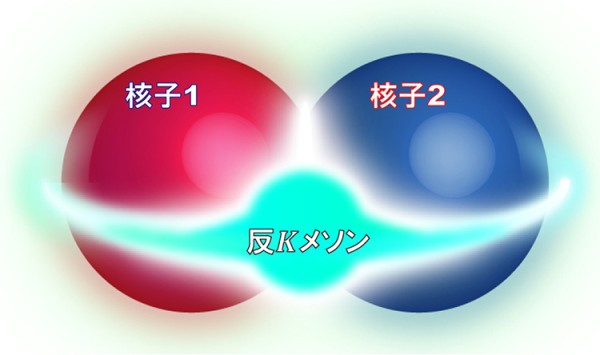
The anti-kaon intervenes, binding protons and neutrons (collectively called nucleons) in the nucleus firmly together like glue
Ordinary nuclei are composed of protons and neutrons, and the binding between protons and neutrons is typically described by pion-mediated interactions. Anti-kaons are a class of mesons containing s quarks and are thought to be able to enter the interior of nuclei, binding nucleons more strongly together like "glue," thereby forming a special state more compact than ordinary nuclei. Previously, anti-kaon beam experiments at J-PARC had reported candidate signals, but whether this state could be confirmed under different reaction mechanisms remained a key question.
In this experiment, anti-kaonic nuclei were successfully produced and observed in photon-deuteron collisions that do not contain s quarks, demonstrating that anti-kaons can play an important role in forming bound states of nuclei. The study also distinguished signal events from background events using the momentum distributions of Lambda hyperons and protons. The results indicate that the two nucleons in the produced anti-kaonic nuclei may be bound more tightly than those in an ordinary deuteron.
The research team believes that this observation corroborates the previous J-PARC experimental results, further strengthening the possibility of the existence of anti-kaonic nuclei. Since the interaction between anti-kaons and nucleons is considered to be closely related to the properties of high-density nuclear matter, this achievement is expected to advance research on the state of matter inside extreme celestial objects such as neutron stars.
The research results were published on July 9 in the international physics journal *Physics Letters B*. The paper is titled "Evidence for a KNN quasi-bound state in the γd→KΛp reaction".
The anti-kaon intervenes, binding protons and neutrons (collectively called nucleons) in the nucleus firmly together like glueDisclaimer: Information republished from partner media, institutions or other websites is provided for reference and communication purposes only. It does not imply endorsement of its views or verification of its accuracy. Please contact us if any content infringes rights or requires correction.