
Japanese research team demonstrates ion wakefield acceleration for the first time, accelerating protons to a maximum of 60 MeV
 Scan to share
Kyushu University, the National Institutes for Quantum Science and Technology (QST), and Osaka University recently announced jointly that the research team used high-intensity laser irradiation on a foam target to experimentally demonstrate the "ion wakefield acceleration" mechanism for the first time, providing a new experimental foundation for research on next-generation laser-driven ion accelerators. The results were published in *Communications Physics* on August 3, Japan time.
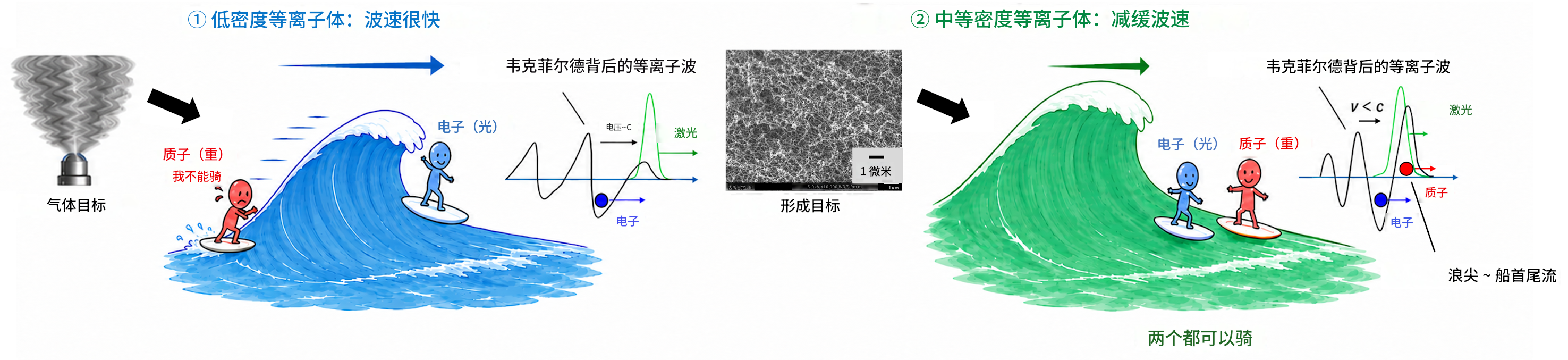
According to the report, the research aims to reproduce physical processes similar to high-energy particle acceleration in space within a laboratory setting. Traditional high-energy accelerators typically require long acceleration tubes or large ring-shaped facilities, while the strong electric fields generated by plasma waves are considered promising for advancing accelerator miniaturization. However, compared with electrons, protons and ions have larger masses and are difficult to capture and efficiently accelerate in the rapidly propagating plasma wakefield, which has long been a major challenge in this field.
The research team used the high-intensity laser facility J-KAREN-P at the Kansai Institute of the National Institutes for Quantum Science and Technology to irradiate a sponge-like foam target with a thickness of 100 micrometers. By adjusting the density of the foam target, the researchers reduced the phase velocity of the plasma wave propagating with the laser, enabling nearly stationary protons to be captured by the strong electric field formed at the laser front and accelerated along with the plasma wave. In the experiment, protons were accelerated to a maximum energy of 60 MeV.
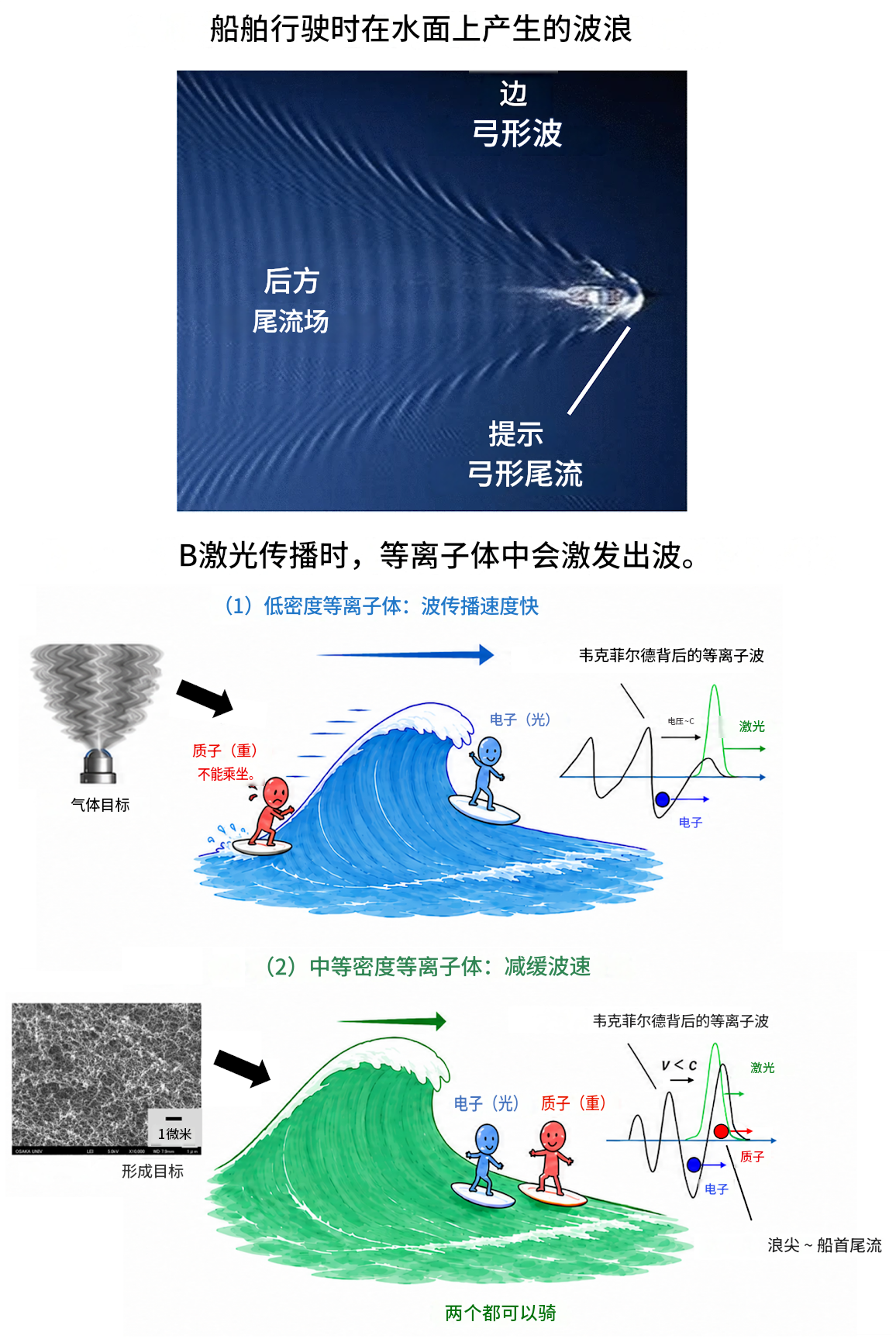
This acceleration process is referred to as "bow-wave wakefield acceleration." When a laser passes through a higher-density plasma, electrons accumulate ahead of the laser, forming a localized strong charge-separation electric field; after protons are captured by this electric field, they continuously gain energy in the wakefield co-propagating with the laser. The research team believes that this mechanism shares similarities with processes that may exist in cosmic ray acceleration, also providing a means to study particle acceleration conditions in space within a laboratory.
As a next step, the research team plans to develop a two-stage acceleration scheme: first using a first laser beam to pre-accelerate ions, then injecting them into the wakefield generated by a second laser beam for further acceleration. Research goals include verifying the principle of further accelerating ions from tens of MeV to several hundred MeV, and conducting higher-intensity laser experiments with the ELI-NP facility in Romania and the Apollon facility in France to explore the possibility of generating GeV-level relativistic ions. In the future, this mechanism is expected to develop into a multi-stage laser-driven ion acceleration system for producing higher-energy ion beams.
Disclaimer: Information republished from partner media, institutions or other websites is provided for reference and communication purposes only. It does not imply endorsement of its views or verification of its accuracy. Please contact us if any content infringes rights or requires correction.