
LLNL Research in the U.S. Reveals New Mechanisms of Laser Polarization Effects in NIF Inertial Confinement Fusion Experiments
 Scan to share
Researchers at Lawrence Livermore National Laboratory (LLNL) have recently discovered in studies related to the National Ignition Facility (NIF) that the polarization state of lasers may influence the cross-beam energy transfer (CBET) process in inertial confinement fusion experiments and could help reduce backscatter and the risk of damage to optical components. The related paper, titled "Effects of Laser Polarization on Cross-Beam Energy Transfer in Inertial Confinement Fusion," was recently published as a featured article in the journal Physics of Plasmas.
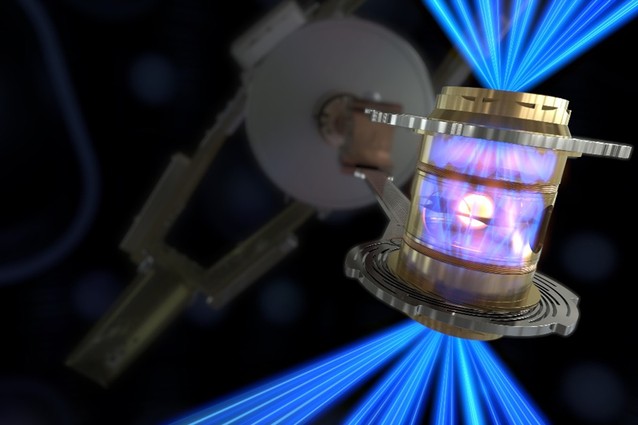
NIF experiments demand extremely high precision in laser control. The facility's 192 laser beams must be focused to a width of a few millimeters and enter the target area through holes approximately 3 millimeters in diameter located at the top or bottom of a gold hohlraum. The hohlraum is about 2 centimeters in diameter. After the lasers enter the plasma, different beams cross each other and undergo energy transfer, a process known as cross-beam energy transfer. When designing NIF inertial confinement fusion experiments, scientists carefully tune the laser wavelengths to use CBET to balance energy distribution and improve implosion symmetry.
The research team focused on the question: what would happen to experimental results if not only the laser wavelength but also the laser polarization state were changed? Pierre Michel, lead author of the paper and a physicist at LLNL, stated that changing the polarization state could make optical components more resistant to filamentation damage, but it also requires evaluating the impact of this change on other aspects of the experiment. In analyzing the CBET effects, the researchers found that circularly polarized light could lead to less backscatter, thereby reducing the risk of damage to optical components.
In the NIF hohlraum, laser beams entering at the same angle form cone regions where cone-to-cone beam energy transfer occurs. If the energy differences between beams within the same cone become too large, it may induce backward scattering instabilities, which in turn could exacerbate damage to the NIF optical system.
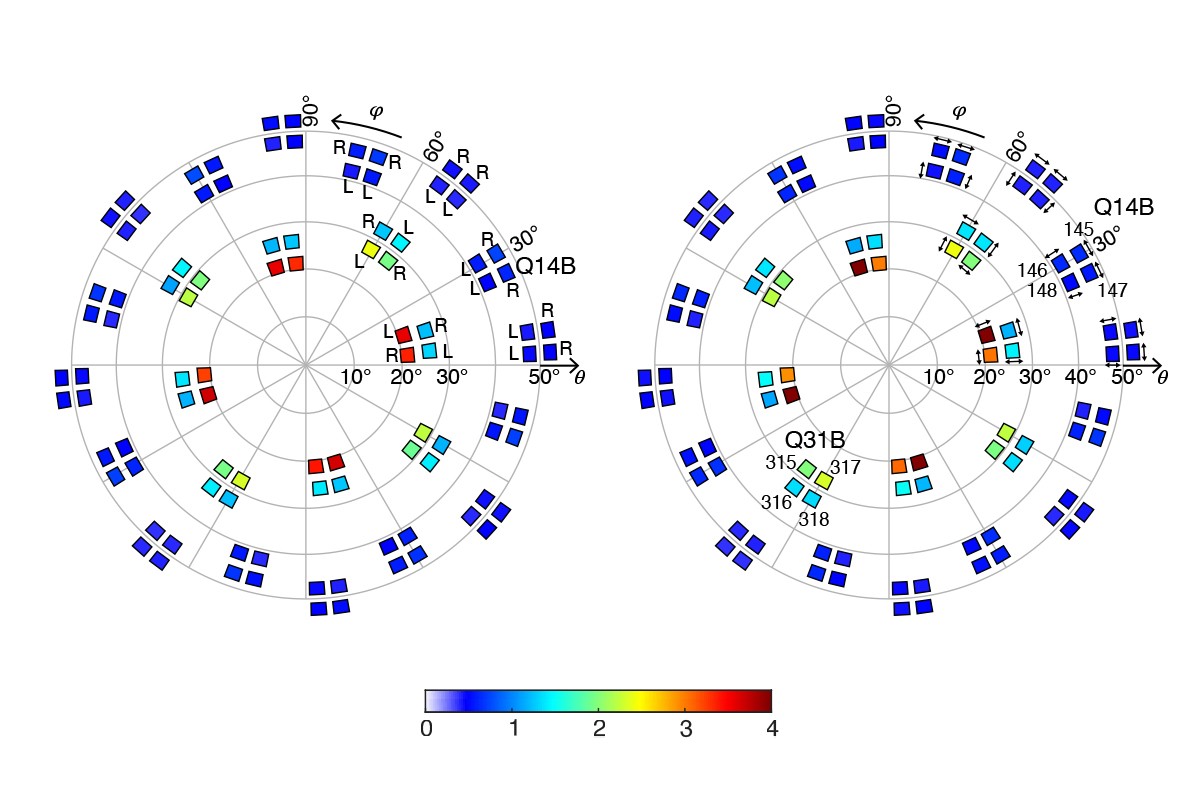
The figure shows the distribution of the 96 lower-hemisphere beams in the NIF target chamber, with color coding representing the CBET power multiplier. The left panel shows the effect of circularly polarized light, where variations in the inner cone are smaller; the right panel shows the effect of linearly polarized light.
Michel and his team compared the differences between linearly polarized and circularly polarized light through CBET simulations. The results showed that circularly polarized light can reduce energy differences between beams within the same cone, thereby improving CBET performance. The simulation images also showed that, compared with linearly polarized light, variations in the inner cone were smaller under circularly polarized light conditions.
However, applying circularly polarized light to NIF is not straightforward. Achieving this goal requires special waveplate components to reorient the electromagnetic field components of the transmitted light. Jean-Michel Di Nicola, NIF Chief Laser Systems Engineer and Co-Director of the Laser Science and Systems Engineering Joint Program, stated that there is currently no known direct method to fabricate quarter-wave plates that meet NIF's aperture size and performance requirements. The team is investigating potential manufacturing approaches, including patented metasurface technology.
The research team's next step is to conduct dedicated experiments on smaller-scale facilities, such as LLNL's Jupiter Laser Facility, to validate the new theory of CBET under circular polarization conditions. Meanwhile, researchers will continue to incorporate more physical effects into simulation codes to further refine the relevant models.
Disclaimer: Information republished from partner media, institutions or other websites is provided for reference and communication purposes only. It does not imply endorsement of its views or verification of its accuracy. Please contact us if any content infringes rights or requires correction.