
Search Results
Keyword:Inertial Confinement Fusion
U.S. Research Reveals Diamond Melting Mechanism at High Pressure, Potentially Enhancing Inertial Confinement Fusion Performance
A research team at Lawrence Livermore National Laboratory (LLNL) in the U.S. recently published a study in Nature Physics reporting that the latest dynamic compression experiments have, for the first time, directly recorded atomic structural changes during diamond melting under extreme high pressure. The experiments showed that under high-pressure conditions, solid diamond can float in liquid metallic carbon, similar to ice floating on water. Diamond is not only a high-hardness carbon material but is also used as the fuel target capsule shell in inertial confinement fusion experiments. When intense lasers drive the capsule implosion, the compression and melting behavior of the diamond shell can affect whether the fusion fuel reaches the required high-temperature, high-pressure state. Meanwhile, the planetary science community has long focused on the high-pressure behavior of carbon in the deep interiors of ice giant planets...
2026-08-26

U.S. SYNOPTICS Produces Large-Size Yb:YLF Crystal for Inertial Confinement Fusion Laser Systems
On August 19, SYNOPTICS, a subsidiary of Northrop Grumman, announced that it had successfully grown and harvested a large-size ytterbium-doped yttrium lithium fluoride crystal, namely a Yb:YLF crystal ingot. The crystal measures approximately 127 millimeters at its widest point, with a diameter three times the industry standard. SYNOPTICS stated that as laser engineering continues to expand toward higher efficiency and higher power, the demand for gain media with larger apertures and larger dimensions continues to grow. The Yb:YLF crystal produced this time is approximately 20% larger than the largest crystal the company had previously grown, and approximately 50% larger than the company's conventional product size. Kevin Stevens, General Manager of SYNOPTICS, stated that yttrium lithium fluoride is a commonly used host material for laser-active rare-earth ions, and scaling up the growth of YLF crystals will help laser engineers continue to raise the upper limit of achievable laser output power. He said that such materials are of significant importance for applications including directed energy, inertial confinement fusion, and industrial laser systems. Stevens also stated that Yb:YLF crystals can be used in applications requiring reduced thermal lensing effects and enhanced pulsed energy storage capability, while also leveraging their natural birefringent host to achieve polarization characteristics. According to information recently released by SYNOPTICS, some of the crystals will be used in the high-energy laser system at the German Electron Synchrotron Research Center (DESY) to support its inertial confinement fusion energy research. The company is currently studying the feasibility of further scaling up the size of Yb:YLF crystals, and plans to extend the relevant processes to other rare-earth-ion-doped YLF crystals, including holmium, thulium, and neodymium doping systems.
2026-08-21
US experiment reveals diamond melting behavior under high pressure, potentially advancing inertial confinement fusion research
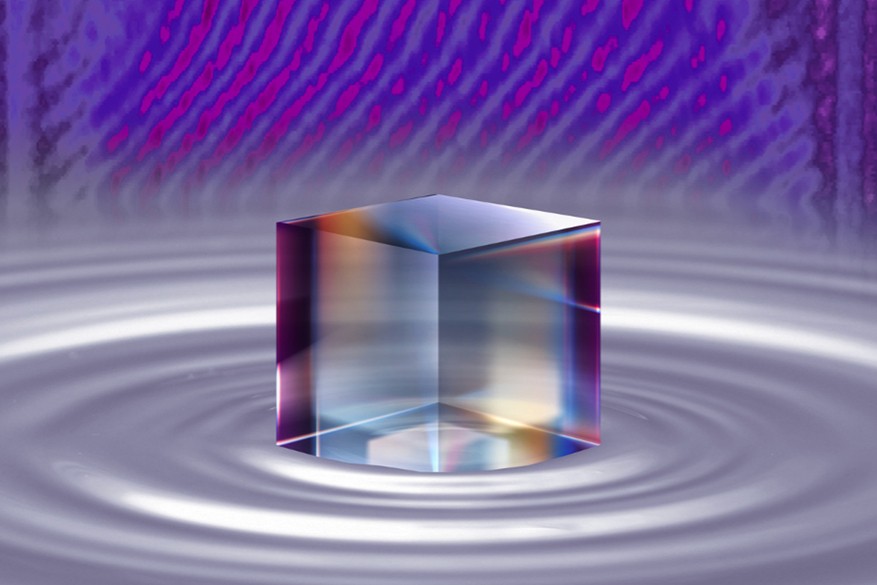
Researchers at Lawrence Livermore National Laboratory published a new study in Nature Physics documenting the melting process of diamond at pressures approximately three times greater than those at Earth's core. The experiments showed that under high-pressure conditions, diamond floats in liquid metallic carbon, similar to how ice floats in water. This finding helps improve inertial confinement fusion experimental models and provides new evidence for understanding the potential "diamond rain" phenomenon inside ice giant planets such as Neptune and Uranus. The latest melting experiments confirmed that under high pressure, diamond floats in liquid metallic carbon, just as ice floats in a glass of water. (Concept image: James Wickboldt/LLNL) The research team stated...
2026-08-17

LLNL Research in the U.S. Reveals New Mechanisms of Laser Polarization Effects in NIF Inertial Confinement Fusion Experiments
Researchers at Lawrence Livermore National Laboratory (LLNL) have recently discovered in studies related to the National Ignition Facility (NIF) that the polarization state of lasers may influence the cross-beam energy transfer (CBET) process in inertial confinement fusion experiments and could help reduce backscatter and the risk of damage to optical components. The related paper, titled "Effects of Laser Polarization on Cross-Beam Energy Transfer in Inertial Confinement Fusion," was recently published as a featured article in the journal Physics of Plasmas. NIF experiments demand extremely high precision in laser control. The facility's 192 laser beams must be focused to a width of a few millimeters and enter the target area through holes approximately 3 millimeters in diameter located at the top or bottom of a gold hohlraum. The hohlraum is about 2 centimeters in diameter. After the lasers enter the plasma, different beams cross each other and undergo energy transfer, a process known as cross-beam energy transfer. When designing NIF inertial confinement fusion experiments, scientists carefully tune the laser wavelengths to use CBET to balance energy distribution and improve implosion symmetry.
2026-08-10