
Jiangmen Neutrino Experiment Targets Mass Ordering Challenge; Wang Yifang Says Expected to Be Resolved Within 3 to 5 Years
 Scan to share
On August 9, the 2026 International Congress of Basic Science opened in Beijing. Wang Yifang, academician of the Chinese Academy of Sciences and researcher at the Institute of High Energy Physics, Chinese Academy of Sciences, was awarded the Samuel C.C. Ting Physics Medal in recognition of his significant contributions to neutrino oscillation research, precise measurement of the mixing angle θ13, and the construction of the Jiangmen Underground Neutrino Observatory (JUNO).
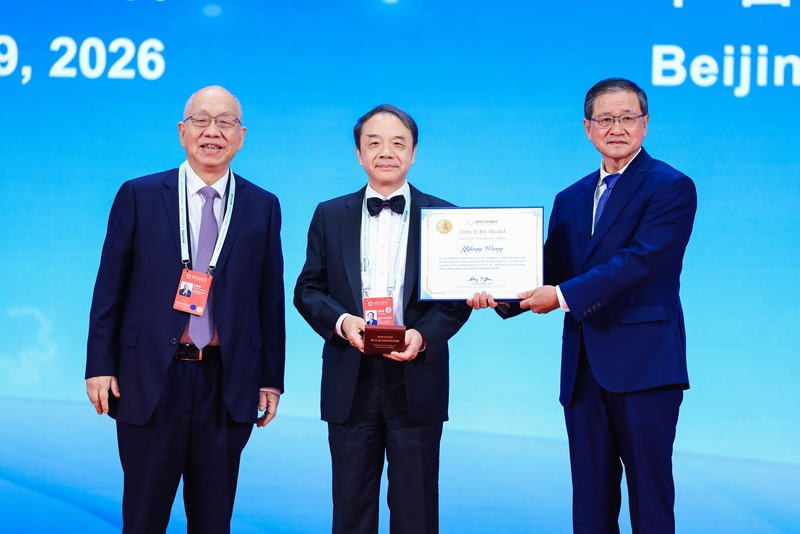
According to reports, the Basic Science Medal is established for scientists worldwide who have achieved groundbreaking results in basic sciences, covering three fields: mathematics, physics, and engineering. Wang Yifang's award-winning achievements include being the first to discover a new neutrino oscillation mode, first to precisely measure the mixing angle θ13, and leading the completion of the Jiangmen Neutrino Experiment construction, laying the foundation for the international determination of the neutrino mass ordering.
During the congress, Wang Yifang stated that one of the primary scientific goals of the Jiangmen Neutrino Experiment is to measure the neutrino mass ordering. In simple terms, this research aims to answer the question of "which is lighter and which is heavier" among different types of neutrinos. He pointed out that clarifying this issue is of great significance for ruling out a range of elementary particle theory models, understanding neutrinoless double beta decay, and future cosmological research.
Neutrinos are important members of elementary particles, including electron neutrinos, muon neutrinos, and tau neutrinos. Nuclear reactions inside stars, supernova explosions, nuclear reactor operations, and radioactive decay of materials in rocks all produce large numbers of neutrinos. Wang Yifang stated that reactor neutrinos are an important tool for studying physics problems because reactors can generate intense neutrino fluxes, giving related detectors certain advantages in scale and cost.
Wang Yifang introduced that since 2001, he has been conducting related experimental research in China, successively participating in the BESIII experiment, the Daya Bay Reactor Neutrino Experiment, and the Jiangmen Neutrino Experiment. Among the six neutrino oscillation parameters, three were first measured by reactor experiments, with θ13 being first measured by Wang Yifang's team in the Daya Bay experiment.
The Jiangmen Neutrino Experiment began operation in August 2025 and has obtained its first batch of physics results. In June 2026, the experiment announced multiple new results after approximately 10 months of official operation, showing indications that the neutrino mass ordering tends toward the normal ordering, which is considered an important advancement in high-precision neutrino mass ordering determination internationally.
When asked when the neutrino mass ordering question can be ultimately resolved, Wang Yifang stated that an answer is expected within approximately 3 to 5 years. In addition to mass ordering, the Jiangmen Neutrino Experiment will continue research in the future on the absolute neutrino mass, neutrinoless double beta decay, and whether neutrinos are their own antiparticles.
Disclaimer: Information republished from partner media, institutions or other websites is provided for reference and communication purposes only. It does not imply endorsement of its views or verification of its accuracy. Please contact us if any content infringes rights or requires correction.