
"Smashing Out" More New Particles Unknown to Humanity — Exploring the Upgraded Beijing Electron-Positron Collider After Its Second Renovation
 Scan to share
Beside Yuquan Road in Beijing, beneath an ancient courtyard surrounded by lush greenery, lies a giant scientific facility shaped like a badminton racket — the Beijing Electron-Positron Collider. Inside this 240-meter-circumference ring-shaped device, electrons and positrons can be accelerated to near the speed of light and smashed head-on into each other. By studying the microscopic particles produced in these collisions, scientists explore the fundamental laws governing the microscopic world, verify existing physical theories, and search for unknown new particles.
Recently, a reporter visited this facility to uncover the secrets of this national heavyweight that has just completed its second major upgrade. After this renovation, key indicators such as collision energy and collision luminosity have been significantly improved, achieving a historic breakthrough in core performance.
"This facility has been in operation for nearly four decades, but it is by no means an 'old machine.'" Entering the underground tunnel, Yu Chenghui, a researcher and chief operations director of the Beijing Electron-Positron Collider at the Institute of High Energy Physics (IHEP) of the Chinese Academy of Sciences, explained that after two major upgrades, the facility has been completely "reborn" and is now a truly modern large-scale scientific installation.
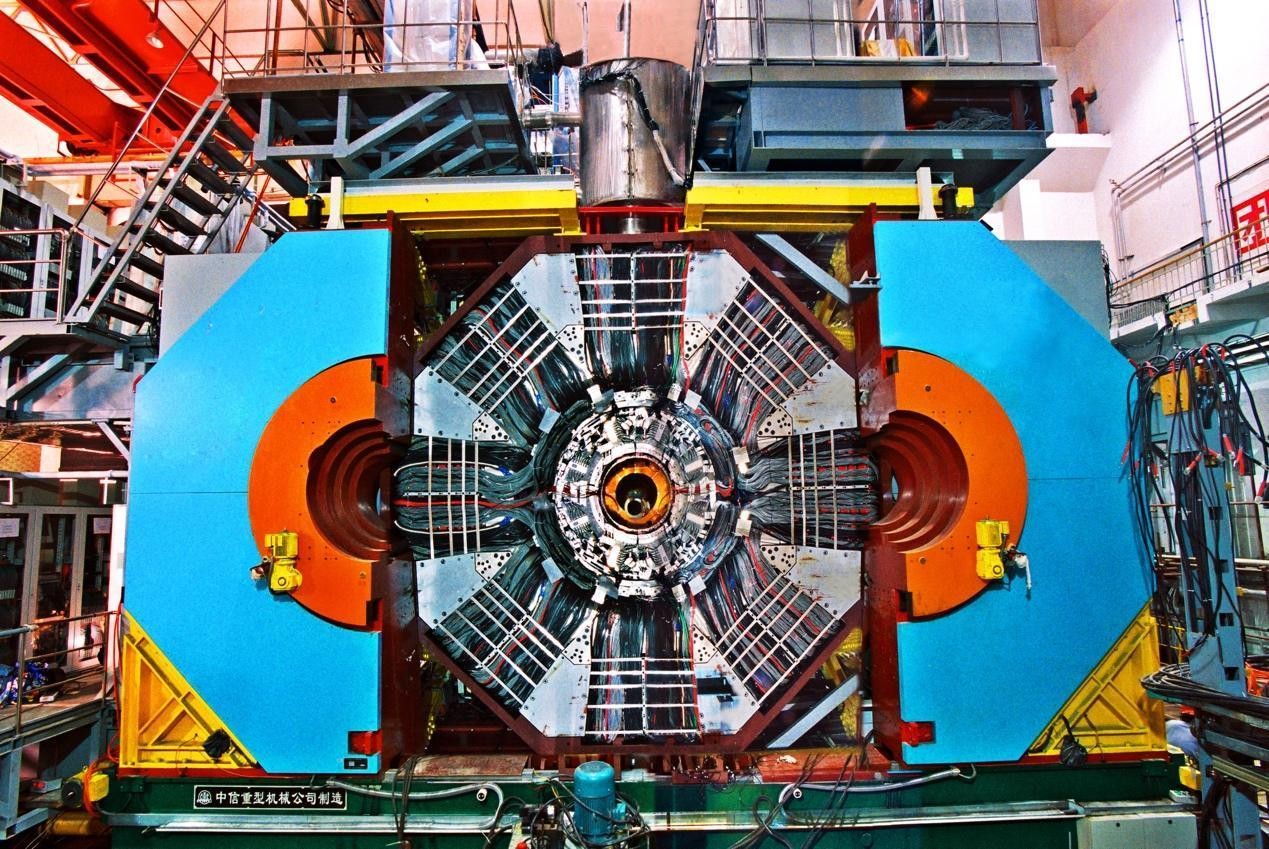
Photo courtesy of the Institute of High Energy Physics, Chinese Academy of Sciences
"To stay ahead, we must surpass ourselves"
"Why was another upgrade necessary?"
In response to the reporter's question, Yu Chenghui explained that since completing its first major upgrade in 2009, the Beijing Electron-Positron Collider has become the only collider in the world operating in the tau-charm energy region. Over the following 11 years, it discovered 32 entirely new particles in this energy region, none of which fit within the framework of the existing Standard Model — signaling that humanity's most fundamental understanding of the material world may need to be rewritten.
"With this achievement, China has long led basic particle physics research in the tau-charm energy region. To stay ahead, we must surpass ourselves," Yu said. "Theoretically, 10 to 15 new particles remain hidden in the tau-charm energy region. Without further improving the collider's performance, we estimated it would take 15 years to 'dig' them out."
These tangible and promising results have attracted multiple international competitors. Since 2020, experimental facilities such as PANDA in Germany, Belle II in Japan, and Jefferson Lab in the United States have applied for funding in attempts to aim their colliders at this "golden" energy region.
"A collider is like a shovel scientists use to dig in a rich mine. We used this shovel to unearth coveted treasures before, and now others are bringing better tools to claim the mine. We must sharpen our own shovel," Yu said by way of analogy.
"We must defend our leading position in the tau-charm energy region and not let the prize slip through our fingers." Pointing to a distribution map of new particle discoveries beside the facility, he noted that in high-energy physics, whoever discovers and publishes results first earns the naming rights — being slow is essentially equivalent to doing nothing. The second upgrade was critical, directly determining whether the Beijing Electron-Positron Collider can maintain its global competitive edge.
In July 2021, the project to upgrade the collision energy and data-taking efficiency of the Beijing Electron-Positron Collider was officially approved, with the Chinese Academy of Sciences investing 160 million yuan. The goal was to increase both the peak luminosity and integrated luminosity of the collider to more than three times their original values.
The international competitors that had been eyeing this field eagerly adjusted their strategies after evaluating our upgrade plan — three of them, from Germany, the United States, and Switzerland, voluntarily withdrew from competition in this energy region. Japan's facility, after its upgrade, failed to achieve its expected goals.
"Not long ago, we successfully completed the upgrade, and all predetermined performance targets were met," Yu said with a smile. "This time, the prize is truly secured."
"Developing the world's best combined-function superconducting magnet"
As they spoke, the reporter followed the researchers through a protective door into the storage ring tunnel. Before them, low-temperature superconducting cavities, combined-function superconducting magnets, and precision vacuum chambers were neatly arranged, their surfaces gleaming with a cool metallic luster under the lights.
"This is the core of the second upgrade. We carried out a major renovation of the collision point region," Yu said, pointing to the newly accepted combined-function superconducting magnet. "To triple performance, the key is to compress the beam bunch size at the collision point and increase the beam current, achieving a qualitative leap in collision efficiency."
This sounds simple, but it is in fact an extreme engineering challenge. Zhu Yingshun, a researcher at IHEP, told the reporter: "The biggest obstacle was the focusing magnets at both ends of the collision point — the combined-function superconducting magnets."
However, the manufacturing technology for such magnets was once exclusively monopolized by Brookhaven National Laboratory in the United States.
"To break free from this technological dependence as early as possible, we spent 13 years developing the world's best combined-function superconducting magnets. The performance of our magnets is 40% higher than that of the American products," Zhu said with evident pride. Even more dramatic, in May 2025, the American laboratory that once held the monopoly proactively contacted IHEP, hoping to purchase combined-function superconducting magnets made in China.
Meanwhile, the team also overcame multiple key core technologies and achieved the domestic production of several critical components. For example, the superconducting radio-frequency module exploits the property of superconducting cavities losing electrical resistance at extreme low temperatures near minus 269 degrees Celsius, multiplying acceleration efficiency severalfold — enabling higher electron and positron beam energies to be achieved more efficiently within limited space. The new injection kicker magnet innovatively replaced the traditional ceramic-coated plate structure with a metal-strip design, reducing the vacuum requirement for the injection kicker magnet by an order of magnitude and solving the technical challenge of stable operation under high beam power and high single-bunch current. The photon absorbers use special copper alloys and a tapered multi-stage absorption structure to ensure effective cooling of synchrotron radiation power, ultimately guaranteeing long-term stability of the ultra-high vacuum in the storage ring.
"Thanks to the comprehensive push for independent innovation, the domestic production rate of equipment for the Beijing Electron-Positron Collider reached 100% after the second upgrade, and the linac energy was upgraded simultaneously, bringing the overall performance to a leading level among similar international facilities," Yu said.
"Maintaining a leading position in tau-charm physics research"
Leaving the storage ring tunnel, the reporter arrived at the control room of the Beijing Spectrometer. Upon entering, complex and colorful particle track diagrams immediately came into view on the computer screens.
"These are the decay tracks of microscopic particles that our detector is continuously capturing," Yu explained. After the upgrade, the event collection rate of the Beijing Spectrometer has tripled, allowing a large number of rare charmed mesons and exotic hadron signals to be recorded more efficiently for physicists to analyze in depth.
"The new particle targets that would have taken 15 years to 'dig out' before the upgrade are now expected to be completed in just 5 years. Through this upgrade, we can maintain our leading position in tau-charm physics research," Yu said. Centered on this facility, a large international collaboration has been formed, bringing together more than 700 top scientists from 96 institutions across 15 countries. Within this collaboration, China is an undisputed leader — experimental design, data collection and analysis, and publication of results are all led by our side.
The contributions of this facility extend beyond the frontiers of particle physics. It serves a "dual-purpose" role: while conducting high-energy physics collisions, the electron beams racing through the storage ring continuously generate high-quality synchrotron radiation light, serving a wide range of users. Wei Yanru of IHEP explained: "When electrons change direction in bending magnets, they emit intense X-rays along the tangential direction. Like a searchlight, this light can illuminate the microscopic structure of experimental samples."
It is precisely with this beam of light that researchers can observe how cracks in metal fatigue begin, how protein molecules fold, and whether nanoscale circuits in chips contain defects... All of these cutting-edge studies rely on the high-resolution penetrating capability of synchrotron radiation light.
"After the second upgrade, the light intensity of the facility has doubled. This means the time required for experiments is halved, and the facility can now support approximately a thousand user experiments annually, providing an indispensable research platform for fields such as materials science, life sciences, and detector calibration both domestically and internationally," Wei said.
Looking to the future, the operations team will continue to tap the facility's potential, further optimizing beam quality and finely tuning operating parameters, pushing ever deeper into the microscopic world to "smash out" more new particles unknown to humanity. "We have already proven that the Chinese people are capable of competing head-on with the world's strongest players in the most cutting-edge fundamental sciences — and of winning consistently," Yu said.
Disclaimer: Information republished from partner media, institutions or other websites is provided for reference and communication purposes only. It does not imply endorsement of its views or verification of its accuracy. Please contact us if any content infringes rights or requires correction.