
USTC Team Participates in STAR Experiment, Discovering Possible "Y"-Shaped Gluon Junction Inside Nucleons
 Scan to share
The University of Science and Technology of China, together with Kent State University and Brookhaven National Laboratory, played a leading role in the STAR international collaboration. Through precise measurements of net baryon number and net charge in high-energy nucleus-nucleus collision experiments, they discovered an exotic structure inside nucleons that may overturn fundamental understanding of nucleon internal structure. In the early morning of August 14, the results were published online in the journal Science under the title “Tracking the baryon number with nuclear collisions.”
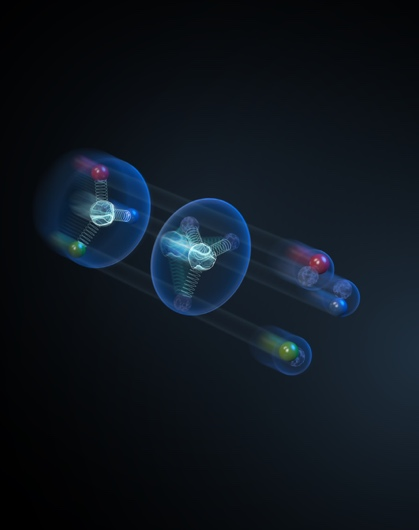
Nucleons are the fundamental particles that make up the material world, carrying more than 99% of the mass of the visible matter in the universe. Understanding the internal structure of nucleons is of paramount importance for understanding the fundamental constituents and fundamental interactions of the material world. It is widely believed that nucleons are composed of quarks (including antiquarks) and gluons. Quarks carry +2/3 or -1/3 electron charge and 1/3 baryon number, antiquarks carry opposite charge and baryon number compared to quarks, while gluons carry neither charge nor baryon number. Through precise experimental measurements, Professor Zebo Tang of the Heavy-Ion Collision Physics Group at the University of Science and Technology of China and his collaborators discovered that the nucleon interior requires a fundamental structure that carries baryon number but no charge or color charge, posing a major challenge to the naive quark model used to describe nucleon internal structure.
The study yielded self-consistent results from two aspects. The experimental group first measured the degree to which nucleons are slowed down inside fast-moving nuclei. The degree of deceleration of fast-moving nucleons is closely related to the internal structure of nucleons and their interactions. The STAR international collaboration performed precise measurements of nucleon deceleration in high-energy nucleus-nucleus collisions and further conducted measurements of nucleon deceleration in photon-nucleus collisions. The experimental results differ significantly from theoretical calculations based on the naive quark model of nucleon internal structure, but agree with theoretical calculations based on a “Y”-shaped gluon junction formed by three connected gluons. The most significant difference between this gluon junction and a single gluon is that it carries one unit of baryon number and can transport baryon number, facilitating baryon deceleration.
Simultaneously, the experimental group precisely measured the ratio of decelerated baryon number to charge number. In the naive quark model, only quarks carry baryon number; by measuring the total number of decelerated baryons, one can obtain the total number of decelerated quarks and thereby derive the expected charge number. The experimentally measured charge number was only half of the expectation, indicating that in addition to quarks and gluons, the nucleon requires a fundamental structure that carries baryon number but no charge. Neither quarks nor gluons, the traditional fundamental constituents of nucleons, possess the above characteristics, whereas the “Y”-shaped gluon junction does.
The results of both types of experimental studies do not support the nucleon internal structure picture of the naive quark model, indicating the existence of an exotic structure inside the nucleon. Currently, the gluon junction is the only theory that can self-consistently describe the results of these systematic experimental studies. This research may open a new chapter in particle physics.
The Heavy-Ion Collision Physics Group at the University of Science and Technology of China is supported by the National Natural Science Foundation of China, the Ministry of Science and Technology, the Chinese Academy of Sciences, and the University of Science and Technology of China. Professor Zebo Tang of the group and his doctoral students Yang Li (graduated) and Wendi Lyu played central roles in this experimental study.
Disclaimer: Information republished from partner media, institutions or other websites is provided for reference and communication purposes only. It does not imply endorsement of its views or verification of its accuracy. Please contact us if any content infringes rights or requires correction.