
SLAC team observes progressive melting of copper under extreme heat in real time
 Scan to share
Researchers at the SLAC National Accelerator Laboratory, under the U.S. Department of Energy, and their collaborators used the Mega-electron-volt Ultrafast Electron Diffraction (MeV-UED) facility to observe in real time the melting process of copper atoms under extreme temperatures. The study was published in Nature Communications.
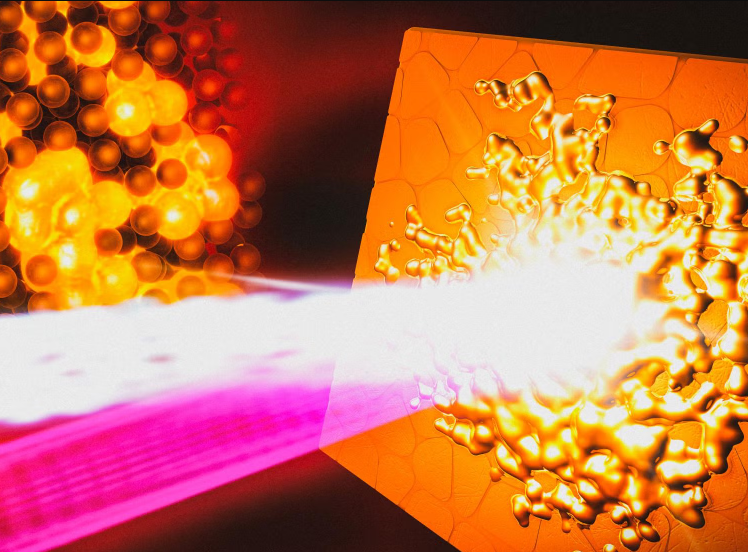
Future fusion power plants will need to replicate fusion reactions that occur inside stars here on Earth. The core plasma can reach temperatures of hundreds of millions of degrees Celsius, while surrounding structural materials must withstand sudden, intense thermal shocks. Copper and its alloys, owing to their excellent thermal conductivity, are considered capable of serving as "heat sinks" in fusion systems, helping to absorb and transfer heat generated by materials near the reaction zone. Therefore, understanding the microscopic behavior of copper at temperatures near or exceeding its melting point is of reference value for the design of materials in fusion devices.
Conventional testing typically involves observing the final state of a sample after high-temperature treatment, making it difficult to capture the actual melting process as it occurs. In this study, the team placed a thin copper film in SLAC's MeV-UED facility, rapidly heated the sample with a laser, and used electron beams to capture atomic-scale structural changes during heating. The facility is capable of recording atomic and molecular motion on the femtosecond timescale, providing researchers with the means to track the melting process of copper step by step.
Previous simulations suggested that when copper is heated ultrafast, it would first begin melting at the surface at approximately 1085 degrees Celsius; as temperature rises, the sides and edges of the sample continue to melt, while the central region, under higher pressure, can maintain its lattice structure for a longer period. When the temperature reaches approximately 1424 degrees Celsius—about 1.25 times the melting point and superheating limit of copper—the remaining lattice was expected to suddenly collapse and transform into a fully disordered liquid state.
The experimental results differed from this prediction. The researchers did not observe an instantaneous collapse of the lattice; instead, they saw a slower, more continuous melting process. Even when temperatures exceeded the expected superheating limit, the copper lattice did not immediately lose its order.
The research team attributes the discrepancy to simplified assumptions about pressure conditions in the simulations. Existing models typically assume that melting copper is in a static environment, with uniform pressure around the sample and fixed constraints on atomic positions; in real ultrafast heating experiments, however, the pressure state is more dynamic, and atoms are able to relax and move. These changes in pressure and atomic motion allow copper to maintain a certain degree of ordered structure even beyond the superheating limit. After incorporating these factors into molecular dynamics simulations, the team successfully reproduced the behavior of copper atoms observed in the experiments.
Mianzhen Mo, the SLAC scientist leading the study, said that real experimental data can identify key factors overlooked in complex simulations, thereby improving predictions of extreme material behavior. Siegfried Glenzer, senior author of the paper and director of SLAC's High Energy Density Science Division, said that high-precision, high-resolution observations help reveal ultrafast, ultra-microscopic dynamic processes and enhance the predictive capability of models.
The experiments also showed that under ultrafast heating conditions, copper exhibits premelting—that is, disordering begins at the surfaces of nanoscale grains and grain boundary regions before the standard melting point is reached.
The research team's next step is to continue testing copper's behavior under hydrostatic pressure conditions to observe whether it collapses near the superheating limit as simulations predict. Building on a deeper understanding of pure copper's properties, the team will also study the more complex dynamics of copper alloys and their potential for absorbing heat in fusion systems. The study was supported in part by the U.S. Department of Energy Office of Science's Fusion Energy Sciences program and SLAC's Laboratory Directed Research and Development program.
Disclaimer: Information republished from partner media, institutions or other websites is provided for reference and communication purposes only. It does not imply endorsement of its views or verification of its accuracy. Please contact us if any content infringes rights or requires correction.