
CMS Experiment Advances Higgs Boson Pair Search with New Data
 Scan to share
The CMS Collaboration has recently announced new progress in the study of Higgs boson pair production. The study is based on proton collision data at a center-of-mass energy of 13.6 TeV recorded by the CMS detector from 2022 to 2024, focusing on the search for processes where one Higgs boson decays to a bottom quark–antiquark pair and the other decays to a τ lepton–antitau pair, namely the HH→bbττ channel.
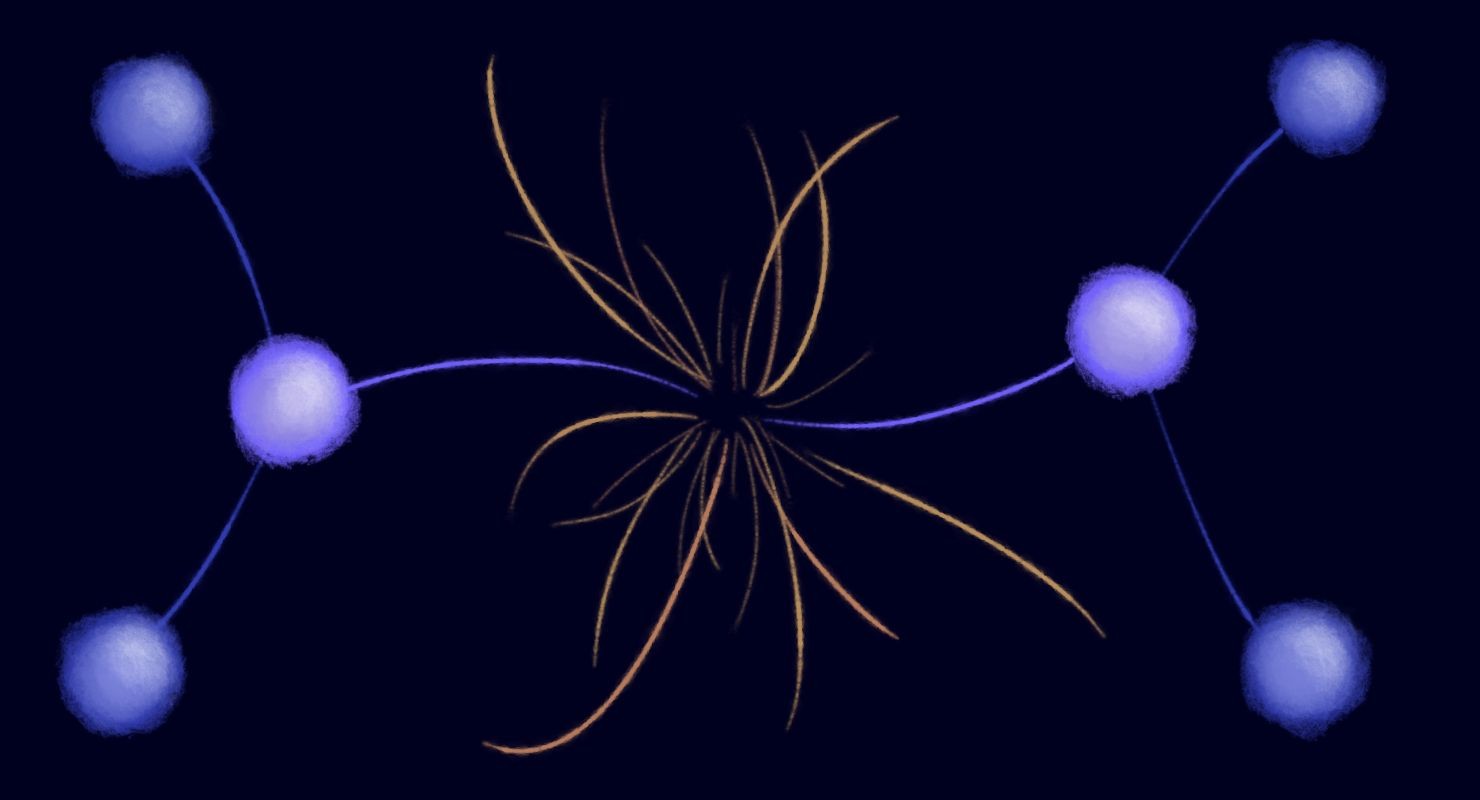
Since the discovery of the Higgs boson in 2012, the CMS and ATLAS Collaborations have continuously measured the interactions of the Higgs boson with other Standard Model particles, and the results so far remain generally consistent with Standard Model predictions. In contrast, the “self-coupling” among multiple Higgs bosons still awaits further experimental verification. The Higgs boson pair production process is an important avenue for studying this question and may also provide clues for exploring new physics beyond the Standard Model.
At the Large Hadron Collider, Higgs boson pairs can be produced primarily through two mechanisms: gluon–gluon fusion and vector-boson fusion. The former is useful for studying the Higgs boson self-coupling, while the latter can be used to investigate the interaction between two Higgs bosons and two W or Z bosons. Since these two processes exhibit different event topologies in the detector, researchers can distinguish the event sources accordingly and constrain the relevant interaction strengths separately.
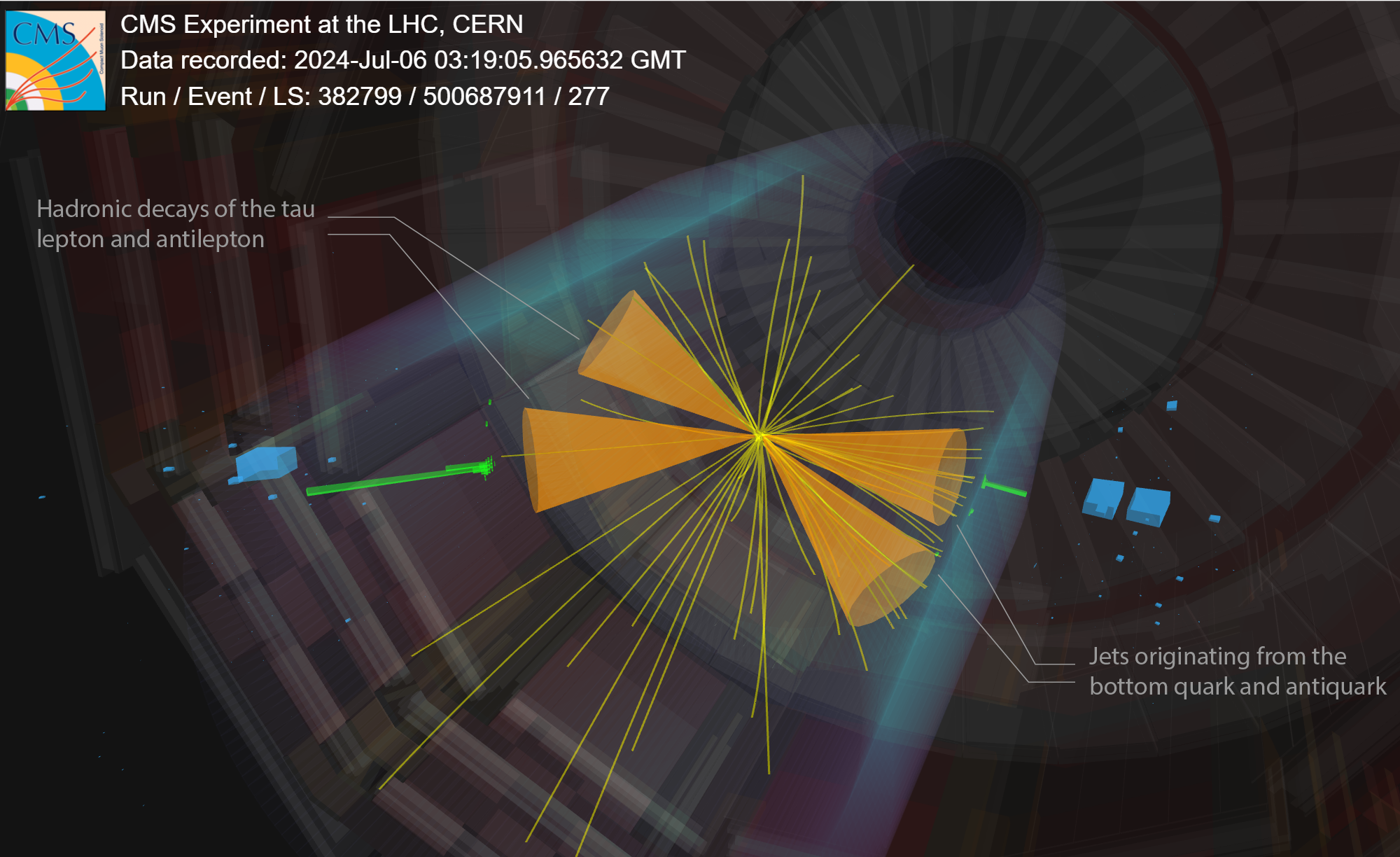
Figure above: A candidate HH→bbττ event recorded by the CMS experiment during the 2024 data-taking period.
This analysis uses 172 fb⁻¹ of data collected between 2022 and 2024. The results show that at the 95% confidence level, CMS sets the observed upper limit on the Higgs boson pair production rate at 6.6 times the Standard Model prediction; the upper limit for vector-boson fusion production of Higgs boson pairs is 81 times the Standard Model prediction.
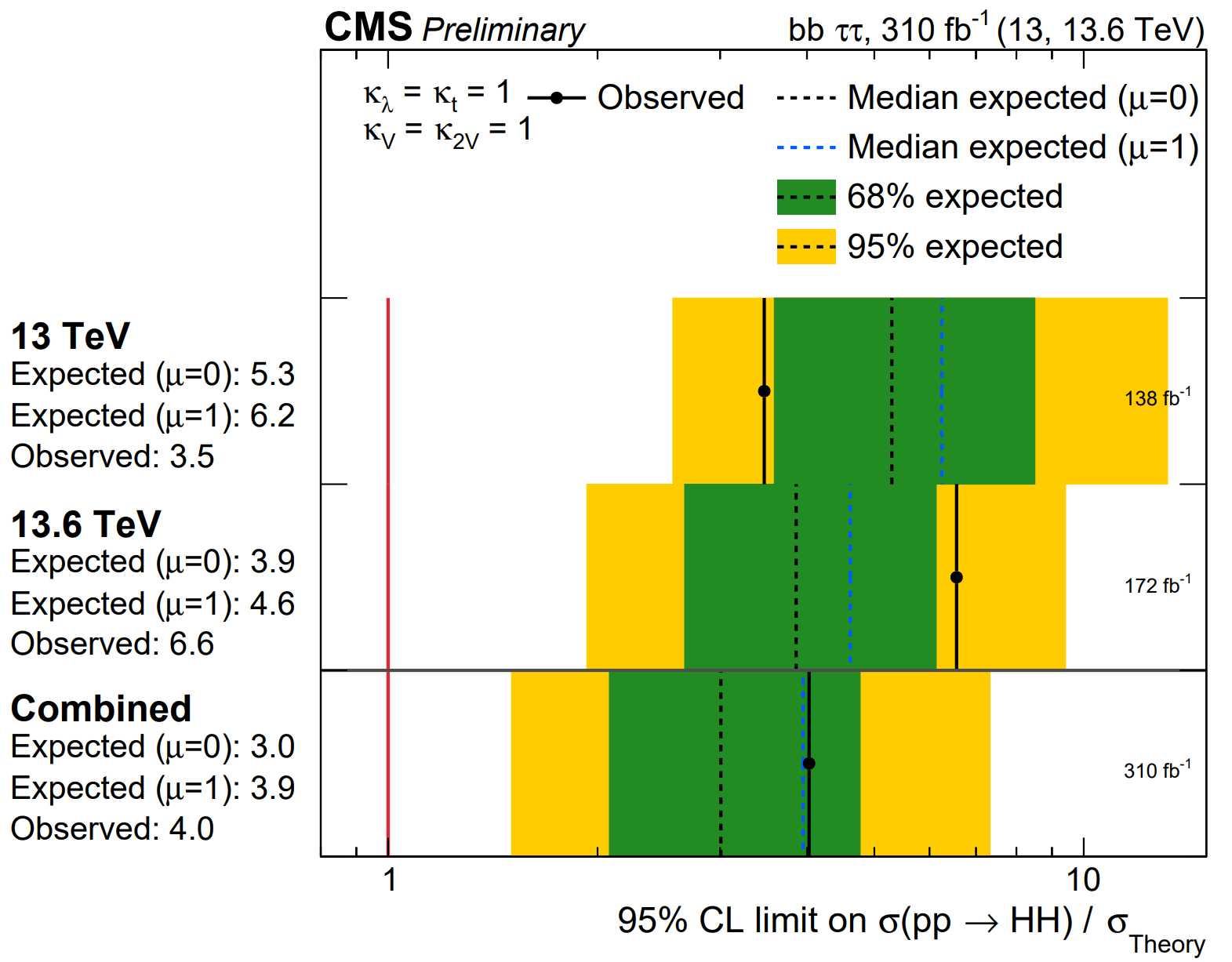
Figure above: Observed and expected values of HH production at 95% CL.
The study also incorporates 138 fb⁻¹ of data collected at a center-of-mass energy of 13 TeV from 2016 to 2018. The combined results show that at the 95% confidence level, the upper limit on the total Higgs boson pair production cross section is 4.0 times the Standard Model prediction; the Higgs boson self-coupling strength is constrained to between –2.5 and 9.4, and the coupling strength between two Higgs bosons and two vector bosons is constrained to between 0.02 and 2.1.
Since the production rate of Higgs boson pairs is approximately 1000 times lower than that of a single Higgs boson, this type of study places high demands on data volume and analysis methods. To improve sensitivity, CMS introduced more efficient trigger algorithms and new machine learning techniques in this analysis. With more data accumulated in 2025 and 2026, and through statistical combinations with other decay channels, the sensitivity of the Higgs boson pair search is expected to continue improving. The High-Luminosity Large Hadron Collider, scheduled to begin operation around 2030, will also provide conditions for CMS to record even larger data samples.
Disclaimer: Information republished from partner media, institutions or other websites is provided for reference and communication purposes only. It does not imply endorsement of its views or verification of its accuracy. Please contact us if any content infringes rights or requires correction.