
Argonne National Laboratory Unveils DONUT Tool to Accelerate Real-Time Analysis of X-ray Nanodiffraction Data
 Scan to share
Researchers at the U.S. Department of Energy's Argonne National Laboratory have developed a new machine learning tool called DONUT to accelerate X-ray data analysis in experiments at the Advanced Photon Source (APS). The tool can process complex images generated by scanning X-ray nanodiffraction microscopy (SXDM) in real time during experiments, helping researchers more quickly determine internal structural changes in materials.
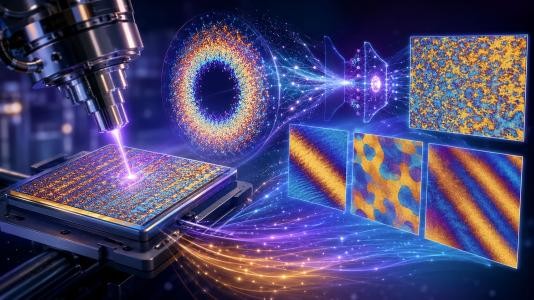
DONUT stands for "Nanobeam Optical Diffraction based on Unsupervised Training," a physics-aware neural network. Its key feature is combining artificial intelligence methods with physical models of focused X-ray beam interactions with materials, allowing it to learn directly from experimental data without relying on pre-labeled training samples. The research team stated that this design reduces the manual effort of comparing measured and simulated diffraction patterns in traditional data analysis, and also lowers the barrier for new users to access advanced light source facilities.
Scanning X-ray nanodiffraction microscopy can reveal crystal structure information of materials at the nanoscale, playing an important role in research on battery materials, catalysts, and advanced electronic and magnetic devices. However, data generated by such experiments are high-dimensional and structurally complex, and analysis often took weeks or even months in the past. With DONUT, researchers can obtain analysis results on-site during experiments, in some cases hundreds of times faster than traditional methods, allowing timely adjustments to experimental plans.
Researchers noted that DONUT's real-time analysis capability also provides a foundation for autonomous experiments. In such experiments, the system can automatically decide subsequent measurement directions based on the latest data, making it particularly suitable for in-situ studies of materials under rapidly changing conditions. As the upgraded APS can produce higher-brightness X-ray beams and collect data at faster rates, DONUT helps researchers keep pace with data generation and conduct more complex dynamic experiments.
Currently, the research team is working to extend DONUT from real-time analysis to experimental automation, including developing a new version for autonomous microscopy, and exploring the potential of its physics-aware training framework in other advanced imaging techniques. The related research findings have been published in npj Computational Materials.
Disclaimer: Information republished from partner media, institutions or other websites is provided for reference and communication purposes only. It does not imply endorsement of its views or verification of its accuracy. Please contact us if any content infringes rights or requires correction.