
Fermilab Muon g-2 Experiment Sets New Direct Detection Limit on Muon Electric Dipole Moment
 Scan to share
On August 12, 2026, the Muon g-2 Collaboration announced that a new analysis based on 25% of the data from the Muon g-2 experiment at the U.S. Department of Energy's Fermi National Accelerator Laboratory has produced the most sensitive direct measurement of the muon's electric dipole moment to date. The results show that if a muon electric dipole moment exists, its magnitude is below the current detection threshold of the experiment.
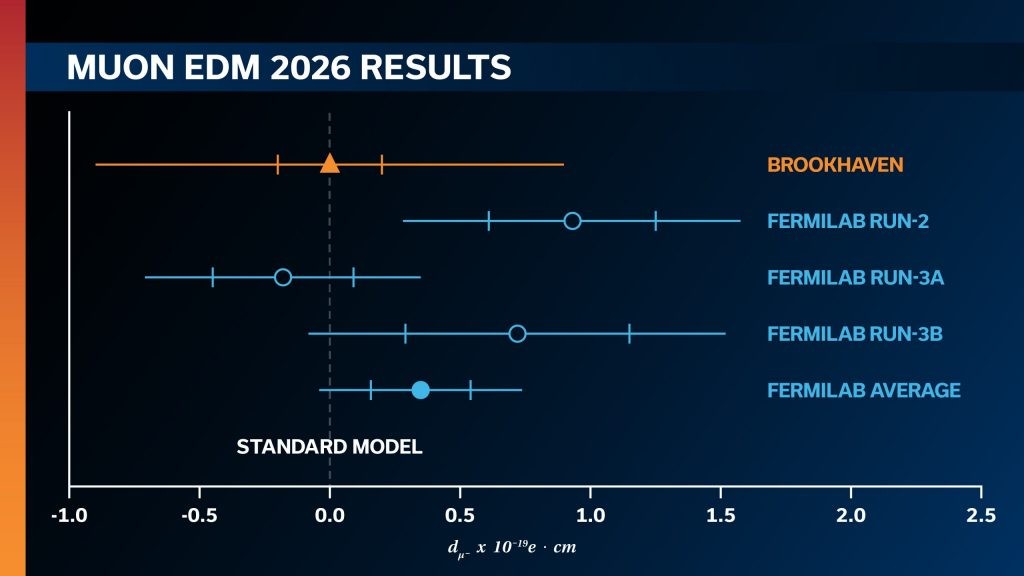
The muon electric dipole moment values measured by Fermilab across different data-taking periods were compared with previous results from Brookhaven National Laboratory. The combined Fermilab value is consistent with zero (no observation). Although the experiment uses positive muons, results are typically reported for negative muons, which reverses the sign of the measured value. Image credit: Muon g-2 Collaboration
The Muon g-2 experiment is primarily designed to measure the muon's magnetic dipole moment. The experiment injects muon antiparticles—antimuons, or positive muons—traveling at near-light speed into a superconducting magnetic storage ring approximately 50 feet in diameter, where the particles circulate hundreds of times before decaying. Detectors positioned around the storage ring record the decay products, helping researchers determine the precession of muons in the magnetic field. The same experimental data were used for this electric dipole moment analysis: the magnetic dipole moment measurement focuses on horizontal oscillations, while the electric dipole moment signal corresponds to a possible vertical oscillation component induced by the electric field.
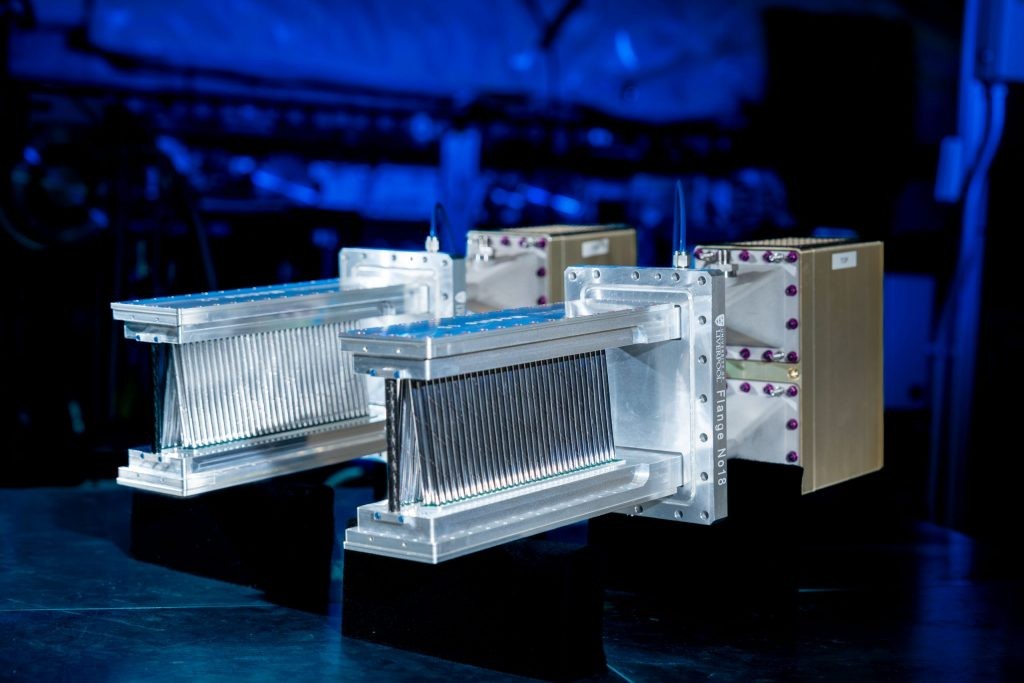
Two of the 16 tracker detector modules in the Fermilab Muon g-2 experiment. These detectors, composed of aluminized Mylar tubes, record hits from muons and positrons passing through, and it is precisely these detectors that enabled the electric dipole moment (EDM) analysis. Image credit: Fermilab, Ryan Postel
The electric dipole moment describes the degree of separation between positive and negative charges within a system. The Standard Model of particle physics predicts that the electric dipole moments of fundamental particles such as the muon are extremely small, far below the detection capabilities of current experiments. Therefore, a non-zero muon electric dipole moment would point to physics beyond the Standard Model and is related to fundamental symmetry questions such as charge-parity violation.
The latest result yields dμ = (-0.35 ± 0.39) × 10^-19 e·cm, consistent with a zero electric dipole moment. Based on this, the Collaboration sets a limit at 95% confidence level: |dμ| < 1.1 × 10^-19 e·cm. This upper bound is approximately 1.5 times more stringent than the limit set by the previous Muon g-2 experiment at Brookhaven National Laboratory.
The completion of this analysis relied critically on the tracker detectors within the storage ring. These detectors, composed of 32 layers of aluminized Mylar tubes, record the trajectories of charged particles. Using these data, researchers compared the difference in the number of positrons moving upward versus downward to search for potential signals left by the muon electric dipole moment.
Over the past nearly 50 years, there have been only two direct measurements of the muon electric dipole moment worldwide, conducted by CERN and Brookhaven National Laboratory, respectively. Although this Fermilab result uses only one-quarter of the total experimental data, the data volume already exceeds that collected by the Brookhaven experiment. The Collaboration stated that this preliminary result will also provide an important reference for next-generation high-precision experiments currently under construction in Japan and Switzerland.
Disclaimer: Information republished from partner media, institutions or other websites is provided for reference and communication purposes only. It does not imply endorsement of its views or verification of its accuracy. Please contact us if any content infringes rights or requires correction.