
US FRIB Research Reveals Low-Energy Gamma-Ray Enhancement Originates from Nuclear Magnetic Transitions
 Scan to share
An international research team led by the US Facility for Rare Isotope Beams (FRIB), with participation from Lawrence Livermore National Laboratory (LLNL) and other institutions, recently published findings in Nature that explain a long-standing question in nuclear physics: why some atomic nuclei emit anomalously high numbers of low-energy gamma rays.
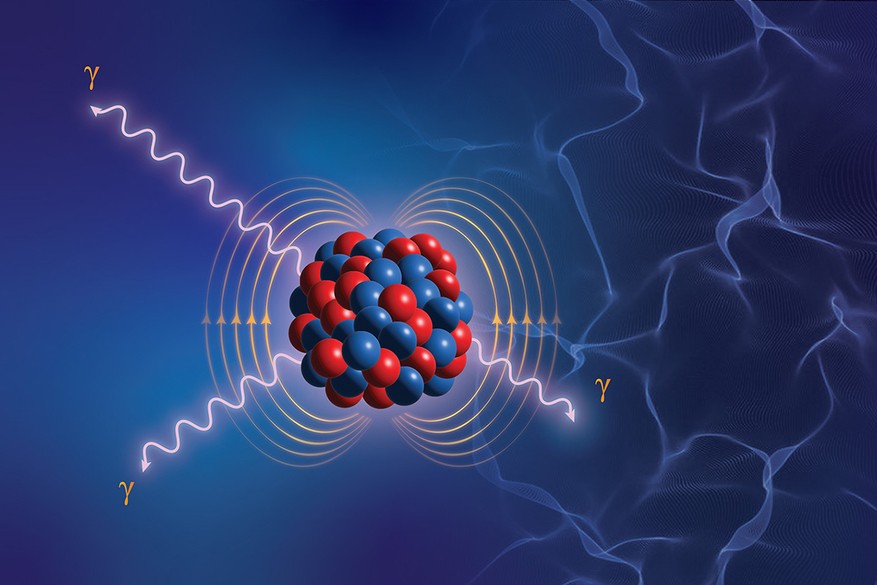
Image: FRIB
Gamma rays are a type of electromagnetic radiation. Excited atomic nuclei release gamma rays during radioactive decay, gradually returning to lower, more stable energy levels. Over the past few decades, scientists have discovered that certain nuclei exhibit a "low-energy enhancement" phenomenon, where the number of low-energy gamma rays emitted exceeds expectations. However, this phenomenon is not universal, and its occurrence is theoretically difficult to predict.
The research team measured gamma-ray radiation produced when radioactive copper isotopes decay into zinc. Leveraging FRIB's beam capabilities and specialized instruments, scientists distinguished two types of decay states: one associated with electric transitions, where protons within the nucleus rearrange during copper decay; and another associated with magnetic transitions, where internal magnetic orientation changes occur among neutrons and protons in the nucleus.
Experimental results showed that only decay states accompanied by magnetic transitions exhibited low-energy gamma-ray enhancement. This provides direct evidence for the magnetic origin of the "low-energy enhancement" phenomenon, establishing a clearer connection between experimental observations and theoretical explanations.
The researchers noted that although this experiment focused on only one nuclear system, the results help improve nuclear structure models and may impact astrophysics-related simulations, including studies of nuclear processes in stars, supernovae, and neutron star mergers, as well as understanding of heavy-element formation reactions. The findings may also serve as a reference for nuclear security-related research such as nuclear forensics.
Disclaimer: Information republished from partner media, institutions or other websites is provided for reference and communication purposes only. It does not imply endorsement of its views or verification of its accuracy. Please contact us if any content infringes rights or requires correction.