
USTC Achieves Cold-Atom Comagnetometer
 Scan to share
Recently, researchers at the University of Science and Technology of China, in collaboration with Lu Zhengtian and Xia Tian from the Hefei National Laboratory, realized a cold-atom comagnetometer using optical quantum control methods. The research team co-trapped two ytterbium isotopes in the same optical trap and synchronously measured their spin precession, achieving a magnetic field noise suppression factor exceeding 30,000. This achievement establishes a spin sensing platform with micron-scale spatial resolution, providing a new avenue for studying spin-dependent short-range interactions. The related research, titled “Cold-atom comagnetometry via optical control of spin states,” was published in Nature Photonics on August 17.
Atomic spin sensors are widely used in precision measurement and quantum information science. A comagnetometer simultaneously and co-locally measures two spin systems with different gyromagnetic ratios, comparing their spin precession frequencies to eliminate common-mode magnetic field fluctuations while retaining sensitive responses to spin-state energy level shifts induced by non-magnetic interactions. Traditional vapor-cell comagnetometers have played important roles in fundamental physics tests and other fields, but their spatial scale is limited by cell size and wall thickness. In contrast, cold atoms can be laser-trapped in micron-scale regions, offering extremely high spatial resolution.
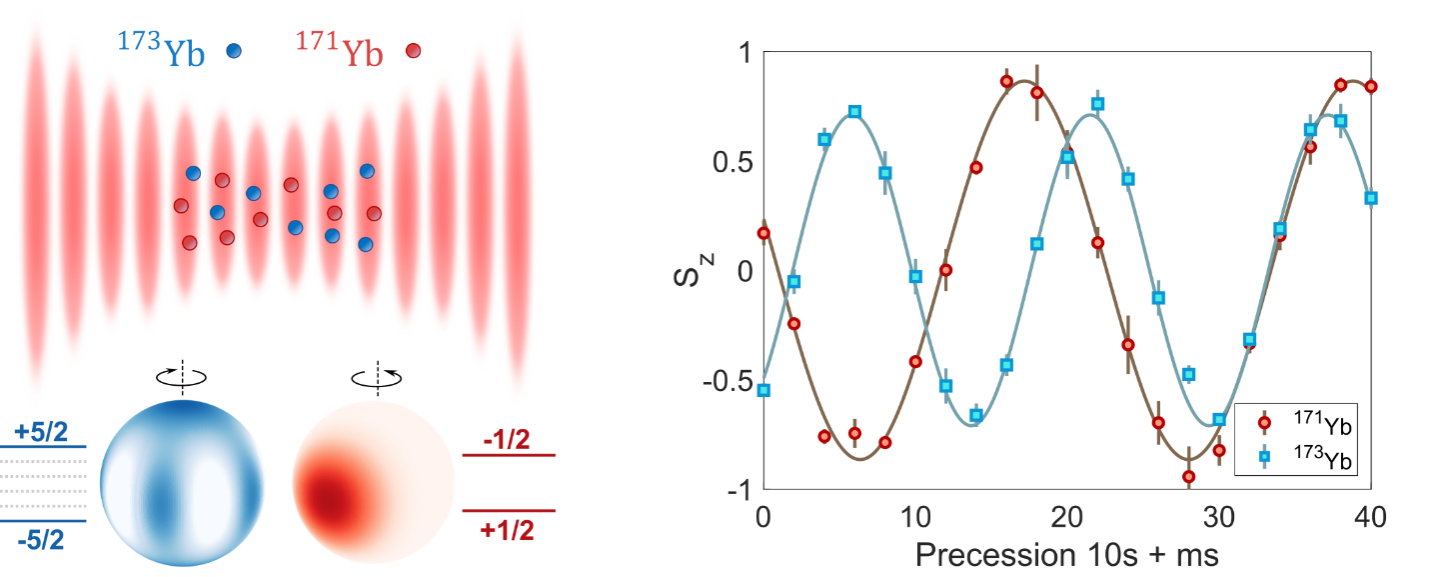
Figure 1. Schematic of the ytterbium cold-atom comagnetometer and spin precession signals of the two isotopes
In this work, the research team co-trapped two isotopes, 171Yb (spin 1/2) and 173Yb (spin 5/2), in a one-dimensional optical lattice, constructing a cold-atom comagnetometer based on pure nuclear spins. The key challenge in achieving long-time spin coherence in cold-atom systems is suppressing decoherence effects caused by light shifts in the optical lattice. For 171Yb, the spin-1/2 structure makes it naturally immune to tensor light shifts; for the high-spin 173Yb, the team employed Schrödinger spin cat states to render its precession frequency insensitive to tensor light shifts. The team had previously used this method to resolve the tensor light shift decoherence problem in high-spin systems [Nat. Photon. 19, 89 (2025)].
In this work, the team further discovered a systematic effect arising from the coupling between residual tensor light shifts and the Zeeman effect, explained it using second-order perturbation theory, and corrected it experimentally. By combining control of vector and tensor light shifts, the team conducted dual-isotope synchronous Ramsey interferometry, achieving spin coherence times of up to 60 seconds and a magnetic noise suppression factor exceeding 3×10⁴, while precisely determining the nuclear magnetic moment ratio of 171Yb and 173Yb. The cold-atom comagnetometer represents a novel spin sensing platform, opening new pathways for quantum-enhanced precision measurement and new physics research beyond the Standard Model.

Figure 2. Doctoral students Zhang Jielin and Luo Weitao operating the experimental setup
Doctoral students Zhang Jielin and Luo Weitao from the Hefei National Research Center for Physical Sciences at the Microscale are co-first authors of the paper. Professor Lu Zhengtian from the USTC School of Microscale and Physics, and Researcher Xia Tian from the Hefei National Laboratory are co-corresponding authors. This work was supported by the National Natural Science Foundation of China, the Ministry of Science and Technology, and the Chinese Academy of Sciences.
Disclaimer: Information republished from partner media, institutions or other websites is provided for reference and communication purposes only. It does not imply endorsement of its views or verification of its accuracy. Please contact us if any content infringes rights or requires correction.