
Argonne National Laboratory Launches Diamond Quantum Sensor Project to Serve High-Energy Physics Electromagnetic Field Measurements
 Scan to share
The U.S. Department of Energy's Argonne National Laboratory recently launched a new three-year, $1 million research project that plans to combine quantum information science with high-energy physics research to develop a new generation of quantum sensors based on diamond materials for higher-precision measurement and mapping of electromagnetic fields.
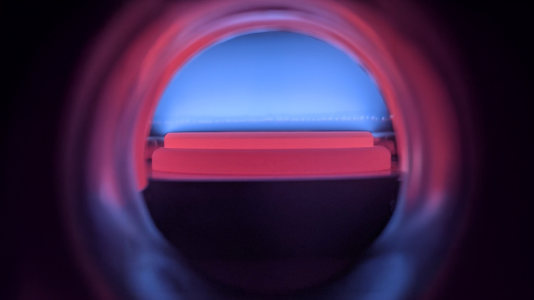
Inside this plasma-filled vacuum chamber is the diamond substrate used to fabricate the diamond thin film (not shown in the image), within which the nitrogen-vacancy qubits are located. (Image courtesy of Nazar·Delegan/Argonne National Laboratory.)
In high-energy physics experiments, the precision of electromagnetic field measurements directly affects the reliability of experimental results. Whether analyzing the momentum of debris produced after particle collisions or tracking subtle motion changes of stored particles in magnetic rings, researchers need to accurately understand the magnetic and electric field distributions in the experimental environment and their variations in space and time. Even small measurement errors can limit experimental precision.
The core technology of this project is the nitrogen-vacancy center (NV center) in diamond. This structure consists of a nitrogen atom in the diamond crystal lattice adjacent to a carbon vacancy, and possesses quantum energy level characteristics that can be read out via light and microwaves. When the surrounding magnetic or electric field changes, its energy levels change accordingly, making it suitable for high-sensitivity electromagnetic field detection.
The project team stated that the research goals include building ultra-high-precision NV quantum sensors, developing a prototype of a large-scale magnetic field mapping system, and laying the foundation for sensor arrays suitable for rapidly changing electromagnetic environments. Researchers will also tailor diamond materials to meet the needs of high-energy physics experiments and conduct tests under laboratory conditions as well as in practical application environments, including high magnetic field and high radiation environments.
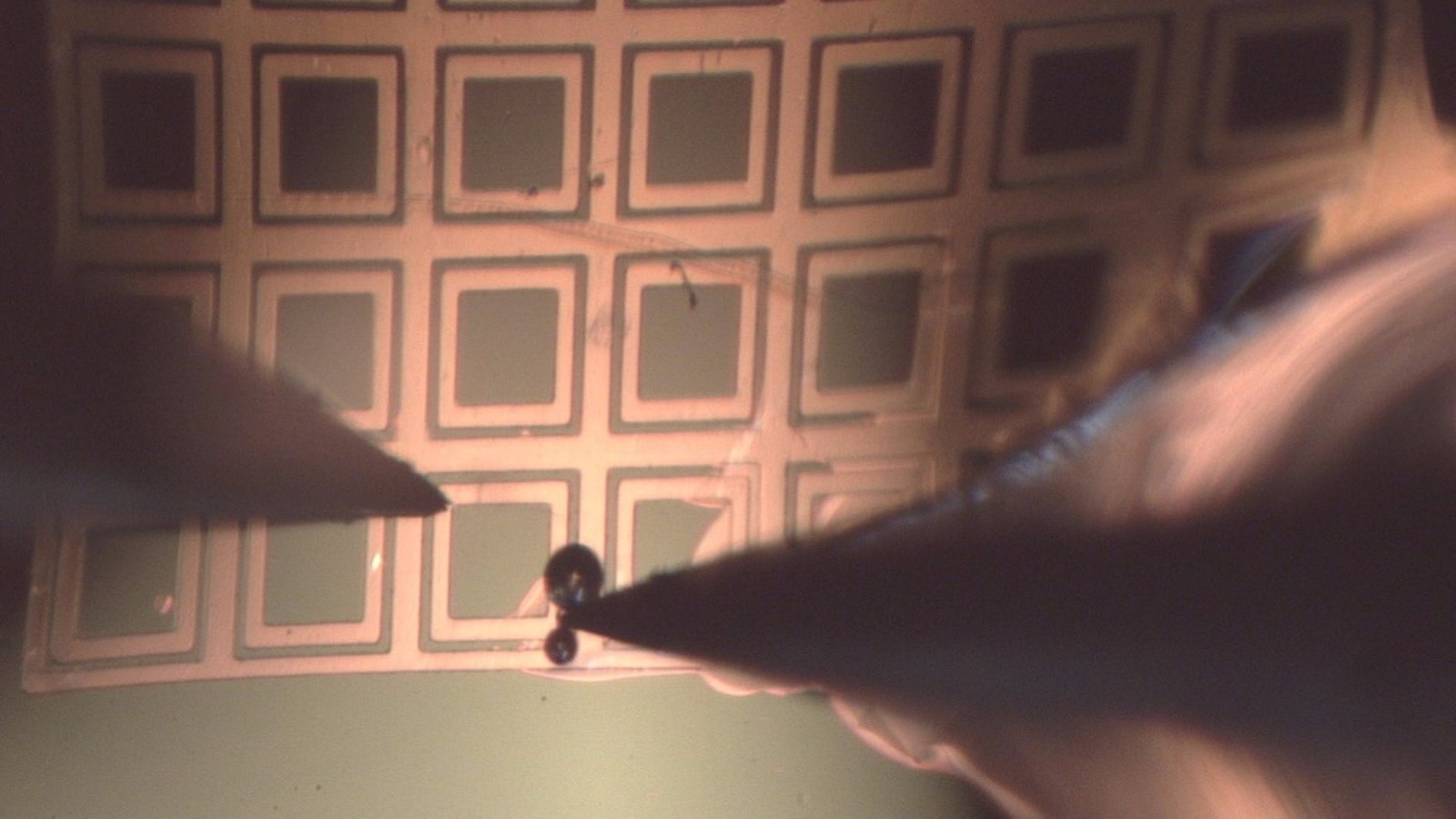
At Argonne National Laboratory, diamond thin films are cut and peeled from larger material layers using specialized tools. (Image courtesy of Nazar·Delegan/Argonne National Laboratory.)
Because diamond-based quantum sensors have natural radiation resistance, compact size, and the ability to measure multiple physical quantities simultaneously, this technology is considered suitable for demanding experimental environments. For high-energy physics facilities with limited space, strong radiation, or extremely high measurement precision requirements, such sensors are expected to reduce the need for instrumentation and cabling while providing more complete information about experimental conditions.
The project lead stated that the research team hopes to develop a sensing platform that can be integrated with existing microelectronic systems, enabling quantum sensors to enter future accelerator and high-energy physics experiment sites. If the project progresses smoothly, this technology will help researchers reduce measurement uncertainties, improve experimental precision, and provide new technical support for exploring the fundamental properties of matter.
This research is funded by the Quantum Information Science program of the U.S. Department of Energy Office of High Energy Physics.
Disclaimer: Information republished from partner media, institutions or other websites is provided for reference and communication purposes only. It does not imply endorsement of its views or verification of its accuracy. Please contact us if any content infringes rights or requires correction.