
RHIC Collision Data Provides New Evidence for the Existence of the "Baryon Bridge"
 Scan to share
August 18 news, an international team of physicists, by analyzing nuclear collision data from the STAR detector at the Relativistic Heavy Ion Collider (RHIC), has presented strong evidence that baryon number may not be carried directly by quarks, but rather transmitted by a "baryon bridge" formed by gluons inside protons. The related paper has been published in the journal Science.
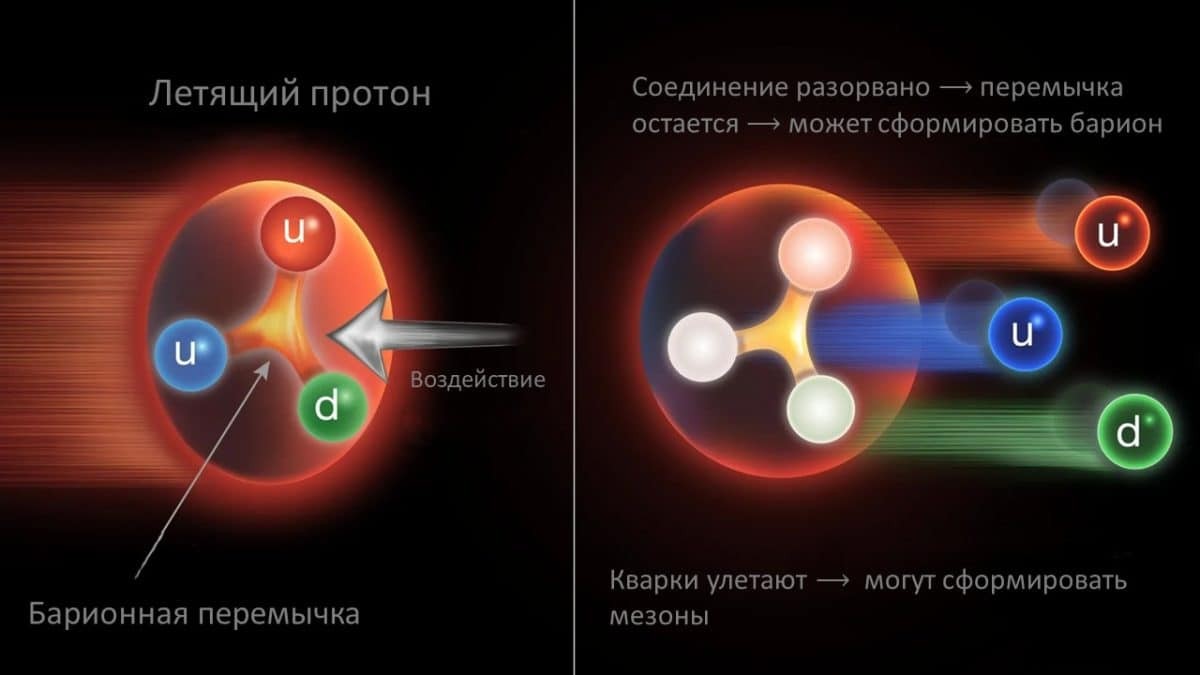
Valerie A. Lentz, Brookhaven National Laboratory
Baryons, including protons and neutrons, are generally considered to be composed of three quarks. In the existing understanding, the baryon number is viewed as being uniformly distributed among the three quarks. Meanwhile, gluons also exist inside protons; they are the carriers of the strong interaction. According to the description of quantum chromodynamics, gluons may form a Y-shaped structure known as a "baryon junction" or "gluon bridge" within the proton, but this structure has long lacked direct experimental evidence.
The research team focused on a persistent phenomenon observed in RHIC collision experiments: in the region perpendicular to the direction of the colliding beams, the number of baryons recorded experimentally was higher than expected. If explained according to traditional models, this would imply that all three quarks of a single colliding proton must "stop" their motion during the collision, with their energy subsequently converted into the production of new particles. However, after comparing the baryon numbers observed in different nuclear collisions with the redistribution of charge, the researchers found that the number of baryons produced in collisions was approximately twice the value expected based on charge measurements of stationary quarks.
The team thus proposed an alternative explanation: quarks carry charge, while the bridge-like structures formed by gluons do not. At high beam energies, gluons inside protons continuously split and multiply, with the fraction of energy carried by individual gluons gradually decreasing; in contrast, quarks do not multiply in the same way, and their energy contribution remains relatively stable. Therefore, the baryon bridge composed of gluons may be more likely to stop in collisions than the three quarks within a proton.
According to this model, when the baryon bridge stops in the collision region, the quarks can continue to move along the direction of the collider. Since quarks and gluons cannot exist independently, they rapidly combine with other particles: quarks can form mesons with antiquarks, while the gluon bridge may attract three new quarks from the vacuum and form new baryons. In actual nuclear collisions, where nuclei containing numerous protons and neutrons collide with each other, thousands of new particles are produced; experiments show that the more particles produced in a collision, the more pronounced the observed baryon excess.
The paper's authors believe that the relevant data accumulated at RHIC between 2000 and 2026 are more consistent with the model in which the gluon bridge carries baryon number, compared to the traditional interpretation where quarks carry baryon number. However, the researchers also emphasized that the current results still require independent verification by other teams. If subsequent studies further confirm this conclusion, it will help deepen the physics community's understanding of baryon number conservation, the strong interaction, and the mechanisms of matter formation in the early universe.
Disclaimer: Information republished from partner media, institutions or other websites is provided for reference and communication purposes only. It does not imply endorsement of its views or verification of its accuracy. Please contact us if any content infringes rights or requires correction.