
US Oak Ridge National Laboratory Advances Radioisotope Nuclear Battery Development
 Scan to share
On August 17, 2026, the US Department of Energy's Oak Ridge National Laboratory stated that its nuclear battery program is advancing the development of radioisotope power systems to meet the demand for stable, long-life power sources in deep space exploration, long-term power supply in remote areas, and national security-related scenarios.
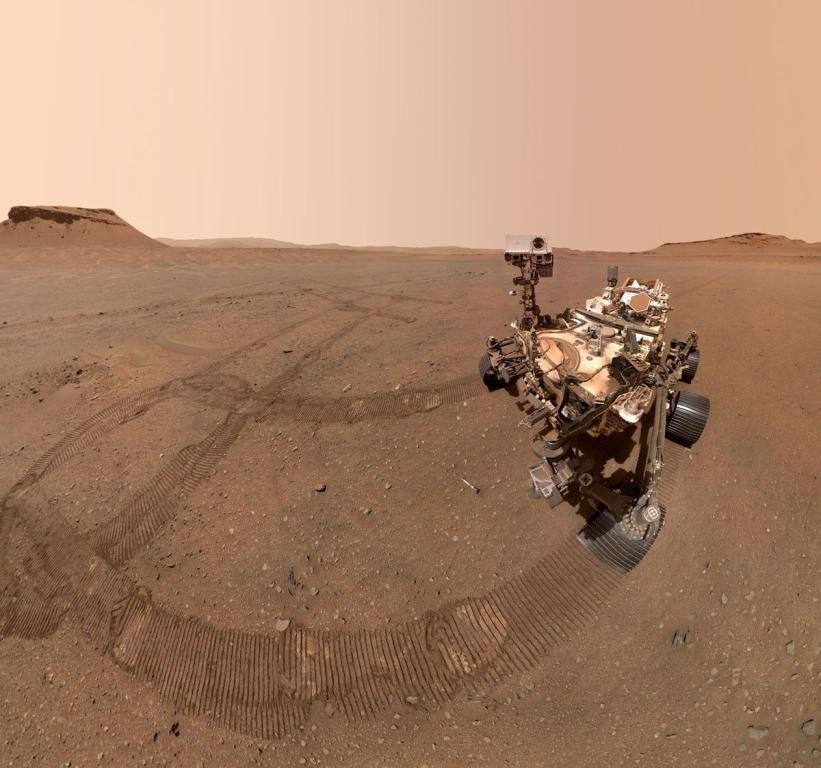
NASA's "Perseverance" Mars rover poses with several of the 10 sample tubes it placed in a sample depot it established in a region of Jezero Crater called "Three Forks." The rover's radioisotope thermoelectric generator is powered by a nuclear battery. Image credit: NASA/JPL-Caltech/MSSS
Nuclear batteries generate electricity from the energy released by the decay of radioisotopes, making them suitable for environments such as the seafloor, remote deserts, and extraterrestrial surfaces where maintenance is difficult and continuous power supply is needed for years or even decades. Brad Johnson,
program lead for nuclear batteries at Oak Ridge National Laboratory, stated that the advantage of nuclear batteries lies in their ability to provide persistent power, noting that this is a mature and safe technology, with current research focused on further improving its performance and safety.
Regarding radioisotope selection, the research team believes that ideal nuclear battery fuels should typically have a half-life of 10 to 100 years. If the half-life is too short, the isotope may largely decay before use; if it is too long, more fuel would be required to generate sufficient energy. Suitable candidate isotopes should also primarily emit alpha particles or beta particles, as these particles have shorter ranges, making it easier to convert decay energy into usable electricity.
Plutonium-238 is one of the current typical applications. Oak Ridge National Laboratory produces plutonium-238 for the US Department of Energy under arrangements with NASA. NASA uses it in multi-mission radioisotope thermoelectric generators to provide long-term power for deep space probes. The Mars rover "Perseverance" uses approximately 10.6 pounds of plutonium-238 in its radioisotope thermoelectric generator, which converts the heat from natural radioactive decay into electricity to charge the rover's main batteries and help keep equipment at suitable operating temperatures. The system has an expected lifespan of 14 years, supporting long-duration mission operations.
Data indicates that future missions impose new requirements on nuclear batteries. For example, in long-duration lunar surface missions, the roughly two-week-long lunar night limits solar power usage, making equipment thermal preservation and continuous power supply critical issues. Oak Ridge National Laboratory believes its integrated capabilities in nuclear materials, isotope production, thermoelectric conversion, and advanced manufacturing can provide technical support for addressing these challenges.
The laboratory's nuclear battery research dates back to the 1960s. In recent years, researchers have also analyzed decommissioned radioisotope thermoelectric generators to understand their performance changes and material degradation after long-term service, accumulating data for the design of next-generation systems.
Johnson noted that the team is evaluating candidate isotopes for use in radioisotope power systems and studying related production methods, including pathways based on fusion-generated neutrons. To date, researchers have identified nine candidate isotopes and, based on properties and scalability of production, have narrowed down three priority options.
Regarding the development of new nuclear batteries, the team believes four major challenges remain to be addressed: first, radioisotope fuel must be producible at higher efficiency and larger scale; second, energy conversion efficiency needs improvement—current thermoelectric technology achieves approximately 5% to 8% efficiency, and if increased to 10% to 15%, fuel costs could drop significantly; third, thermal management should be enhanced through improved insulation and system design to reduce energy losses; and fourth, power control and management systems need further optimization.
Researchers stated that 3D printing, spherical powder preparation, advanced thermoelectric materials, improved radioisotope heat sources and containment, engineered safety systems, and new modeling approaches are expected to advance nuclear battery technology from research to deployable applications. Oak Ridge National Laboratory stated that its goal is to establish a long-term nuclear battery program to continuously meet the demand for reliable radioisotope power sources in relevant fields.
Disclaimer: Information republished from partner media, institutions or other websites is provided for reference and communication purposes only. It does not imply endorsement of its views or verification of its accuracy. Please contact us if any content infringes rights or requires correction.