
Princeton Plasma Physics Laboratory to Validate Spherical Tokamak Fusion Path with NSTX-U
 Scan to share
The Princeton Plasma Physics Laboratory (PPPL) is advancing research on the National Spherical Torus Experiment-Upgrade (NSTX-U), planning to use this largest spherical tokamak in the United States to assess the potential of compact tokamak configurations for future fusion power plants. The device is designed to become one of the most powerful spherical tokamaks in the world and will be used to study key issues such as high-temperature plasma confinement, heat transport, material performance, and real-time control.
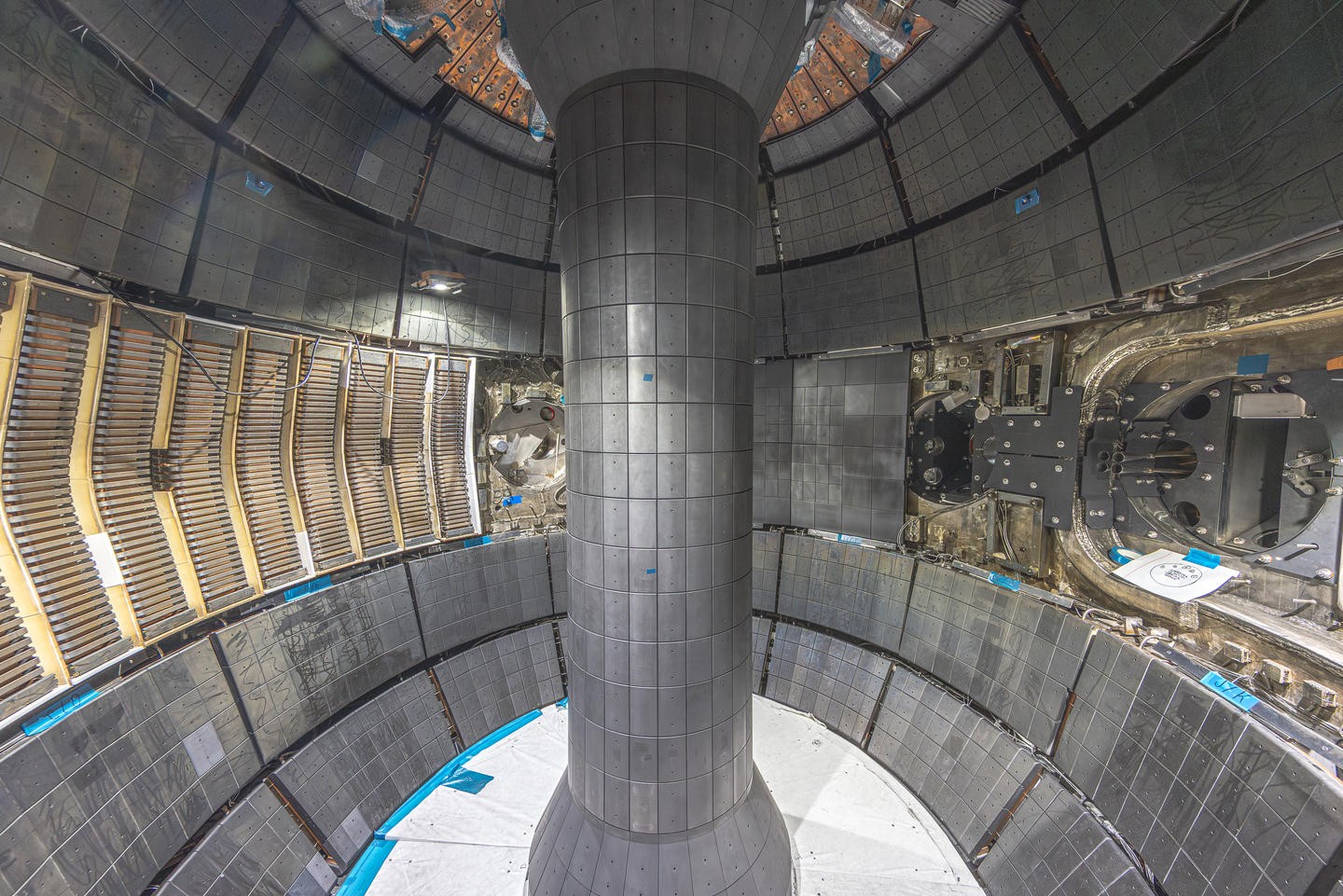
The image above shows the vacuum vessel and center column of the NSTX-U at the Princeton Plasma Physics Laboratory (PPPL). This device will help scientists determine the optimal shape for future fusion power plants. (Photo credit: Michael Livingston/PPPL Office of Communications)
A tokamak is a fusion experimental device that uses magnetic fields to confine plasma. Compared with conventional "donut"-shaped tokamaks, spherical tokamaks more closely resemble a "cored apple" shape, with a narrower central bore and a more compact overall structure. Researchers believe that this geometry helps achieve higher plasma pressure at relatively lower magnetic field strength, thereby improving magnetic field utilization efficiency.
In fusion research, the ratio of plasma pressure to magnetic field pressure is known as the beta value. A higher beta value means the device can sustain higher plasma pressure with lower magnetic field strength, and high-field magnet systems are typically among the most costly and technically challenging components of fusion devices. Therefore, whether spherical tokamaks can maintain high performance under reactor-relevant conditions is a critical question for evaluating future fusion power plant concepts.
According to PPPL, the center column of the NSTX-U will generate a 1-tesla magnetic field using currents of up to approximately 4 million amperes. For comparison, a typical lightning strike carries about 30,000 amperes, and a 1-tesla magnetic field is roughly 20,000 times stronger than the Earth's surface magnetic field. The device will also be equipped with advanced diagnostic systems to obtain key parameters such as plasma temperature and density, and plans call for the integration of artificial intelligence systems to enhance real-time analysis and control capabilities.
Researchers will use the NSTX-U to observe energy storage and heat confinement performance of spherical tokamaks under high-power conditions. PPPL has stated that once the device is operational, a key focus will be verifying whether plasma confinement time continues to improve as operating conditions approach reactor requirements. Confinement time, plasma temperature, and density together form what is commonly referred to as the "triple product" in fusion research, a key metric for evaluating fusion performance.
Another advantage of spherical tokamaks is their smaller device size. Jack Berkery, NSTX-U deputy director of research, noted that compared with larger-diameter conventional tokamaks, spherical tokamaks could theoretically reduce the amount of steel, concrete, copper, and other materials required, thereby lowering construction costs.
In addition, the magnetic field structure of spherical tokamaks helps stabilize the plasma. Stefan Gerhardt, a senior research physicist at PPPL, explained that the magnetic field line geometry in the device helps suppress large-scale instabilities that could cause energy loss, allowing the plasma to retain more heat and sustain higher pressure.
Small-scale turbulence is also an important factor affecting fusion performance. Researchers believe that plasma in spherical tokamaks is more readily driven into rapid rotation by neutral beam heating, and velocity differences between regions can create shear effects that weaken turbulent structures and reduce particle and heat outflow. Steven Cowley, director of PPPL, stated that the smaller plasma size of spherical tokamaks is conducive to producing more effective rotation and shear effects.
The NSTX-U will also serve as an international user facility, providing a test platform for public research institutions, private organizations, and industry to validate the performance of new materials and components in plasma environments and to develop AI-based control tools for fusion device operation. The research team hopes to further clarify the optimal aspect ratio for spherical tokamaks through this device, providing experimental evidence for the design of future compact fusion power plants.
Disclaimer: Information republished from partner media, institutions or other websites is provided for reference and communication purposes only. It does not imply endorsement of its views or verification of its accuracy. Please contact us if any content infringes rights or requires correction.