
U.S. University Develops Laser De-icing Technology for Nuclear Power Plant Safety System Maintenance
 Scan to share
An engineering team at the University of South Florida has developed a customized laser de-icing technology to address the issue of ice basket adhesion in the maintenance of critical safety systems at nuclear power plants. After four years of research, design, and testing, the technology has completed field testing at two nuclear power plants operated by the Tennessee Valley Authority (TVA).
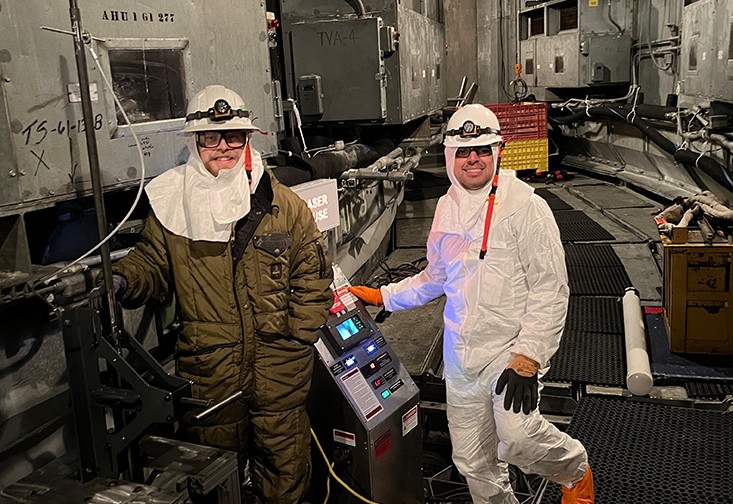
Developed jointly by Ahmed Vaselbehagh, Professor of Mechanical and Aerospace Engineering at the University of South Florida, and postdoctoral researcher Ty Hagan, this technology is primarily aimed at ice condenser systems used in certain nuclear power plants in the United States, Japan, and Finland. These systems contain numerous ice baskets filled with borated ice. Under extreme accident conditions, this ice can absorb heat and help reduce pressure inside the containment vessel.
During routine inspections, plant personnel must individually lift and weigh thousands of ice baskets to verify their condition meets requirements. However, as ice replenishment operations are repeated, adjacent ice baskets may freeze together, making it difficult to lift and inspect individual baskets. TVA therefore commissioned the research team to develop a safer and more efficient separation method that reduces manual labor intensity while avoiding equipment damage.
The laser de-icing system designed by the research team can operate in the narrow spaces between ice baskets and is capable of cutting at depths of approximately 40 feet (about 12 meters). The device uses precision lasers to cut through the ice layer connecting adjacent ice baskets, allowing personnel to complete separation and inspection without extensively melting the ice, thereby reducing meltwater generation and alleviating the burden of managing re-freezing in other areas or water accumulation in low-lying regions.
The development of this system involved multiple disciplines, including mechanical engineering, electrical engineering, optics, control systems, manufacturing, and safety compliance. The team needed to ensure the equipment could withstand extremely low temperatures, pass through very narrow openings, and be safely operated by nuclear plant personnel in strictly regulated operating environments. The researchers also completed certifications related to radiation workers and laser safety, and conducted multiple rounds of testing in freezing environments and contamination control zones to verify its reliability for use within nuclear facilities.
The final device consists of hundreds of components and is accompanied by operating procedures, technical documentation, and training materials to enable plant personnel to independently use and maintain it. The research team stated that the technology can remove several feet of accumulated ice within minutes, helping to shorten maintenance time and improve the efficiency of critical safety inspections at nuclear power plants.
Disclaimer: Information republished from partner media, institutions or other websites is provided for reference and communication purposes only. It does not imply endorsement of its views or verification of its accuracy. Please contact us if any content infringes rights or requires correction.