
US FRIB Experiment Reveals Magnetic Origin of Anomalous Low-Energy Gamma-Ray Enhancement
 Scan to share
According to an August 21 announcement from Lawrence Livermore National Laboratory, a new study led by the U.S. Facility for Rare Isotope Beams (FRIB) with participation from researchers at Lawrence Livermore National Laboratory and other institutions has provided a new experimental explanation for the long-standing "low-energy enhancement" phenomenon in nuclear physics. The findings were published in the journal Nature.
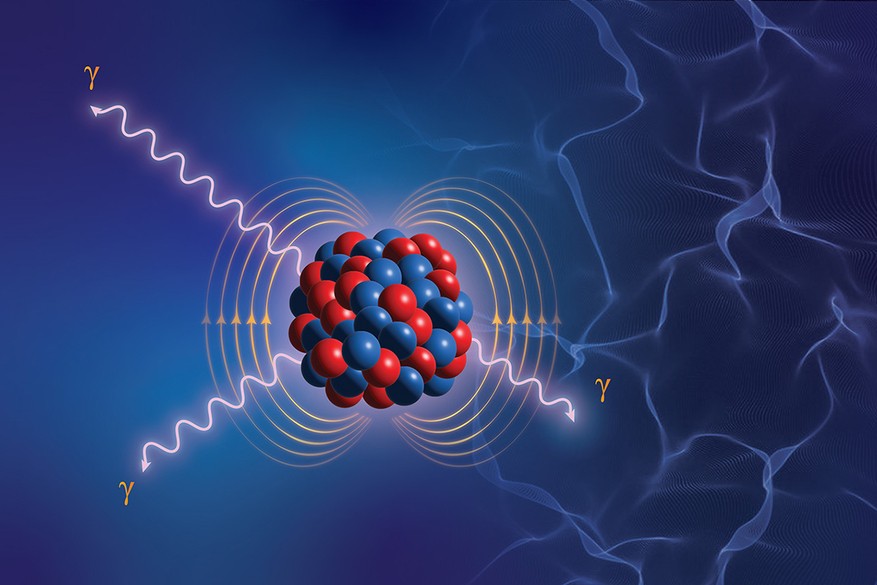
An experiment at the Facility for Rare Isotope Beams (FRIB) has yielded new results, answering a fundamental question about nuclear structure. (Image: FRIB)
Gamma rays are a form of electromagnetic radiation. When an excited nucleus loses energy during radioactive decay and transitions to a lower, more stable energy level, it emits gamma rays. Over the past few decades, scientists have discovered that certain nuclei emit anomalously large numbers of low-energy gamma rays, but this phenomenon does not occur in all nuclei, and its occurrence conditions have been difficult to predict reliably in theory.
In this study, the research team measured gamma rays produced when radioactive copper isotopes decay into zinc. Leveraging FRIB's experimental capabilities and specialized instrumentation, the researchers isolated and analyzed two distinct decay modes: one associated with electric transitions, manifested as changes in proton positions within the nucleus, and the other associated with magnetic transitions, involving flips of internal magnetic moments of protons and neutrons in the nucleus.
The experimental results showed that only the decay mode corresponding to magnetic transitions exhibited low-energy gamma-ray enhancement. This provides direct evidence for the magnetic origin of the "low-energy enhancement" phenomenon and establishes a clearer connection between experimental observations and nuclear structure theory.
The researchers noted that although this experiment focused on a single nuclear system, the findings are expected to drive improvements in broader nuclear models and help scientists more accurately simulate nuclear reaction processes in stars, supernovae, and neutron star mergers, including the mechanisms of heavy element formation. Additionally, the results may provide new references for nuclear energy-related process research and nuclear forensics analysis.
Disclaimer: Information republished from partner media, institutions or other websites is provided for reference and communication purposes only. It does not imply endorsement of its views or verification of its accuracy. Please contact us if any content infringes rights or requires correction.