
Rock Fusion Completes Key Processes for Stellarator 3D Non-Planar Superconducting Prototype Coil
 Scan to share
Recently, the stellarator high-strength stainless steel armored 3D non-planar superconducting prototype coil developed by Rock Fusion (Shanghai) Technology Co., Ltd. has completed two key processes: 3D precision winding and ground insulation wrapping. The overall 3D geometric error of the coil is consistently controlled at the millimeter level, indicating that the company has preliminarily established key manufacturing processes including material adaptation, 3D precision forming, and insulation wrapping for high-field steady-state stellarator superconducting magnets.
The stellarator is an important device for steady-state controlled nuclear fusion research, and 3D superconducting coils are used to generate the complex magnetic fields required to confine plasma. Unlike conventional planar coils, stellarator coils typically feature non-planar spatial structures with continuously varying curvature, imposing stringent requirements on conductor forming precision, mechanical properties, and insulation reliability.
According to reports, some current international devices use aluminum alloy or copper conductor armor. Rock Fusion has opted for high-strength stainless steel armor this time, with a cryogenic yield strength exceeding 700 MPa, offering favorable fatigue resistance and impact resistance, which can enhance the coil's load-bearing capacity under high magnetic field, high current, and strong electromagnetic load conditions. The prototype coil was manufactured on the company's dedicated stellarator 3D non-planar superconducting magnet production line.
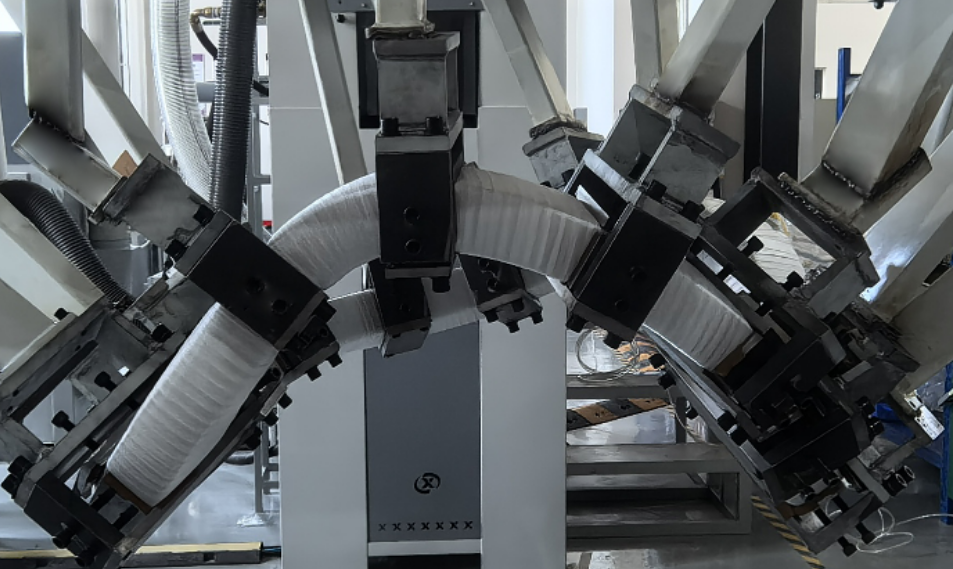
3D superconducting prototype coil after ground insulation wrapping
3D precision forming is one of the major challenges in manufacturing this type of coil. Stainless steel has a narrow plastic forming window, and bending and twisting tend to induce residual internal stress, which may lead to surface distortion and profile deviation; during multi-layer, multi-turn stacking, forming errors also accumulate progressively. Through numerical simulation iteration and process testing, Rock Fusion has developed a combined bending—twisting forming process that predicts and compensates for stainless steel springback, with closed-loop control over winding tension and conductor cross-section distortion.
Currently, the company has completed the winding and forming of a complete 72-turn stainless steel armored coil, featuring a 6-layer structure with 12 turns per layer, with overall 3D geometric error controlled at the millimeter level, and geometric specifications matching complex magnetic field design requirements.
After coil winding was completed, Rock Fusion also carried out the ground insulation wrapping process. To address potential deformation and insulation quality issues during insulation wrapping of 3D coils, the company adopted a multi-point shape-retaining ground insulation wrapping method, supported by a rigid integral frame and split conformal shape-retaining fixtures. The prototype coil has completed full-area multi-layer continuous ground insulation wrapping, with uniform insulation layer thickness and no defects such as delamination or blistering, and relevant specifications meeting service requirements under cryogenic and high magnetic field conditions.
As next steps, Rock Fusion plans to carry out subsequent processes including vacuum pressure impregnation and nano-ohm-level superconducting joint assembly, and to advance comprehensive superconducting performance testing under full operating conditions at cryogenic temperatures and high magnetic fields, in order to verify the electromagnetic characteristics and long-term insulation reliability of the stainless steel armored winding.
Disclaimer: Information republished from partner media, institutions or other websites is provided for reference and communication purposes only. It does not imply endorsement of its views or verification of its accuracy. Please contact us if any content infringes rights or requires correction.