
Japanese team achieves high-precision mass measurements of argon isotopes, revealing variations in the strength of the new magic number N=32
 Scan to share
An international collaborative research team comprising RIKEN and the High Energy Accelerator Research Organization (KEK), among others, conducted high-precision mass measurements of short-lived argon isotopes far from the line of nuclear stability, using the superconducting RI beam generation and separation device BigRIPS at the RI Beam Factory (RIBF) of RIKEN Nishina Center for Accelerator-Based Science, as well as the CRISMASS system, a stationary slow radioactive isotope precision mass spectrometer jointly developed by the two institutions.
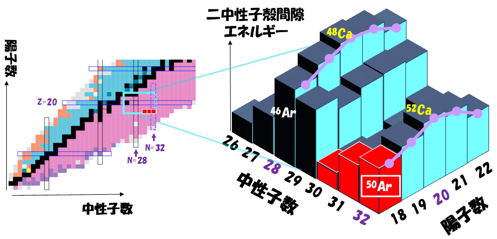
The energy of the two-neutron shell gap near the new magic number N=32
The research team directly measured the mass of argon-50 (^50Ar, 18 protons, 32 neutrons) for the first time, and improved the mass measurement precision of argon-49 (^49Ar) by approximately 250-fold compared to previous measurements. The results were published online in Physical Review Letters on August 6.
Atomic nuclei are composed of protons and neutrons. When the number of protons or neutrons reaches specific values, the nucleus exhibits a relatively stable "closed-shell" structure, and these specific values are called "magic numbers." In recent years, experimental evidence of a new magic number at neutron number N=32 in calcium-52 (^52Ca) has attracted attention in the field of nuclear physics, but whether this new magic number also exists in neighboring elements and how its strength varies still requires further experimental verification.
In this experiment, the researchers used the helium gas cell and multi-reflection time-of-flight mass spectrometer (MRTOF) in the CRISMASS system to rapidly extract short-lived radioactive isotopes and perform time-of-flight measurements, achieving a mass precision on the order of one part in ten million. Peaks corresponding to ^49Ar and ^50Ar were clearly observed in the experimental spectra, demonstrating the system's ability to resolve nuclei with extremely small mass differences.
Based on the newly obtained mass data, the research team derived information such as the two-neutron shell gap energy related to magic number strength. The results further support that N=32 in calcium-52 is a new magic number; meanwhile, in argon isotopes, which have two fewer protons than calcium, the N=32 magic number effect tends to weaken. This indicates that magic number strength is not fixed but varies with the proton number of the element.
The study also compared the experimental results with various theoretical calculations, finding that theoretical models reproduce to a large extent the trend of "N=32 being strong in calcium and weakened in argon." The research team believes that this achievement contributes to a deeper understanding of nuclear shell structure and the properties of short-lived nuclei, and provides experimental evidence for studying nucleosynthesis processes in extreme environments such as stars, supernova explosions, and neutron star mergers.
Disclaimer: Information republished from partner media, institutions or other websites is provided for reference and communication purposes only. It does not imply endorsement of its views or verification of its accuracy. Please contact us if any content infringes rights or requires correction.