
India's Representative Highlights Nuclear Innovation and International Cooperation at IAEA's 70th General Conference
 Scan to share
At the 70th General Conference of the International Atomic Energy Agency (IAEA), India's representative and Chairman of the Atomic Energy Commission, Ajit·Kumar·Mohanty, delivered an address highlighting India's latest progress in nuclear technology breakthroughs, regulatory reform, and international cooperation.
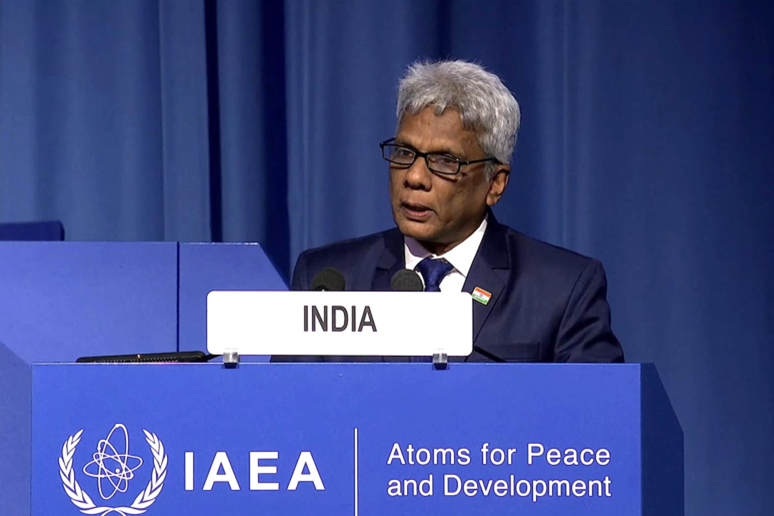
Chairman Mohanty congratulated the President of the General Conference on his election and reaffirmed India's long-standing commitment to the IAEA. He noted that India's cooperation with the Agency has a long history, and specifically mentioned that India assumed the Chairmanship of the Regional Cooperative Agreement for Research, Development and Training Related to Nuclear Science and Technology for Asia and the Pacific (RCA) in Mumbai in May 2026. Guided by the philosophy of "Vasudhaiva Kutumbakam" (the world is one family), India is committed to deepening scientific research cooperation and talent development across the Asia-Pacific region.
In terms of technological breakthroughs and legislation, Chairman Mohanty announced several milestone developments:
Modernization of nuclear energy regulations: The Indian Parliament passed the SANTI Bill (Sustainable Development and Advancement of Nuclear Transition in India Bill) in December 2025, which, while retaining sovereign state control over sensitive activities, opened broad participation to public and private entities, granted statutory status to the nuclear regulatory body, and aligned domestic liability provisions with international best practices.
New breakthrough in fast reactor technology: In April 2026, the 500 MWe Prototype Fast Breeder Reactor (PFBR) at Kalpakkam successfully achieved criticality, making India the second country in the world to master this technology.
Hydrogen production and life extension of aging reactors: In June 2026, India completed the world's first nuclear-process-based hydrogen production demonstration using indigenous copper-chlorine thermochemical cycle technology; in addition, India's regulatory body has approved the restart and continued operation of Units 1 and 2 of the Tarapur Atomic Power Station, the world's longest-operating commercial nuclear reactors.
Frontier science and medical cooperation: In March 2026, engineering, procurement, and construction contracts were formally signed for the LIGO-India mega science project in Maharashtra. Meanwhile, India is actively pursuing its "Neighborhood First" policy by providing cancer diagnosis and treatment training to medical personnel from neighboring countries through the Tata Memorial Centre, and is leading the promotion of international regulatory cooperation in nuclear medicine during its 2026 BRICS Chairmanship.
Chairman Mohanty concluded by emphasizing that every country has the right to peaceful uses of nuclear technology to improve people's livelihoods. India will continue to share its indigenous technology and capacity-building experience through the IAEA and multilateral platforms, promoting nuclear science as an effective force serving the common welfare and development of humanity.
Disclaimer: Information republished from partner media, institutions or other websites is provided for reference and communication purposes only. It does not imply endorsement of its views or verification of its accuracy. Please contact us if any content infringes rights or requires correction.