
IAEA Incheon Conference Calls for Accelerated Nuclear Energy Deployment
 Scan to share
Recently, the International Ministerial Conference on Nuclear Energy, jointly hosted by the International Atomic Energy Agency (IAEA) and the Nuclear Energy Agency of the Organisation for Economic Co-operation and Development (OECD/NEA) and organized by the Ministry of Science and ICT of the Republic of Korea, officially opened in Incheon, South Korea. IAEA Director General Rafael Mariano Grossi called on all parties at the opening ceremony to translate policy support into concrete nuclear energy construction outcomes.
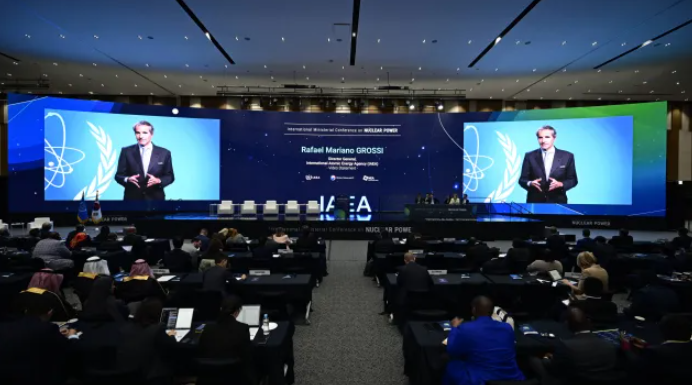
Bae Kyung-hoon, Deputy Prime Minister and Minister of Science and ICT of the Republic of Korea, stated at the conference that this meeting provides a key dialogue platform for the international community to jointly address energy security and carbon neutrality challenges, and that South Korea will continue to promote the peaceful and safe application of future nuclear technologies, including small modular reactors (SMRs).
According to the latest data from the IAEA Power Reactor Information System (PRIS), 417 nuclear reactors are currently operating in 31 countries worldwide, with a total installed capacity of approximately 380 GW; meanwhile, 78 new reactors are under construction in 17 countries, with an additional installed capacity of approximately 81 GW. The IAEA has raised its global nuclear power capacity projections for the sixth consecutive year, forecasting that global nuclear power installed capacity will significantly increase to 641 to 1,045 GW by 2050, with more than 60 countries actively preparing for or considering the introduction of nuclear power.
Grossi (Rafael Mariano Grossi) pointed out that the global digital economy, data center cooling, and deep industrial decarbonization are driving a sharp increase in demand for round-the-clock baseload electricity. Citing the Barakah Nuclear Power Plant jointly built by South Korea and the UAE as an example, he noted that the full operation of all four units at the plant has already accounted for one-quarter of the UAE's electricity supply, fully demonstrating the decisive role of long-term stable cooperation in nuclear power project delivery.
It is reported that in terms of specific support mechanisms, the IAEA is guiding emerging nuclear energy countries in building infrastructure through its "Milestones Approach" and deepening cooperation with international financial institutions such as the World Bank to facilitate project financing. Regarding cutting-edge SMR technologies, the IAEA has launched the "Nuclear Harmonization and Standardization Initiative" (NHSI), aimed at helping national regulators reduce duplicate reviews and improve approval efficiency.
The Incheon conference brought together ministerial-level officials and industry experts from multiple countries around the world, focusing on new nuclear energy programs, advanced regulation, talent pipeline development, supply chain coordination, and the application of nuclear energy in emerging scenarios such as maritime propulsion and remote areas. Grossi (Rafael Mariano Grossi) emphasized in his summary that countries should introduce financial and technical partners as early as possible and use real engineering milestones as the sole criterion for measuring the global nuclear energy renaissance.
Disclaimer: Information republished from partner media, institutions or other websites is provided for reference and communication purposes only. It does not imply endorsement of its views or verification of its accuracy. Please contact us if any content infringes rights or requires correction.