
Canada Report Says Ontario Nuclear Power Projects Have Economic Advantages
 Scan to share
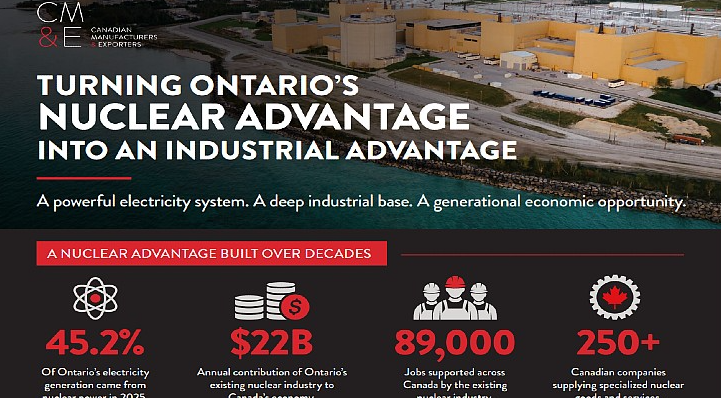
Recently, the Canadian Manufacturers & Exporters (CME), a representative organization representing Canadian manufacturing, released a report titled "Turning Ontario's Nuclear Advantage into an Industrial Advantage," pointing out that four key nuclear power projects are expected to bring tens of billions of dollars in economic benefits to Ontario, Canada and Canada as a whole, but governments and industry must act immediately to transform nuclear expansion into lasting industrial advantages. The report examined four key projects among Ontario's sequence of seven major nuclear power projects——the Darlington small modular reactor project, the Pickering nuclear power plant refurbishment, the potential Bruce C reactor construction project, and the potential Wesleyville reactor construction project——and estimated that together they could contribute CAD 882 billion (approximately USD 617 billion) in Gross Domestic Product (GDP) and 3.45 million job-years to Canada, of which CAD 806.1 billion in GDP and 2.94 million job-years would remain in Ontario.
The four major projects focused on in the report are all aimed at completion between the 2030s and 2040s. Among them, construction has started on the first of four planned small modular reactors at the Darlington site, with all four expected to be in service by the mid-2030s; the project is expected to add CAD 38.5 billion (approximately USD 26.9 billion) to Canada's GDP. The refurbishment of Units 5 through 8 at Ontario Power Generation's (OPG) Pickering Nuclear Power Plant began in September this year and is expected to be completed between 2031 and 2032, with an estimated CAD 41.6 billion increase in GDP.
In terms of large new reactor construction, the potential large reactor project Bruce C (for which a CAD 300 million pre-development agreement was signed in May this year) could, subject to approval, be built from the late 2020s to the mid-2040s, with an estimated CAD 259.6 billion contribution to GDP; Ontario Power Generation's proposed potential large nuclear project at Wesleyville/Port Hope, subject to approval, would be built from the early 2030s to the mid-2040s and is expected to contribute USD 541.8 billion (as stated in the original text) to Canada's GDP. The remaining three projects in the report's sequence of seven major nuclear power projects in Ontario are: the Darlington nuclear power plant unit refurbishment completed in February this year, the ongoing Bruce Power life extension and Major Component Replacement project, and the potential second refurbishment of Units 1 and 2 at the Bruce Nuclear Power Plant in the 2040s.
Dennis Darby, President and Chief Executive Officer of the Canadian Manufacturers & Exporters, said that Ontario has a tremendous opportunity to transform nuclear investment into decades of manufacturing growth, skilled jobs and export success, and that the existing strong nuclear industry and mature domestic supply chain can help Canadian manufacturers fully seize the historic investment dividend; Dennis Darby also said that with long-term planning, close industry-government collaboration and continued support for domestic suppliers, manufacturers will be more confident in investing in new facilities, advanced technologies and workforce development. The report was commissioned by Ontario's Nuclear Advantage (ONA), an alliance of industry, labor and supply chain members. Julie O'Driscoll, Executive Director of the alliance, said that Ontario has been building its nuclear advantage for decades, and that every refurbishment, every new reactor and every small modular reactor creates jobs for local skilled workers, engineers and manufacturers, and that nuclear energy is driving the economy, not just lighting homes.
It is understood that Ontario already has a solid industrial foundation for advancing the next phase of nuclear power projects. The existing nuclear industry contributes approximately CAD 22 billion to Canada's economy each year and supports 89,000 jobs nationwide, and the related opportunities will extend beyond the existing nuclear supplier base; in addition, the report's estimates show that achieving the nuclear export targets set in Canada's Nuclear Energy Strategy could create an additional CAD 48 billion to CAD 97 billion in Canadian GDP. The Canadian Manufacturers & Exporters, founded in 1871, also noted that the findings, analysis and conclusions in the report represent its own positions and do not necessarily reflect the views of the commissioning party.
Disclaimer: Information republished from partner media, institutions or other websites is provided for reference and communication purposes only. It does not imply endorsement of its views or verification of its accuracy. Please contact us if any content infringes rights or requires correction.